
🔥 Limited-Time Sale. Offer Ends 11/10/2026. View Details
🔥 Limited-Time Sale. Ends 11/10/2026. View Details
🔥 Limited-Time Sale. View Details
Artists
Subjects
Movements
Collections
Decor
Portraits
Commissions
Framing
Reviews
Gift Cards
On Sale
Alphonse Mucha Oil Painting Reproductions
Shop museum-quality reproductions of Alphonse Mucha’s most famous paintings, each hand-painted in oil on canvas by a professional artist.
Shop Art
Showing 1-40 of 124 results
Sort By
Most Popular
- Most Popular
- New Arrivals
- Best Sellers
- Alphabetical A-Z
- Alphabetical Z-A
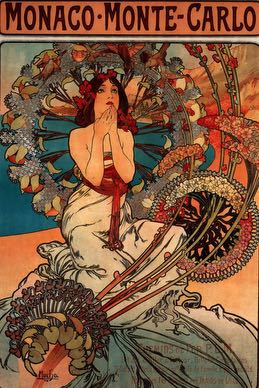
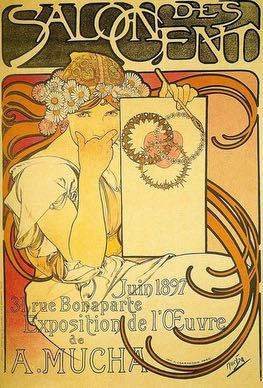
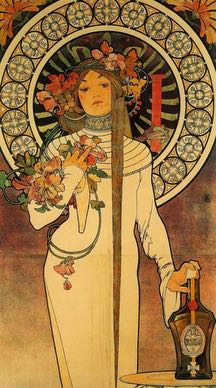
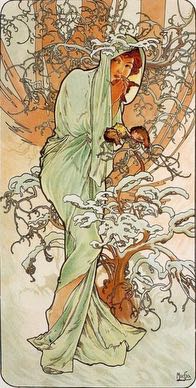


From: $1,060.00$530.00
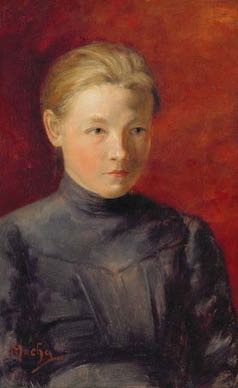
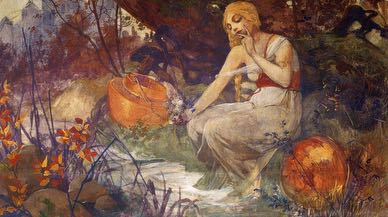
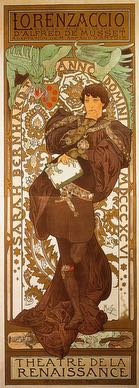
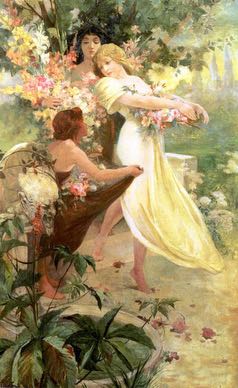
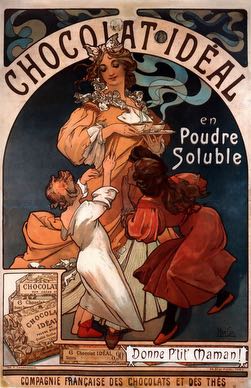

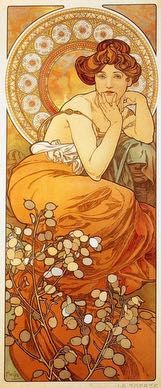
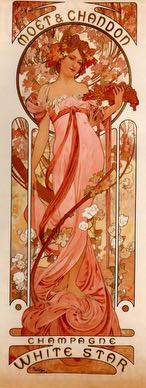
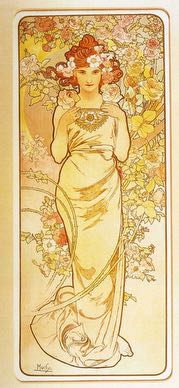



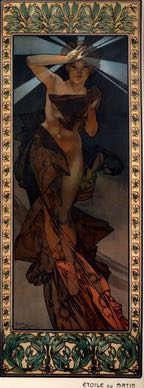


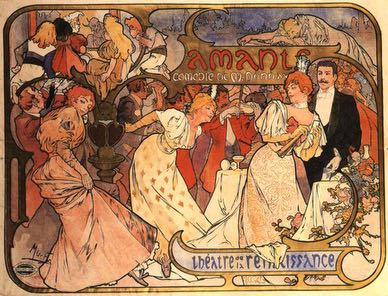
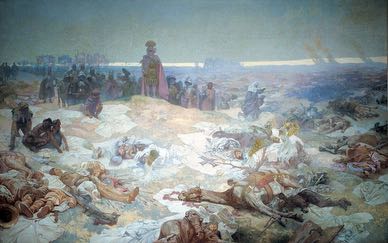
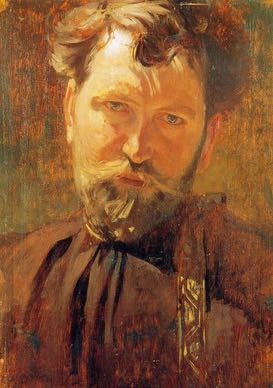

From: $1,060.00$530.00
Can’t Find the Painting You Want?
Looking for a specific painting that isn’t in our catalog? Just let us know. We can recreate almost any artwork in the size and style you’re looking for.
Request a PaintingHand-Painted Alphonse Mucha Reproductions
Bring Mucha’s art into your home with an oil-on-canvas reproduction hand-painted by a professional artist. Our collection features more than one hundred paintings from across his career, including Gismonda, Job Cigarettes, and Zodiac. Discover graceful women, theatrical posters, floral allegories, ornate advertisements, idealized portraits, monumental Slavic histories, and other subjects closely associated with Mucha. Every reproduction is a real oil painting, offering depth and texture that a print or digital transfer cannot provide. From iconic masterpieces to lesser-known works, find a Mucha painting that suits your space.
The Making of an Alphonse Mucha Oil Painting Replica
Creating an Alphonse Mucha oil painting replica requires patience, precision, and an understanding of the original artwork. Our studio includes artists who specialize in Art Nouveau painting and understand the distinctive qualities of Mucha’s work. The artist begins by studying the source image, then recreates its flowing contours, ornamental patterns, muted colors, and Mucha’s graceful integration of figures and decorative motifs on canvas using traditional oil-painting methods. After completion, the painting is inspected by our quality-control team and photographed for your approval. The result is a carefully executed oil painting that reflects the visual character of the original.
Custom Sizes and Frames for Your Mucha Painting
Your Mucha painting can be ordered in practically any size, from popular standard dimensions to custom canvas sizes selected directly on the product page. This flexibility lets you choose a painting that fits your wall and complements your room perfectly. After selecting the size, you can choose from high-quality frames in classic or modern designs, with professional canvas stretching also available. Our framing options complement the elegant lines and decorative character of Mucha’s paintings. With sizing, stretching, and framing arranged in one order, your artwork can arrive ready for display without a separate visit to a frame shop.
Order an Alphonse Mucha Reproduction with Confidence
Buying hand-painted art online should feel clear and comfortable. After your Alphonse Mucha reproduction is completed, we send high-resolution photographs for your review before shipping. You can inspect the composition, colors, ornamental details, and overall finish, then request adjustments if needed. The painting is dispatched only after you approve it, so you know what to expect when it arrives. Your order also includes free express worldwide shipping and is covered by our 90-day return policy. Together, these assurances help you purchase a Mucha oil painting with greater confidence and peace of mind.
The Life and Art of Alphonse Mucha
Alphonse Mucha was a Czech painter, illustrator, and designer whose elegant posters became closely identified with Art Nouveau. Born in Moravia in 1860, he trained in Munich and Paris before an unexpected commission for actress Sarah Bernhardt brought him sudden fame. Mucha surrounded idealized figures with flowers, stars, curving hair, patterned borders, and halo-like circles, creating a visual language that moved easily between theater, advertising, books, jewelry, and interiors. He later returned to his homeland and devoted many years to the Slav Epic, a monumental cycle presenting episodes from Slavic history. His career joined popular design with spiritual belief, Czech patriotism, and an ambitious idea of art as a shared public language.
Read More
Who Was Alphonse Mucha?
Alfons Maria Mucha was born on 24 July 1860 in Ivančice, a Moravian town then within the Austrian Empire. Music and drawing were part of his early life, and he sang in a church choir while developing his artistic ability. After an unsuccessful application to the Prague Academy, he found practical work rather than giving up on art.
Mucha became a painter, illustrator, poster designer, photographer, teacher, and designer of objects and interiors. Paris made him famous, but he never saw commercial decoration as the limit of his ambitions. Czech and wider Slavic history, spiritual ideas, and the social purpose of art occupied him throughout his career.
His name is inseparable from Art Nouveau, though the familiar label covers only part of his work. Mucha created theater posters and advertisements, but also portraits, book illustrations, jewelry, murals, stamps, banknotes, and enormous history paintings.
How Did Mucha Find His Way from Moravia to Paris?
In 1879, Mucha went to Vienna and worked for a company that produced theatrical scenery. The job introduced him to large-scale decoration and the practical demands of stage design. When a fire destroyed the Ringtheater in 1881 and reduced the company’s work, he returned to Moravia and supported himself with portraits and decorative commissions.
His work attracted Count Eduard Khuen-Belasi, who commissioned him to decorate rooms at Emmahof Castle and later supported his studies. Mucha entered the Munich Academy of Fine Arts in 1885, then moved to Paris in 1887. He attended the Académie Julian and the Académie Colarossi, where drawing from the figure and historical composition strengthened his formal training.
When the count’s financial support ended in 1889, Mucha earned a living through magazine and book illustration. Those demanding years taught him to work for reproduction, organize pictures around printed text, and meet deadlines. The skills proved decisive when a last-minute theater commission arrived at the end of 1894.
Why Did Gismonda Change Mucha’s Career?
On 26 December 1894, Mucha was at the Lemercier printing works when an urgent request arrived for a poster advertising Sarah Bernhardt in Victorien Sardou’s play Gismonda. The usual designers were unavailable, and Mucha accepted the assignment. His Gismonda appeared on Paris streets at the beginning of 1895.
The poster looked unlike the louder advertisements around it. Its unusually tall, narrow shape gave Bernhardt the presence of a standing icon. Pale colors, mosaic-like ornament, and a circular form behind her head created dignity and stillness rather than rapid action. The design became a public sensation and made its previously little-known creator famous.
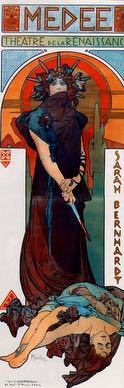
Bernhardt offered Mucha a six-year contract. He designed posters, costumes, stage settings, and other material for her productions, including La Dame aux Camélias, Lorenzaccio, Hamlet, and Médée. Their collaboration gave his work international visibility and allowed the actress’s theatrical identities to develop into a distinctive graphic world.
What Makes the Mucha Style So Recognizable?
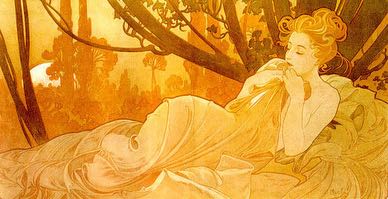
A typical Mucha design places a graceful figure within a shallow decorative space. Long hair curls into arabesques; flowers, vines, stars, jewelry, and patterned fabrics echo the body’s movement; and circles or arches frame the head. Firm outlines hold these details together, while soft greens, golds, pinks, and blues keep even elaborate compositions visually calm.
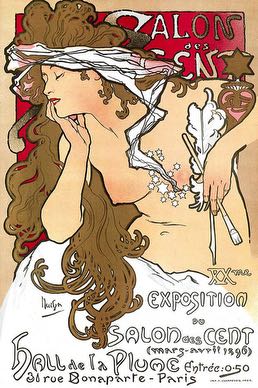
Mucha drew on many sources rather than one established formula. Byzantine mosaics, medieval manuscripts, Slavic ornament, Japanese prints, contemporary photography, and Symbolist ideas all fed his designs. He often coordinated lettering with image so that a poster, package, or magazine cover worked as a complete composition.
Parisian audiences called this visual language le style Mucha, and it became one of the most widely recognized forms of Art Nouveau. Its success brought imitation, yet Mucha continued adjusting it to suit theater, advertising, decorative panels, books, and objects instead of repeating a single image unchanged.
Where Did Mucha Take Art Beyond the Poster?
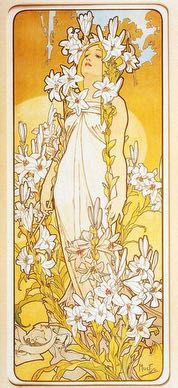
After his breakthrough, Mucha worked with the printer F. Champenois on advertisements, calendars, menus, postcards, and decorative panels intended for domestic interiors. Series devoted to the seasons, flowers, times of day, arts, and precious stones transformed allegorical women into coordinated sets that buyers could display together.
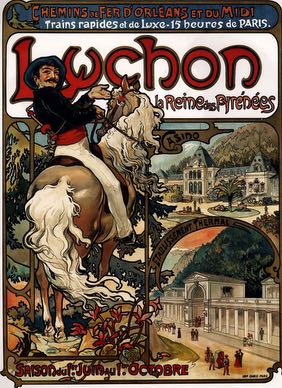
His designs promoted products ranging from biscuits and bicycles to champagne and cigarette papers. In works such as Job, the product may occupy little space, while hair, smoke, lettering, and ornament carry the visual appeal. Commercial purpose and careful design are not separate; the advertisement succeeds because every element belongs to the same rhythm.
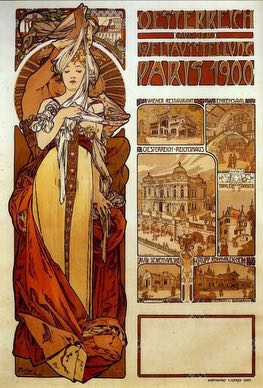
Mucha also collaborated with jeweler Georges Fouquet from 1899 to 1901, designing jewelry and the interior of Fouquet’s rue Royale shop. For the 1900 Paris Exposition, he worked on the Bosnia-Herzegovina pavilion. Books such as Documents décoratifs and Figures décoratives later shared patterns, figure studies, and design ideas with students and working artists.
How Did Photography Support Mucha’s Working Process?
Mucha used photography as a practical studio tool from his early Paris years. Models posed in costumes, held props, or arranged their hands and bodies for a proposed composition. The resulting photographs preserved details that could be difficult to sustain during long drawing sessions and allowed him to test gestures before settling on a final design.
He did not simply copy these images. A photographed pose might become longer and more fluid, while actual fabric could turn into a broad decorative shape. Hair, halos, flowers, borders, and lettering were then developed around the figure until observation and invention became difficult to separate.
This method helps explain why his idealized women still possess convincing weight and posture. Photography provided a physical starting point; drawing supplied the clarity, rhythm, and ornament for which his finished work became known.
What Drew Mucha to Spiritual and Symbolic Themes?
Behind Mucha’s public success lay a sustained interest in mysticism, Freemasonry, and the moral purpose of art. He believed beauty could communicate across social divisions and encourage harmony. This conviction gave decorative art a seriousness that went beyond making attractive objects for wealthy clients.
Le Pater, published in 1899, was his personal interpretation of the Lord’s Prayer. Its pages combine symbolic figures, ornamental borders, and images of humanity moving from darkness toward spiritual understanding. Mucha considered it among his most meaningful works, even though it was less familiar to the broad public than his posters.
Similar concerns appear in allegories of youth, spring, fate, and national renewal. Beauty in Mucha’s work is rarely only surface decoration. It often serves as an invitation to contemplate love, suffering, unity, or hope.
Why Did Mucha Spend Several Years in the United States?
Mucha first traveled to the United States in 1904. He hoped that portrait commissions, teaching, and wealthy patrons would help finance a monumental cycle devoted to Slavic history. Over the next several years, he moved between America and Europe, working in New York and Chicago and lecturing about design.
American commissions included portraits and decorative projects. Maude Adams as Joan of Arc, painted in 1909, combines theatrical portraiture with an elongated format and richly patterned setting. The work recalls his designs for Bernhardt while giving Adams a quieter, visionary presence.
The American period also brought Mucha the support he needed. Industrialist Charles Richard Crane agreed to finance the planned Slav Epic. That commitment enabled Mucha to return to Bohemia in 1910 and begin the project that had occupied his imagination for years.
Which Projects Marked Mucha’s Return to His Homeland?
Back in Prague, Mucha decorated the Lord Mayor’s Hall in the new Municipal House. Murals, ceiling paintings, furnishings, and architectural ornament allowed him to create a unified civic interior centered on Czech history and shared responsibility. The commission joined the decorative skill of his Paris years with an explicitly national purpose.
After Czechoslovakia became independent in 1918, Mucha offered his abilities to the new state. He designed its first postage stamps and worked on banknotes, official documents, and other public symbols. Familiar ornamental forms now helped give a young country a visible identity rather than advertise a commercial product.
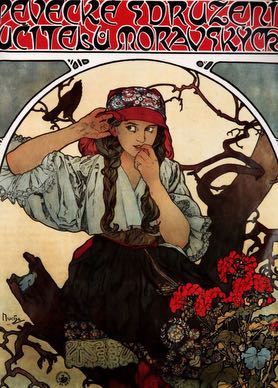
He also produced posters for Czech cultural and charitable organizations. These works replaced the distant elegance of some Paris designs with folk dress, Slavic emblems, and direct appeals for education, community, and national independence.
How Did the Slav Epic Recast History on a Monumental Scale?
Mucha began the Slav Epic after returning to Bohemia, working in a large studio at Zbiroh Castle. The cycle consists of twenty enormous canvases devoted to more than a thousand years of Czech and other Slavic history. He researched architecture, clothing, ceremonies, and historical settings, and traveled to gather material.
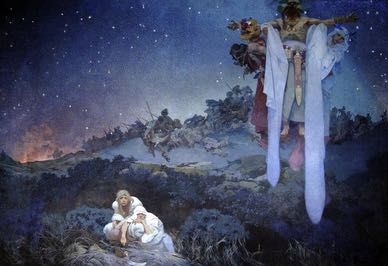
The first canvas, The Slavs in Their Original Homeland, places vulnerable figures within a dark landscape threatened by invasion. Later scenes address religious debate, education, military conflict, political independence, and cultural exchange. Across the cycle, Mucha treated history as a difficult passage toward unity rather than a simple sequence of victories.
He completed the canvases between 1912 and 1926. In 1928, Mucha and Crane presented the full cycle to the city of Prague as a gift marking the tenth anniversary of Czechoslovakia. The scale and historical ambition challenged the idea that he was principally a maker of fashionable posters.
Which Works Offer the Best Introduction to Mucha?
Mucha’s career crossed painting, printmaking, theater, advertising, and national history. These works show how his decorative language changed with different purposes:
- Gismonda, 1894: Sarah Bernhardt appears in a tall, restrained design whose pale colors and halo-like arch transformed Parisian poster art.
- The Lady of the Camellias, 1896: A melancholy theatrical image surrounds Bernhardt with stars, flowers, and silver-toned ornament.
- Job Cigarettes, 1896: Sweeping hair, curling smoke, and bold lettering turn an advertisement into a unified decorative composition.
- Zodiac, 1896: An elaborate circular frame, jewelry, and stylized profile demonstrate the richness of the mature Mucha style.
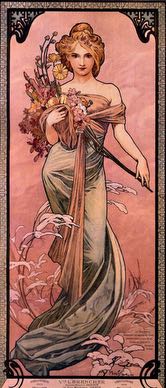
- The Four Seasons: Spring, 1896: A lyrical female figure gives human form to seasonal growth and decorative nature.
- Le Pater, 1899: Mucha’s symbolic reading of the Lord’s Prayer joins spiritual aspiration with highly controlled page design.
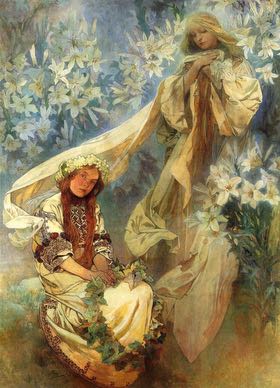
- Maude Adams as Joan of Arc, 1909: A stage role becomes a solemn portrait built from patterned fabric, lilies, and quiet concentration.
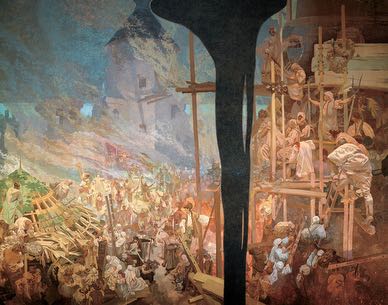
- The Introduction of the Slavonic Liturgy, 1912: Religious history opens into a broader meditation on language, culture, and Slavic identity.
- The Apotheosis of the Slavs, 1926: The final Slav Epic canvas gathers suffering, liberation, and hope into a radiant historical vision.
How Has Mucha’s Reputation Changed Since His Death?
Mucha’s later years unfolded under growing political danger. After German forces occupied Czechoslovakia in March 1939, the Gestapo arrested and questioned him because of his public standing and Czech nationalism. He was released, but his health deteriorated, and he died in Prague from pneumonia on 14 July 1939.
For a time, modernist criticism treated his decorative work as unfashionable and his historical painting as old-fashioned. Renewed interest in Art Nouveau during the 1960s returned his posters to public attention, sometimes so completely that the rest of his career remained in their shadow.
Today, Mucha is recognized not only as a defining Art Nouveau designer but as an artist who moved between mass communication and private belief, Parisian celebrity and Czech public life. His images helped expand the status of graphic design, while the Slav Epic preserves the more demanding historical and spiritual ambitions behind his accessible beauty.
Copyright © 2026 BrushWiz. All Rights Reserved.
About Our Alphonse Mucha Paintings
Are your Alphonse Mucha reproductions painted by hand?
Yes. Every reproduction is individually painted by hand in oil on canvas by a professional artist. We do not use prints, digital transfers, or mechanical reproduction methods.
How closely do your Mucha copies resemble the original?
Our artists work to capture the composition, colors, texture, and visual character of the original Mucha painting as closely as possible. Because every reproduction is painted by hand, small variations are natural and make each canvas unique.
How long does an Alphonse Mucha painting take to complete?
Most Mucha reproductions require approximately two to three weeks to paint, dry, and inspect. Production time may vary depending on the artwork and canvas size, so check the estimate displayed on the product page.
Can I request a Mucha artwork that is not listed?
Yes. If you cannot find the Alphonse Mucha artwork you want in our catalog, send us its title or an image. Our team will review your request and confirm the available sizes, estimated production time, and price.
Will I receive photos of my painting before shipping?
Yes. We send high-resolution photographs of the completed painting for your approval. You can request adjustments if needed, and the painting will not be dispatched until the review process is complete.
Are custom canvas sizes available?
Yes. We offer custom dimensions in addition to the standard sizes shown on the product page. Select the dimensions you need directly from the available size options.
May I order my Mucha painting with a frame?
Yes. High-quality frames in classic and modern designs are available for many paintings. You can view compatible framing options and add your preferred design from the product page. Professional canvas stretching is also available.
What determines the price of an Alphonse Mucha reproduction?
The price depends on the selected artwork, canvas dimensions, and framing option. Choose your preferred configuration on the product page to see the current price before ordering.
Do Mucha reproductions qualify for free worldwide shipping?
Yes. Mucha reproductions qualify for free express worldwide shipping. After dispatch, delivery usually takes five to eight business days, although timing may vary by country and destination.
Which return policy covers Alphonse Mucha reproductions?
Orders are covered by our 90-day return policy. Review the current return-policy page before ordering for complete information about eligibility, time limits, and the return process.
Why BrushWiz?
100% Hand Painted
Every piece is entirely handmade
Museum Quality
Faithfully recreated by expert artists
Custom Framing
Choose from a wide range of frames
Free Shipping
Enjoy free shipping on all orders
Cash Back Rewards
Earn cash back with every purchase