
🔥 Limited-Time Sale. Offer Ends 11/10/2026. View Details
🔥 Limited-Time Sale. Ends 11/10/2026. View Details
🔥 Limited-Time Sale. View Details
Artists
Subjects
Movements
Collections
Decor
Portraits
Commissions
Framing
Reviews
Gift Cards
On Sale
Carl Spitzweg Oil Painting Reproductions
Shop museum-quality reproductions of Carl Spitzweg’s most famous paintings, each hand-painted in oil on canvas by a professional artist.
Shop Art
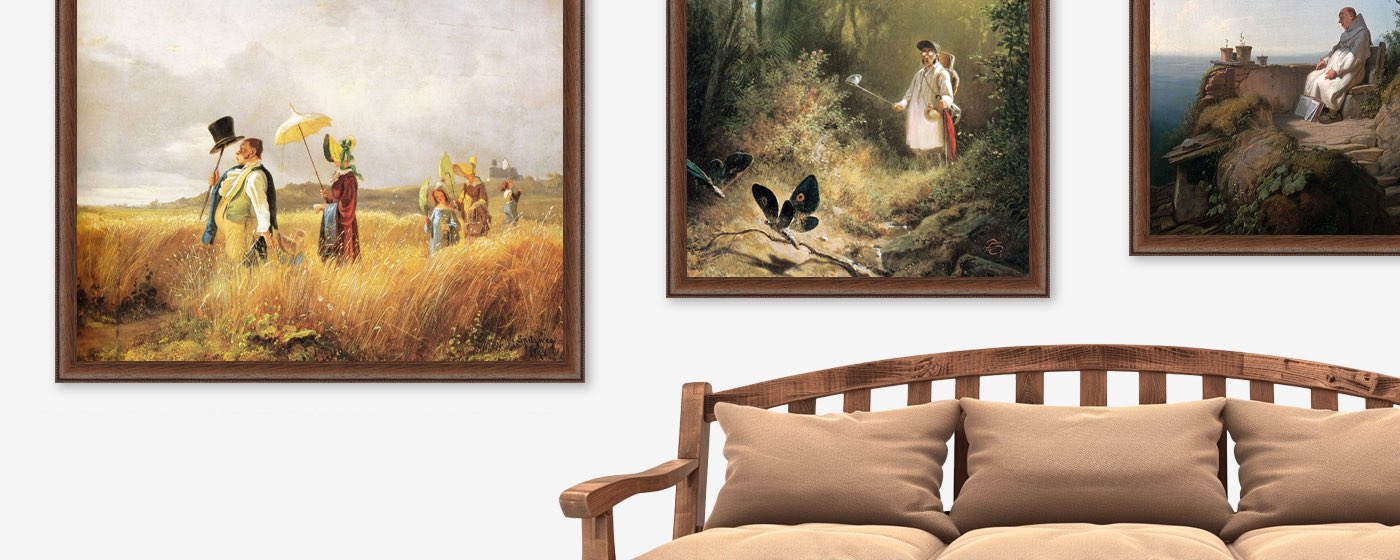
Showing 1-40 of 174 results
Sort By
Most Popular
- Most Popular
- New Arrivals
- Best Sellers
- Alphabetical A-Z
- Alphabetical Z-A
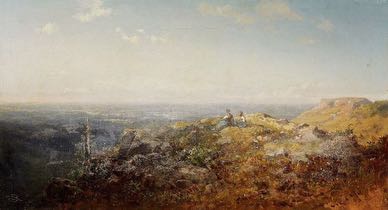
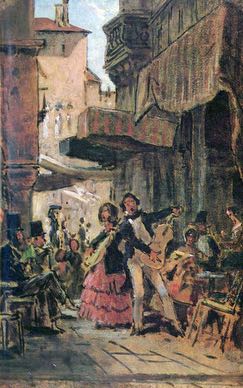
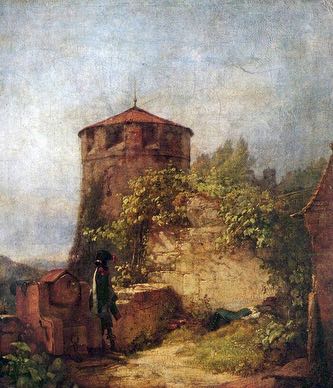
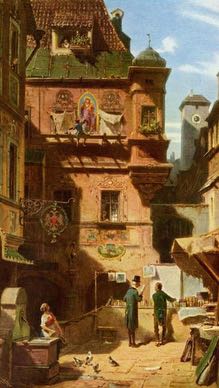
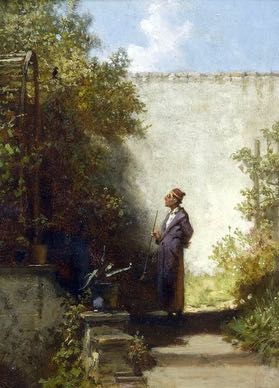
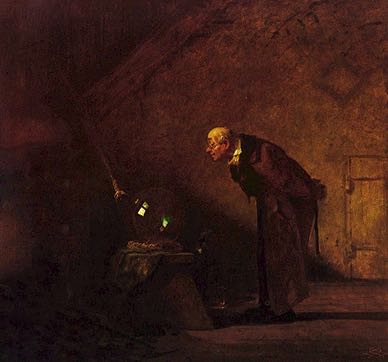
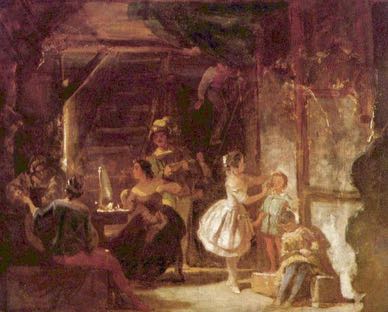
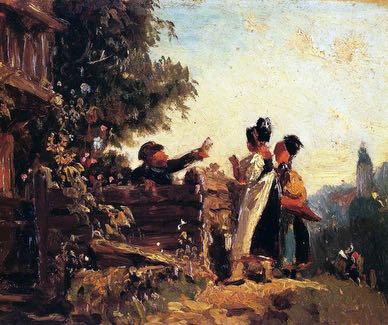
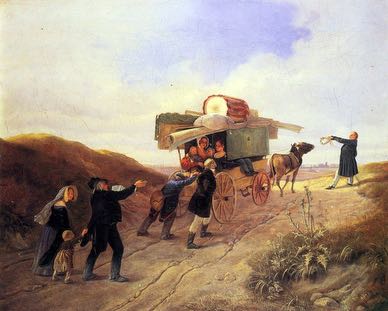
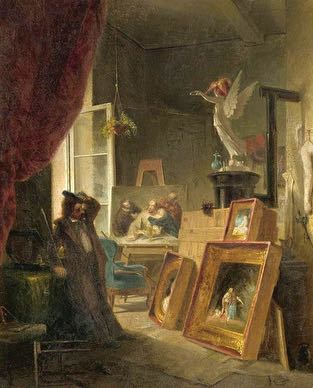
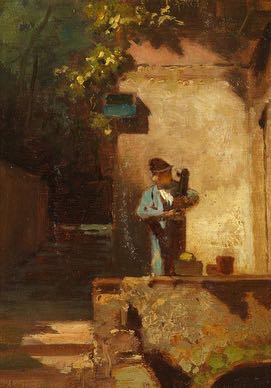
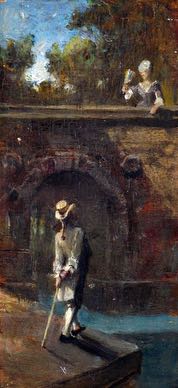

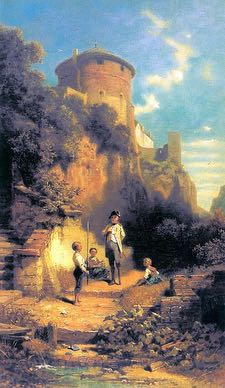
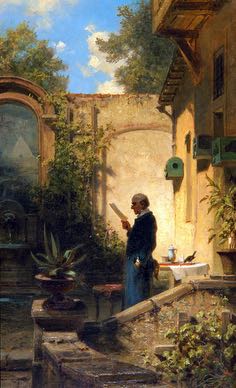
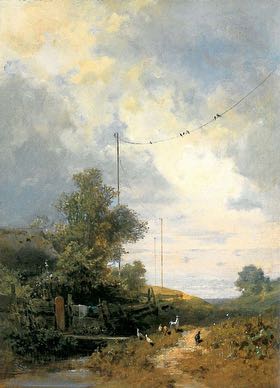
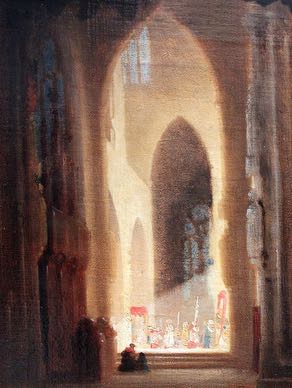
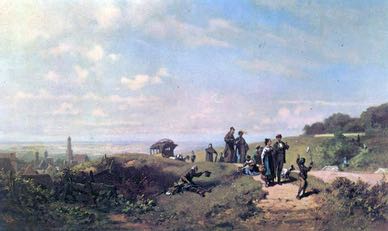
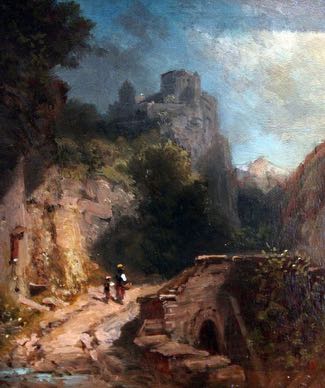
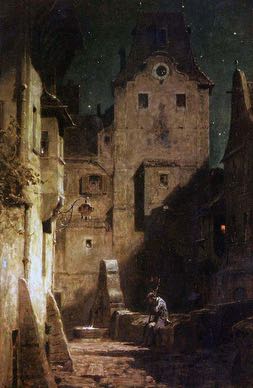
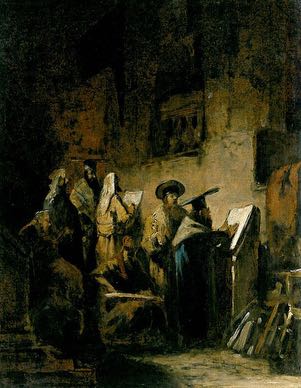
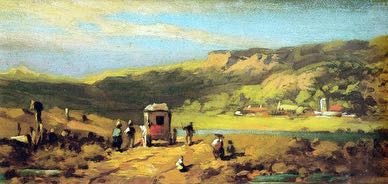
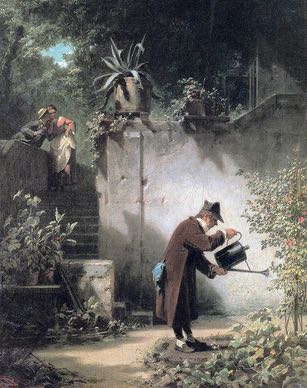
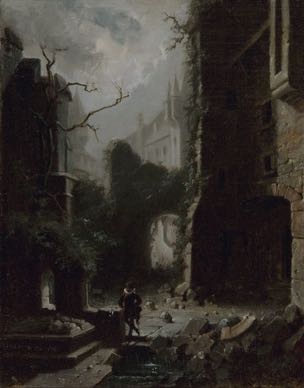
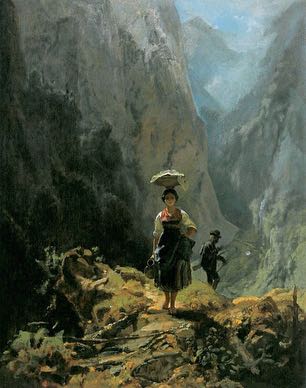
Can’t Find the Painting You Want?
Looking for a specific painting that isn’t in our catalog? Just let us know. We can recreate almost any artwork in the size and style you’re looking for.
Request a PaintingHand-Painted Carl Spitzweg Reproductions
Bring Spitzweg’s art into your home with an oil-on-canvas reproduction hand-painted by a professional artist. Our collection features more than one hundred paintings from across his career, including The Poor Poet, The Book Worm, and The Intercepted Love Letter. Discover bookish eccentrics, secluded gardens, narrow town streets, mountain scenery, and other subjects closely associated with Spitzweg. Every reproduction is a real oil painting, offering depth and texture that a print or digital transfer cannot provide. From iconic masterpieces to lesser-known works, find a Spitzweg painting that suits your space.
The Making of a Carl Spitzweg Oil Painting Replica
Creating a Carl Spitzweg oil painting replica requires patience, precision, and an understanding of the original artwork. Our studio includes artists who specialize in Romantic genre painting and understand the distinctive qualities of Spitzweg’s work. The artist begins by studying the source image, then recreates its intimate scale, warm color, precise details, and Spitzweg’s subtle balance of affectionate humor and social observation on canvas using traditional oil-painting methods. After completion, the painting is inspected by our quality-control team and photographed for your approval. The result is a carefully executed oil painting that reflects the visual character of the original.
Custom Sizes and Frames for Your Spitzweg Painting
Your Spitzweg painting can be ordered in practically any size, from popular standard dimensions to custom canvas sizes selected directly on the product page. This flexibility lets you choose a painting that fits your wall and complements your room perfectly. After selecting the size, you can choose from high-quality frames in classic or modern designs, with professional canvas stretching also available. Our framing options complement the intimate scenes, warm colors, and detailed settings of Spitzweg’s paintings. With sizing, stretching, and framing arranged in one order, your artwork can arrive ready for display without a separate visit to a frame shop.
Order a Carl Spitzweg Reproduction with Confidence
Buying hand-painted art online should feel clear and comfortable. After your Carl Spitzweg reproduction is completed, we send high-resolution photographs for your review before shipping. You can inspect the figures, colors, architectural details, and overall finish, then request adjustments if needed. The painting is dispatched only after you approve it, so you know what to expect when it arrives. Your order also includes free express worldwide shipping and is covered by our 90-day return policy. Together, these assurances help you purchase a Spitzweg oil painting with greater confidence and peace of mind.
The Life and Art of Carl Spitzweg
Carl Spitzweg was a German Biedermeier painter, illustrator, poet, and trained pharmacist whose small pictures find comedy, tenderness, and quiet frustration in ordinary life. Born in Bavaria in 1808, he taught himself to paint by studying nature, copying older masters, and working beside artist friends. His readers, poets, monks, night watchmen, lovers, collectors, and amateur scientists occupy cramped rooms, old streets, gardens, and mountain retreats rendered with precise storytelling and luminous color. Journeys to Paris and London broadened his landscape style and connected him with European Romantic painting. Long dismissed as a harmless recorder of cozy bourgeois life, Spitzweg is now valued for the gentle but persistent irony beneath his apparent idylls.
Read More
How Did a Pharmacist Become One of Germany’s Best-Known Painters?
Carl Spitzweg was born on 5 February 1808 in Unterpfaffenhofen, near Munich, into a prosperous merchant family. His father expected him to enter a secure profession, and in 1825 the young Spitzweg began an apprenticeship at a Munich pharmacy. The work suited his patient eye and introduced him to botany, minerals, chemical compounds, and the careful preparation of materials.
He continued studying pharmacy, botany, and chemistry at the University of Munich and qualified with distinction in 1832. A long illness the following year interrupted his professional path. During his recovery, he drew and painted with increasing seriousness, eventually deciding not to return to pharmacy.
An inheritance gave Spitzweg unusual independence. He did not have to build his career around large public commissions or academic appointments, and he never enrolled at an art academy. That freedom allowed him to work at his own pace, repeatedly revisiting small everyday subjects that official art institutions often regarded as minor.
Where Did Spitzweg Learn to Paint Without Academic Training?
Spitzweg educated himself through close looking. He copied Dutch and Flemish paintings in Munich collections, studied drawing and color, and carried sketchbooks on walks through the Bavarian countryside. Older genre painters showed him how a room, costume, or gesture could reveal character without a grand narrative.
Friendships supplied the community that an academy might otherwise have provided. Christian Ernst Bernhard Morgenstern and Eduard Schleich the Elder were especially important landscape painters in his circle. Spitzweg and Schleich traveled, sketched, studied old masters, and sometimes contributed to one another’s pictures. Moritz von Schwind shared his interest in poetry, fantasy, and narrative art.
Spitzweg joined the Munich Art Association in 1835 and began selling paintings later in the decade. He signed many works with a small monogram shaped like a rhombus containing the letter S. Recognition came gradually, but his independence did not mean isolation. He learned continuously from other artists, reproduced images in print, and watched closely as Munich’s art market expanded.
What Does Biedermeier Life Look Like in His Paintings?
Biedermeier culture developed in German-speaking Europe between the end of the Napoleonic Wars and the revolutions of 1848. Public political life was tightly controlled, while middle-class ideals increasingly centered on domestic comfort, private cultivation, orderly towns, hobbies, and family respectability. Spitzweg painted that compact world from inside.
His pictures often begin with recognizable security: a sunlit courtyard, a tidy garden, a library, or an old town street. Yet one detail disturbs the calm. A lover’s message goes astray, an official dozes, a scholar forgets his surroundings, or a poet remains absorbed in literature while rain enters through the roof.
The Poor Poet, first exhibited in 1839, became the defining example. Its writer lies beneath an umbrella in a freezing attic, surrounded by manuscripts and scant possessions. The scene is affectionate, but it also questions romantic myths about genius, poverty, and the supposedly noble distance between art and material life.
Was Spitzweg’s Humor More Critical Than It First Appears?
Spitzweg rarely turns a figure into a cruel caricature. His collectors, soldiers, hermits, bachelors, and scholars are funny because their private obsessions have narrowed the world around them. The viewer recognizes their vanity or impracticality while also understanding the pleasure they find in books, plants, music, science, or solitude.
From 1844 to 1852, he contributed drawings to the Munich weekly Fliegende Blätter. Print allowed him to respond more directly to censorship, bureaucracy, military routine, social pretension, and the anxieties of the years surrounding 1848. The quick visual joke sharpened habits that continued in his paintings, where a small object or sidelong glance often carries the point.
Where Is the Passport? places modern paperwork inside a comic encounter with authority. Other scenes show inattentive guards, debating monks, fussy naturalists, and men waiting for romantic opportunities. Spitzweg’s world is gentle, but it is never entirely innocent of surveillance, hierarchy, and rules.
How Did Architecture Become Part of the Joke?
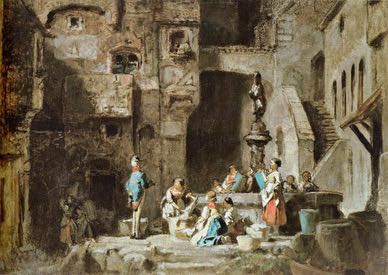
Many Spitzweg paintings resemble tiny stages. Narrow façades rise steeply, windows face one another, stairs climb at improbable angles, and courtyards create pockets of privacy that are never quite private. Architecture separates the figures while making their glances, messages, and misunderstandings possible.
In The Intercepted Love Letter, the viewer understands the situation by following a letter across neighboring windows. The sender believes he is reaching one woman, while another person observes or intercepts the exchange. Distance creates both romance and comedy.
Spitzweg was particularly drawn to tall, narrow formats that emphasize cramped urban space. A strong beam of sunlight may isolate one balcony or courtyard from surrounding shadow. Laundry, flowerpots, shutters, roofs, wells, and crumbling plaster are not background decoration. They establish who can see whom and how a private action becomes a neighborhood event.
What Changed After His Journeys to Paris and London?
Travel formed an important part of Spitzweg’s education. He walked through Bavaria, Tyrol, and Switzerland and visited Italian cities, Prague, Vienna, Berlin, and other European centers. Sketching outdoors helped him move beyond anecdotal interiors toward landscapes in which weather, distance, and light carry much of the meaning.
In 1851 he traveled with Eduard Schleich to Paris and London. French Barbizon painting demonstrated how an intimate landscape could be built from tonal atmosphere and freer paint. In London, works by John Constable and Richard Parkes Bonington offered fresh approaches to clouds, moisture, and changing light.
Spitzweg’s later landscapes often reduce people to tiny accents within forests, mountains, coastlines, and broad skies. His handling became looser, with thin passages beside thicker touches of light. The narrative did not disappear, but nature no longer needed to function merely as scenery for a joke. It could become the painting’s principal event.
Why Did He Keep Returning to Solitary Eccentrics?
The bookworm, cactus enthusiast, hermit, alchemist, mineralogist, and night watchman belong to a recognizable Spitzweg family. Each has withdrawn into a task or private world. Their surroundings tell us almost everything: shelves close around the reader, laboratory vessels crowd the alchemist, and rock walls contain the collector searching for specimens.
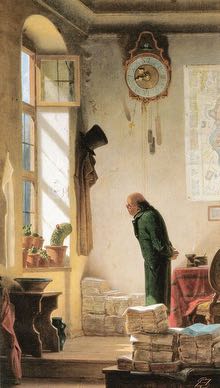
The Book Worm, painted around 1850, turns concentration into physical comedy. The scholar balances high on a ladder with books in both hands, beneath an arm, and between his knees. His learning is genuine, yet his complete separation from ordinary space makes him vulnerable and absurd.
Spitzweg’s scientific education adds another layer to these figures. He understood the satisfactions of classification, close study, and specialized knowledge. His humor therefore comes partly from recognition rather than contempt. The eccentric may be cut off from society, but private enthusiasm also protects a small zone of freedom within an orderly and restrictive world.
Did Modern Life Enter His Apparently Old-Fashioned World?
Spitzweg is often associated with old roofs, monks, village streets, and a seemingly preindustrial calm. Modernity nevertheless enters at the edges. Newspapers circulate political information, passports regulate movement, telegraph wires cross the landscape, customs officers inspect travelers, and railways arrive as strange machines within familiar terrain.
Gnome Watching Railway Train brings folklore and industrial technology into one image. A tiny figure peers from the safety of the rocks as the train passes in the distance. The contrast is humorous, but it also captures the speed with which modern systems altered older ideas about space and travel.
His imagined Middle Eastern scenes present a different kind of distance. Spitzweg never traveled to Cairo or the Ottoman world. Markets, harems, and reclining figures were assembled from costumes, objects, exhibitions, prints, and European Orientalist conventions. These pictures reveal contemporary curiosity, but they also show how nineteenth-century artists turned diverse cultures into generalized scenes for Western viewers.
Which Paintings Best Represent Spitzweg’s Range?
Spitzweg’s finest works move between close social observation and spacious landscape. These paintings show how recurring types, architectural wit, changing light, and carefully placed details sustained his long career:
- The Poor Poet, 1839: A writer beneath an indoor umbrella makes poverty, creative absorption, and Romantic idealism funny and uncomfortable at once.
- The Sunday Walk, 1841: A carefully dressed family ventures into the countryside with more social confidence than practical ease.
- The Book Worm, circa 1850: A scholar overloaded with books turns intellectual devotion into an affectionate study of tunnel vision.
- The Intercepted Love Letter, circa 1855: Windows, walls, and exchanged glances transform a private message into public comedy.
- Spanish Serenade, circa 1856: Music, moonlight, and stacked architecture create a theatrical variation on courtship.
- The Convent School Outing, circa 1860: A supervised walk places disciplined respectability beside food, flirtation, and other worldly temptations.
- The Hypochondriac, circa 1865: An anxious patient studies illness within the seclusion of a bright garden.
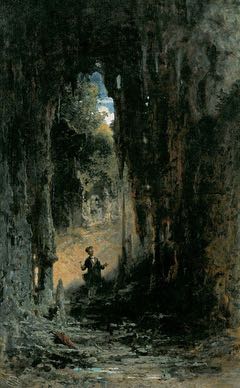
- Moonlit Scene with Castle Ruins, later nineteenth century: Atmospheric light and a quiet landscape reveal the painter beyond his familiar comic figures.
How Did Spitzweg Become More Than a Painter of Cozy Nostalgia?
Spitzweg achieved steady success during his lifetime, reportedly selling about four hundred paintings. Official recognition came later than popular support. In 1868, the Munich Academy named the self-taught artist an honorary member, acknowledging a professional standing he had established outside its classrooms.
He remained unmarried and worked quietly in Munich until his death on 23 September 1885. His pictures became especially popular through prints and reproductions during the twentieth century. That familiarity sometimes reduced them to comforting images of an imagined old Germany, while critics dismissed their humor as harmless sentiment.
A closer reading makes the paintings less settled. Spitzweg noticed the leaking roof above artistic idealism, the official who neglects his duty, the scholar trapped by learning, and the modern machine approaching an older landscape. His warmth keeps satire from becoming cruel, but it does not remove the satire. By joining exact detail, luminous paint, and comic timing, he turned small private worlds into enduring observations of how people protect their hopes, habits, and eccentric freedoms.
Copyright © 2026 BrushWiz. All Rights Reserved.
About Our Carl Spitzweg Paintings
Are your Carl Spitzweg reproductions painted by hand?
Yes. Every reproduction is individually painted by hand in oil on canvas by a professional artist. We do not use prints, digital transfers, or mechanical reproduction methods.
How closely do your Spitzweg copies resemble the original?
Our artists work to capture the composition, colors, texture, and visual character of the original Spitzweg painting as closely as possible. Because every reproduction is painted by hand, small variations are natural and make each canvas unique.
How long does a Spitzweg reproduction take to complete?
Most Spitzweg reproductions require approximately two to three weeks to paint, dry, and inspect. Production time may vary depending on the artwork and canvas size, so check the estimate displayed on the product page.
Can I request a Carl Spitzweg painting that is not listed?
Yes. If you cannot find the Carl Spitzweg artwork you want in our catalog, send us the painting’s title or an image. Our team will review your request and confirm the available sizes, estimated production time, and price.
Will I receive approval photos before shipping?
Yes. We send high-resolution photographs of the completed painting for your approval. You can request adjustments if needed, and the painting will not be dispatched until the review process is complete.
Are custom canvas sizes available for Spitzweg paintings?
Yes. We offer custom dimensions in addition to the standard sizes shown on the product page. Select the dimensions you need directly from the available size options.
May I order my Spitzweg painting with a frame?
Yes. High-quality frames in classic and modern designs are available for many paintings. You can view compatible framing options and add your preferred design from the product page. Professional canvas stretching is also available.
What determines the price of a Carl Spitzweg reproduction?
The price depends on the selected artwork, canvas dimensions, and framing option. Choose your preferred configuration on the product page to see the current price before ordering.
Is free express worldwide shipping included?
Yes. Spitzweg reproductions qualify for free express worldwide shipping. After dispatch, delivery usually takes five to eight business days, although timing may vary by country and destination.
Which return policy covers Spitzweg reproductions?
Orders are covered by our 90-day return policy. Review the current return-policy page before ordering for complete information about eligibility, time limits, and the return process.
Why BrushWiz?
100% Hand Painted
Every piece is entirely handmade
Museum Quality
Faithfully recreated by expert artists
Custom Framing
Choose from a wide range of frames
Free Shipping
Enjoy free shipping on all orders
Cash Back Rewards
Earn cash back with every purchase