
❄️ Winter Sale. Offer Ends 11/21/2026. View Details
❄️ Winter Sale. Ends 11/21/2026. View Details
❄️ Winter Sale. View Details
Artists
Subjects
Movements
Collections
Decor
Portraits
Commissions
Framing
Reviews
Gift Cards
On Sale
Claude Lorrain Oil Painting Reproductions
Shop museum-quality reproductions of Claude Lorrain’s most famous paintings, each hand-painted in oil on canvas by a professional artist.
Shop Art
Showing 1-40 of 108 results
Sort By
Most Popular
- Most Popular
- New Arrivals
- Best Sellers
- Alphabetical A-Z
- Alphabetical Z-A



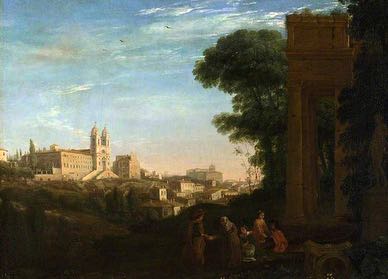
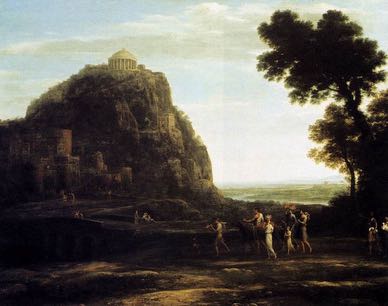
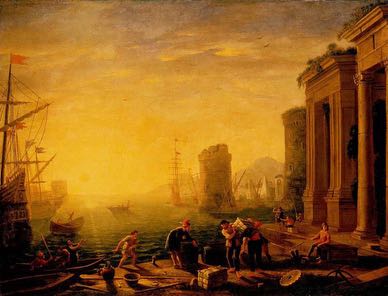
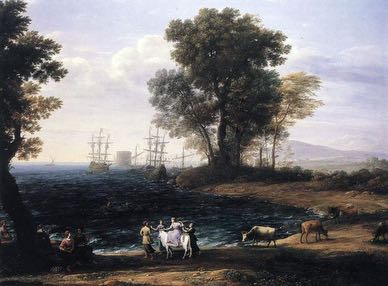
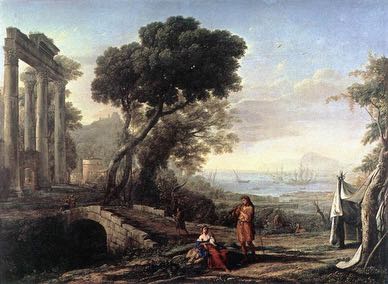
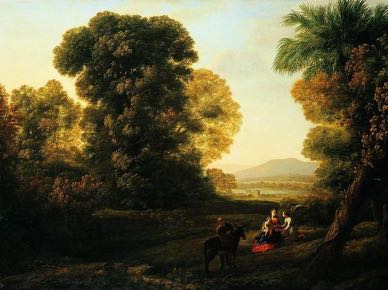

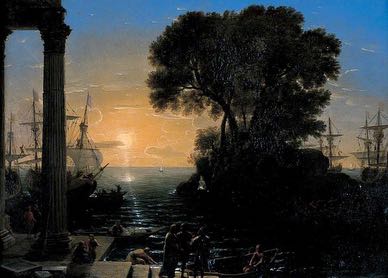

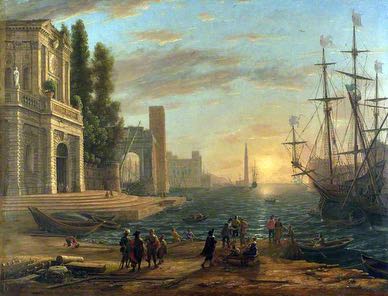
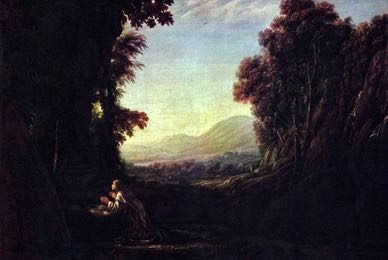
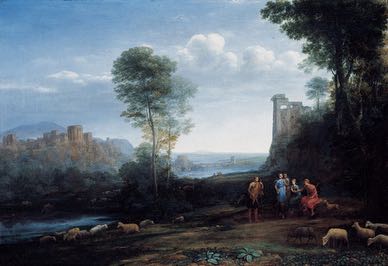

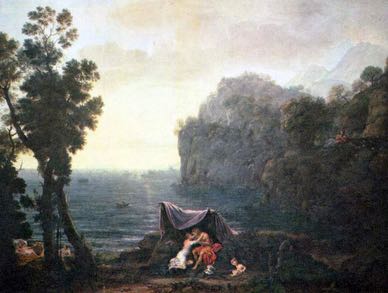
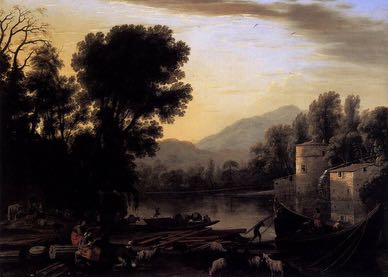








Can’t Find the Painting You Want?
Send us a reference image. We can recreate almost any artwork in the size and style you’re looking for.
Get a Free QuoteHand-Painted Claude Lorrain Reproductions
Bring Claude Lorrain’s art into your home with an oil-on-canvas reproduction hand-painted by a professional artist. Our collection features more than one hundred paintings from across his career, including Seaport with the Embarkation of the Queen of Sheba, Landscape with the Marriage of Isaac and Rebecca, and The Enchanted Castle. Discover harbors, valleys, classical ruins, biblical and mythological journeys, and other subjects closely associated with Claude. Every reproduction is a real oil painting, offering depth and texture that a print or digital transfer cannot provide. From celebrated masterpieces to quieter views, find a Claude Lorrain painting that suits your space.
The Making of a Claude Lorrain Oil Painting Replica
Creating a Claude Lorrain oil painting replica requires patience, precision, and an understanding of the original artwork. Our studio includes artists who specialize in Classical landscape painting and understand the distinctive qualities of Claude’s work. The artist begins by studying the source image, then recreates its luminous skies, layered distances, balanced architecture, and Claude’s gradual transition from shaded foreground to radiant horizon using traditional oil-painting methods. After completion, the painting is inspected by our quality-control team and photographed for your approval. The result is a carefully executed oil painting that reflects the visual character of the original.
Custom Sizes and Frames for Your Claude Lorrain Painting
Your Claude Lorrain painting can be ordered in practically any size, from popular standard dimensions to custom canvas sizes selected directly on the product page. This flexibility lets you choose a painting that fits your wall and complements your room perfectly. After selecting the size, you can choose from high-quality frames in classic or modern designs, with professional canvas stretching also available. Our framing options complement the luminous skies and classical compositions of Claude’s paintings. With sizing, stretching, and framing arranged in one order, your artwork can arrive ready for display without a separate visit to a frame shop.
Order a Claude Lorrain Reproduction with Confidence
Buying hand-painted art online should feel clear and comfortable. After your Claude Lorrain reproduction is completed, we send high-resolution photographs for your review before shipping. You can inspect the composition, colors, details, and overall finish, then request adjustments if needed. The painting is dispatched only after you approve it, so you know what to expect when it arrives. Your order also includes free express worldwide shipping and is covered by our 90-day return policy. Together, these assurances help you purchase a Claude Lorrain oil painting with greater confidence and peace of mind.
The Life and Art of Claude Lorrain
Claude Lorrain, born Claude Gellée around 1604 or 1605, was a French Baroque painter who transformed landscape into a vehicle for light, atmosphere, and poetic narrative. Raised in the Duchy of Lorraine, he spent nearly his entire career in Rome, studying the countryside and coast while serving popes, princes, cardinals, and European rulers. Claude arranged pastoral valleys, ancient ruins, harbors, shepherds, and small biblical or mythological figures within idealized settings inspired by direct observation. His sunlit distances and balanced compositions became models for generations of painters. The Liber Veritatis, his drawn record of completed paintings, documents almost five decades of invention. His work profoundly influenced European landscape painting, garden design, and artists from Richard Wilson to J. M. W. Turner.
Read More
Who Was Claude Gellée Before He Became Claude Lorrain?
Claude was born around 1604 or 1605 in Chamagne, a village in the independent Duchy of Lorraine. His family name was Gellée, but in Italy he became known by his place of origin as Claude le Lorrain. English-speaking audiences later shortened this to Claude Lorrain or simply Claude.
Reliable details of his childhood are scarce. Early biographies disagree about the route by which he reached Italy and sometimes surround his beginnings with stories about poverty, orphanhood, and work as a pastry cook. What is clear is that he arrived young and received only limited formal education.
Those modest beginnings make the intellectual range of his mature art remarkable. Claude learned through workshops, close looking, travel, and persistent drawing rather than through a humanist education. He would eventually paint stories drawn from scripture, Virgil, Ovid, and later literature for some of Europe’s most sophisticated patrons.
How Did Rome Become the Center of His Artistic World?
Claude was in Rome by his youth and entered the workshop of Agostino Tassi, a specialist in architectural decoration, perspective, and landscape. Work on fresco projects taught him how imaginary buildings and distant scenery could expand real interiors. Tassi’s harbor compositions also offered an important early model.
A brief return north took Claude to Nancy, where he assisted the court painter Claude Deruet around 1625. He soon went back to Rome and remained there for the rest of his life. The city provided ancient ruins, modern construction, powerful patrons, and an international community of artists.
Claude emerged as an independent painter by the late 1620s. His reputation rose quickly during the following decade. By 1636 he was working for Pope Urban VIII and soon received commissions connected with King Philip IV of Spain. From a workshop in Rome, his paintings traveled to courts and private collections across Europe.
What Did Claude Learn by Drawing Outdoors?
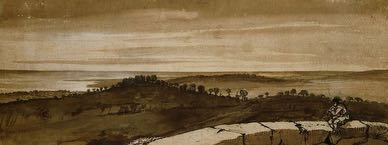
Claude repeatedly left Rome to draw in the Campagna, along the Tiber, near Tivoli, and toward the coast. Accounts by contemporaries describe him studying nature from before sunrise into evening. He watched how mist softened distance, how reflections changed with the sun, and how trees appeared against bright sky.
An Artist Studying from Nature gives this practice a visible place within his art. Outdoor drawings recorded fragments rather than complete future paintings: a tree, bank, cloud, building, or fall of light that could later be reorganized in the studio.
Claude’s finished landscapes are therefore neither exact topographical views nor pure fantasy. They combine observed details into an ordered world. A hill seen near Tivoli might join an invented harbor, an ancient temple, and figures from a distant story. Truth to natural light made the ideal construction believable.
Why Are the Figures So Small in Claude’s Landscapes?
Seventeenth-century patrons generally expected important paintings to carry a biblical, mythological, or historical subject. Claude supplied those narratives, but he reversed the usual hierarchy. The surrounding land, water, architecture, and light occupy most of the canvas, while the named event may unfold among tiny foreground figures.
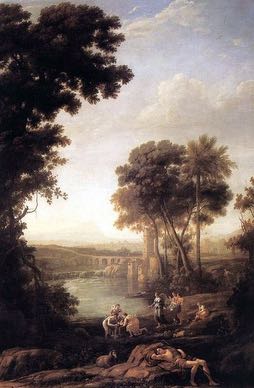
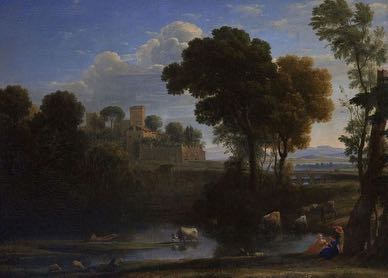
In Landscape with the Marriage of Isaac and Rebecca, also known as The Mill, dancing and celebration animate a small portion of a vast pastoral setting. The biblical story gives meaning to the scene without overwhelming the landscape.
Claude was less assured with anatomy than with atmosphere, and assistants may sometimes have contributed figures. Yet their scale was a deliberate part of his design. Human lives appear within a world larger and more enduring than any individual action. The landscape does not merely illustrate the story; it establishes its emotional and poetic terms.
How Did Harbors Become Theaters of Light and Departure?
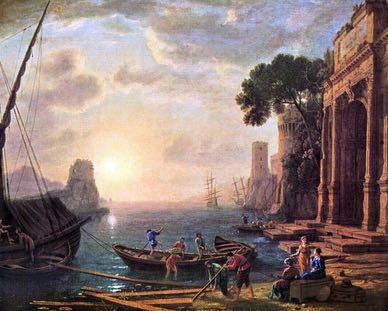
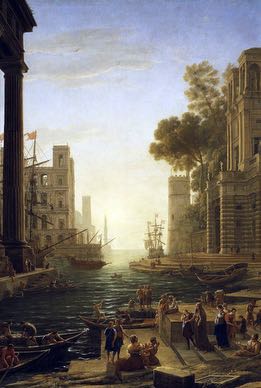
Claude’s ports combine tall classical buildings, towers, ships, small boats, merchants, sailors, passengers, and open sea. The architecture often forms dark wings on either side, directing the eye toward a low sun near the center. Water then carries its brightness forward through the composition.
A Seaport at Sunrise demonstrates how morning light can unify countless activities without requiring every detail to be equally sharp. Masts and rigging cross the sky, figures prepare vessels, and distant forms dissolve into luminous air.
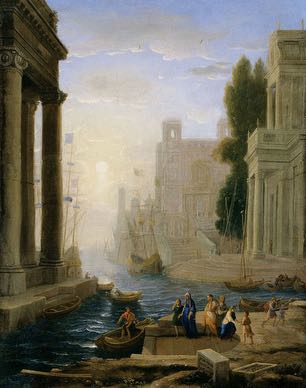
Embarkation stories suited this structure particularly well. The Queen of Sheba, Saint Ursula, Saint Paula, Ulysses, and other travelers leave or arrive at imagined ports. Even when the narrative promises a destination, Claude makes the moment of transition central. Architecture suggests civilization behind the figures, while the glowing horizon opens onto uncertainty.
What Was the Purpose of the Liber Veritatis?
Around 1635 or 1636, Claude began keeping a visual record of his finished paintings. For each composition, he made a careful drawing in pen and wash, often adding the patron’s name, destination, or subject on the reverse. The album eventually contained nearly two hundred numbered sheets.
Now known as the Liber Veritatis, or Book of Truth, it helped Claude distinguish authentic works from copies and imitations produced as his fame grew. It was not simply an administrative list. Each sheet translates color and light into a concentrated range of brown, gray, and white.
The book is unusually valuable because Claude’s paintings are spread across countries and collections. It preserves lost works, identifies commissions, reveals paired designs, and allows scholars to follow changes across decades. Later publication of the drawings as prints also extended Claude’s influence, especially in Britain.
In What Ways Did Patrons Shape His Ideal Landscapes?
Claude painted for popes, cardinals, Roman families, foreign ambassadors, and European monarchs. These patrons selected subjects, destinations, formats, and sometimes companion pieces. A morning harbor might be paired with an evening landscape, allowing a room to hold contrasting times of day.
Classical culture mattered deeply to this audience. Ruins, temples, shepherds, and stories from antiquity connected private ownership with learning, travel, and political authority. Claude’s landscapes offered an ideal past, but they were informed by the living countryside and working ports around seventeenth-century Rome.
His relationship to Nicolas Poussin is often emphasized because both French-born painters built major careers in Rome and developed classical landscape. Poussin generally organized narrative through firmer intellectual structure, while Claude gave changing light a more commanding role. Their differences helped establish two lasting approaches to the ideal landscape.
Why Did Claude’s Late Paintings Grow More Solemn?
Claude continued painting into old age, but later works often feel less open and festive than the bright harbors of the 1630s and 1640s. Darker trees, heavier clouds, unusual stories, and deepening distances create a more reflective mood. The compositions remain balanced without becoming predictable.
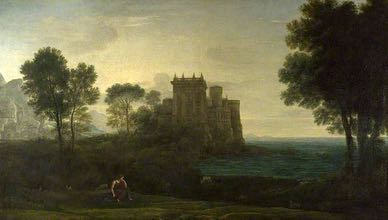
The Enchanted Castle places Psyche outside the distant palace of Cupid. She occupies the edge of a shadowed foreground while the building catches light beyond water. The setting conveys separation and longing more strongly than her small gesture alone could do.
Other late paintings draw on the Aeneid and less frequently illustrated episodes from ancient literature. Claude’s command of light did not fade into a repeated golden formula. He used atmosphere to distinguish expectation from loss, morning from evening, security from exile, and pastoral calm from approaching tragedy.
Which Paintings Define Claude Lorrain’s Poetic Landscape?
Claude developed a remarkably flexible language from harbors, rivers, pastoral valleys, architecture, and changing light. These works show how different narratives could inhabit that ordered world:
- A Seaport at Sunrise: Ships, architecture, and waterfront labor gather around a low sun that transforms the harbor.
- Coast Scene with the Rape of Europa: A violent myth begins almost unnoticed within an expansive and deceptively calm shore.
- Landscape with the Marriage of Isaac and Rebecca, 1648: Celebration, grazing animals, water, and distant hills form an ideal pastoral world.
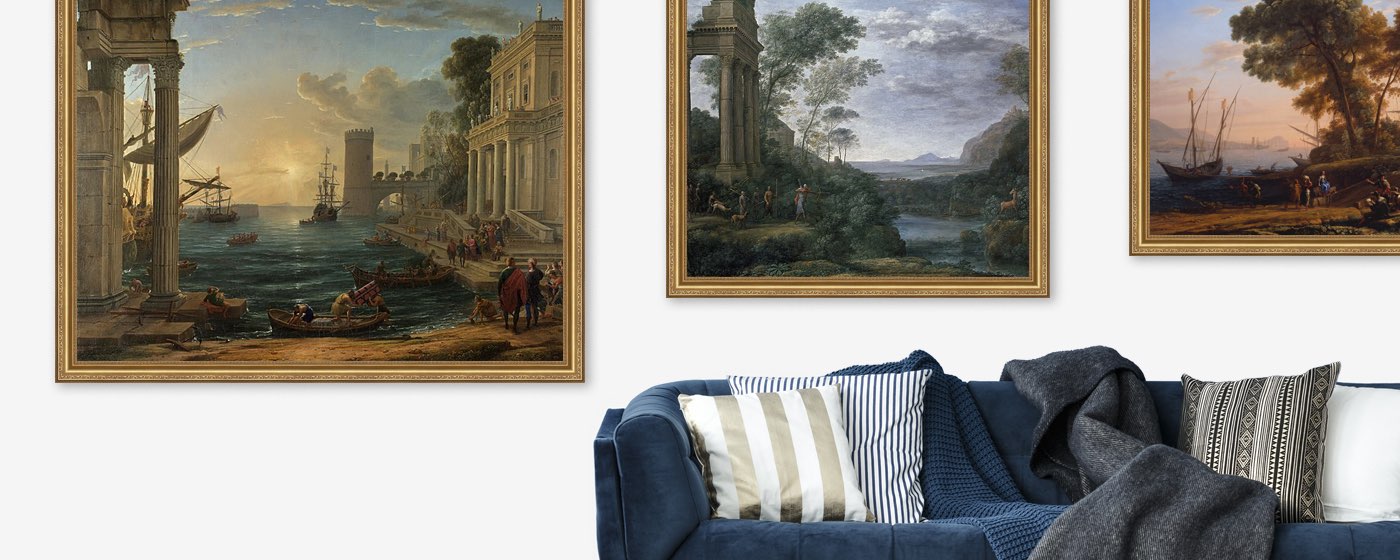
- Seaport with the Embarkation of the Queen of Sheba, 1648: Monumental buildings frame a radiant departure across water and morning air.
- The Enchanted Castle, 1664: Psyche’s solitude is expressed through shadow, distance, and an unreachable sunlit palace.
- Landscape with Hagar and the Angel: A biblical encounter occupies a quiet clearing within a much larger journey through nature.
- Marine with the Trojans Burning Their Boats: Fire, sea, and gathering weather turn epic history into atmospheric drama.
- The Arrival of Aeneas at Pallanteum: Ancient architecture and river landscape give an epic arrival the weight of remembered history.
How Did Claude Change the Course of European Landscape Painting?
Claude died in Rome on 23 November 1682 after a career of more than fifty years. He had raised landscape from a relatively modest specialty to a form sought by Europe’s most powerful patrons. His work offered later artists a durable system for joining observed nature, classical order, narrative, and light.
British collectors acquired his paintings enthusiastically during the eighteenth century. Country estates and landscape gardens were designed to resemble Claude’s balanced views, and tinted viewing mirrors became known as Claude glasses. Painters including Richard Wilson and John Constable responded to different parts of his example.
No later admirer engaged him more intensely than J. M. W. Turner. Turner left two paintings to Britain on condition that they hang beside Claude’s Queen of Sheba and Marriage of Isaac and Rebecca. That deliberate comparison captures Claude’s lasting position: a seventeenth-century painter whose luminous structures helped later artists imagine entirely new landscapes.
Copyright © 2026 BrushWiz. All Rights Reserved.
About Our Claude Lorrain Paintings
Are your Claude Lorrain reproductions painted by hand?
Yes. Every reproduction is individually painted by hand in oil on canvas by a professional artist. We do not use prints, digital transfers, or mechanical reproduction methods.
How closely do your Claude Lorrain copies resemble the original?
Our artists work to capture the composition, colors, brushwork, details, and visual character of the original Claude Lorrain painting as closely as possible. Because every reproduction is painted by hand, small variations are natural and make each canvas unique.
How long does a Claude Lorrain reproduction take to complete?
Most Claude Lorrain reproductions require approximately two to three weeks to paint, dry, and inspect. Production time may vary depending on the artwork and canvas size, so check the estimate displayed on the product page.
Can I request a Claude Lorrain painting that is not listed?
Yes. If you cannot find the Claude Lorrain artwork you want in our catalog, send us the painting’s title or an image. Our team will review your request and confirm the available sizes, estimated production time, and price.
Will I receive approval photos before shipping?
Yes. We send high-resolution photographs of the completed painting for your approval. You can request adjustments if needed, and the painting will not be dispatched until the review process is complete.
Are custom canvas sizes available for Claude Lorrain paintings?
Yes. We offer custom dimensions in addition to the standard sizes shown on the product page. Select the dimensions you need directly from the available size options.
May I order my Claude Lorrain painting with a frame?
Yes. High-quality frames in classic and modern designs are available for many paintings. You can view compatible framing options and add your preferred design from the product page. Professional canvas stretching is also available.
What determines the price of a Claude Lorrain reproduction?
The price depends on the selected artwork, canvas dimensions, and framing option. Choose your preferred configuration on the product page to see the current price before ordering.
Is free express worldwide shipping included?
Yes. Claude Lorrain reproductions qualify for free express worldwide shipping. After dispatch, delivery usually takes five to eight business days, although timing may vary by country and destination.
Which return policy covers Claude Lorrain reproductions?
Orders are covered by our 90-day return policy. Review the current return-policy page before ordering for complete information about eligibility, time limits, and the return process.
Why BrushWiz?
100% Hand Painted
Every piece is entirely handmade
Museum Quality
Faithfully recreated by expert artists
Custom Framing
Choose from a wide range of frames
Free Shipping
Enjoy free shipping on all orders
Cash Back Rewards
Earn cash back with every purchase