
❄️ Winter Sale. Offer Ends 11/18/2026. View Details
❄️ Winter Sale. Ends 11/18/2026. View Details
❄️ Winter Sale. View Details
Artists
Subjects
Movements
Collections
Decor
Portraits
Commissions
Framing
Reviews
Gift Cards
On Sale
Edward Hicks Oil Painting Reproductions
Shop museum-quality reproductions of Edward Hicks’s most famous paintings, each hand-painted in oil on canvas by a professional artist.
Shop Art

Showing 1-6 of 6 results
Sort By
Most Popular
- Most Popular
- New Arrivals
- Best Sellers
- Alphabetical A-Z
- Alphabetical Z-A
Can’t Find the Painting You Want?
Send us a reference image. We can recreate almost any artwork in the size and style you’re looking for.
Get a Free QuoteHand-Painted Edward Hicks Reproductions
Bring Hicks’s art into your home with an oil-on-canvas reproduction hand-painted by a professional artist. Our collection includes works from across his career, including The Peaceable Kingdom, Penn’s Treaty with the Indians, and The Cornell Farm. Browse biblical visions, Pennsylvania landscapes, historical subjects, and other works closely associated with Hicks. Every reproduction is a real oil painting, offering depth and texture that a print or digital transfer cannot provide. From his familiar images of peaceful animals to detailed farm scenes, find an Edward Hicks painting that suits your space.
The Making of an Edward Hicks Oil Painting Replica
Creating an Edward Hicks oil painting replica requires patience, precision, and an understanding of the original artwork. Our studio includes artists who specialize in American folk and Naive painting and understand the distinctive qualities of Hicks’s work. The artist begins by studying the source image, then recreates its patterned animals, rolling landscape, direct outlines, and Hicks’s balance of biblical symbolism and rural detail on canvas using traditional oil-painting methods. After completion, the painting is inspected by our quality-control team and photographed for your approval. The result is a carefully executed oil painting that reflects the visual character of the original.
Custom Sizes and Frames for Your Edward Hicks Painting
Your Edward Hicks painting can be ordered in practically any size, from popular standard dimensions to custom canvas sizes selected directly on the product page. This flexibility lets you choose a painting that fits your wall and complements your room perfectly. After selecting the size, you can choose from high-quality frames in classic or modern designs, with professional canvas stretching also available. Our framing options complement the warm colors and balanced landscapes of Hicks’s paintings. With sizing, stretching, and framing arranged in one order, your artwork can arrive ready for display without a separate visit to a frame shop.
Order an Edward Hicks Reproduction with Confidence
Buying hand-painted art online should feel clear and comfortable. After your Edward Hicks reproduction is completed, we send high-resolution photographs for your review before shipping. You can inspect the composition, animals, colors, and overall finish, then request adjustments if needed. The painting is dispatched only after you approve it, so you know what to expect when it arrives. Your order also includes free express worldwide shipping and is covered by our 90-day return policy. Together, these assurances help you purchase an Edward Hicks oil painting with greater confidence and peace of mind.
The Life and Art of Edward Hicks
Edward Hicks was an American Quaker minister, coach painter, sign maker, and self-trained artist whose repeated visions of peaceful animals became enduring images of American Naive Art. Born in Pennsylvania in 1780, he learned decorative painting through a carriage-making apprenticeship and relied on that trade to support his family and religious work. Hicks painted more than sixty versions of The Peaceable Kingdom, joining Isaiah’s prophecy of natural harmony with an idealized meeting between William Penn and the Lenape. The changing expressions and arrangements reveal his hopes and anxieties during bitter divisions among the Quakers. His farm portraits, biblical scenes, and historical paintings share the direct forms, patterned surfaces, and moral purpose that make his work immediately recognizable.
Read More
How Did an Orphaned Boy Find a Home Among Pennsylvania Quakers?
Edward Hicks was born on 4 April 1780 in Attleborough, now Langhorne, in Bucks County, Pennsylvania. His family’s fortunes had suffered during the American Revolution because his father and grandfather supported Britain. When his mother died while Edward was still an infant, his unsettled father arranged for others to care for him.
David and Elizabeth Twining took the young boy into their Quaker household near Newtown. Their farm gave him a stable childhood shaped by work, animals, scripture, and the plain habits of the Religious Society of Friends. Hicks was not born into that faith, but its ideas about humility, peace, self-discipline, and inward spiritual guidance became central to his adult life.
The countryside of Bucks County remained his physical world. He traveled widely as a minister, yet returned to its farms, meetinghouses, roads, signs, and local stories. Even his most visionary paintings are grounded in familiar livestock, cultivated fields, and the practical visual language of a rural craftsman.
What Did Coach Painting Teach Him About Making Pictures?
At thirteen, Hicks was apprenticed to the coachmakers William and Henry Tomlinson. Carriage decoration required him to prepare surfaces, grind colors, handle lettering, apply varnish, and paint ornaments that could be understood quickly from a distance. This was skilled commercial work rather than academic training, and it formed the foundation of his later easel paintings.
After completing his apprenticeship, he worked independently and then joined the coachmaker Joshua C. Canby in Milford, now Hulmeville. Hicks painted coaches, houses, furniture, fireboards, shop signs, and tavern signs. Popular prints supplied useful figures and compositions that he could adapt to a customer’s needs.
Those habits remained visible when he began making pictures on canvas. Animals stand in clear profiles, fences create decorative rhythms, inscriptions become part of the image, and space is organized for legibility rather than strict academic perspective. What later collectors called a folk style grew from years of purposeful craft.
Why Did Painting Trouble Hicks After He Became a Minister?
Hicks joined the Society of Friends in 1803 and married Sarah Worstall that year. His gift for speaking became increasingly important within local meetings, and in 1811 he was formally recognized as a Quaker minister. He traveled to preach and devoted long periods to religious concerns without receiving a ministerial salary.
Ornamental painting created a personal conflict. Quaker testimony favored plainness and warned against vanity, luxury, and worldly display, while signs and decorated coaches depended on visual appeal. Hicks worried that his livelihood encouraged the very values he was expected to question from the meetinghouse.
He briefly abandoned painting for farming, believing agriculture more consistent with his faith. The attempt placed his growing family under severe financial pressure. By 1816, he had returned to the trade and gradually accepted useful craftsmanship as honest labor. Easel paintings with biblical or moral subjects offered another reconciliation: pictures could instruct, console, and strengthen community rather than serve fashion alone.
When Did the First Peaceable Kingdoms Appear?
Hicks began painting versions of The Peaceable Kingdom around 1820. The subject came from Isaiah’s prophecy that predators and domestic animals would live together, led by a little child. He adapted the animal group from printed Bible illustrations, especially a design associated with the English artist Richard Westall.
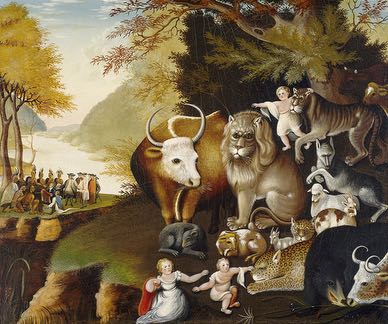
In Hicks’s hands, the borrowed arrangement became intensely personal. Lions, leopards, bears, wolves, cattle, sheep, and children gather in an American landscape. Their improbable calm represents the spiritual conquest of aggressive impulses. Peace begins when pride and self-will submit to the inward guidance Friends called the Light or Christ Spirit.
Many versions include lines of verse across the lower edge or within the landscape. Words explain what the animals alone cannot: the kingdom is not merely a charming scene but an image of difficult moral transformation. Hicks usually gave these paintings to relatives, friends, and supporters rather than treating them as the main commercial product of his shop.
How Did One Composition Sustain More Than Sixty Paintings?
Hicks returned to the theme for nearly three decades, creating more than sixty known versions. He did not simply repeat a successful formula. The animals change in scale, age, expression, and proximity. Children appear or disappear, branches divide the space, banners enter the scene, and the distant treaty group grows larger or smaller.
Early kingdoms often feel open and hopeful. The young animals cluster gently around a child, and the landscape seems capable of containing difference without strain. In later paintings, the lion may bare its teeth, the leopard stares sharply, and the creatures press together with a tense alertness. Harmony looks less like innocence and more like appetite held under control.
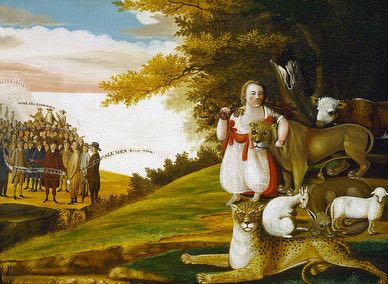
A Peaceable Kingdom with Quakers Bearing Banners brings religious community directly into the vision. These shifts turned the series into a record of Hicks’s changing spiritual condition. Repetition allowed him to test the same promise against new disappointment, conflict, and hope.
What Changed After the Quaker Separation of 1827?
During the 1820s, American Friends divided over theology, authority, and religious practice. One group emphasized scripture and more orthodox Christian belief. The other gathered around the preaching of Elias Hicks, Edward’s older cousin, who stressed direct inward revelation and resisted external creeds. The separation of 1827 divided meetings, families, property, and long-standing friendships.
Edward supported the Hicksite branch and traveled as an outspoken minister, yet the bitterness of the conflict weighed heavily on him. The Peaceable Kingdom became more urgent because his own religious community could not maintain peace. Predators and prey offered a painful contrast to people who shared a tradition but could no longer worship together.
Later kingdoms often acknowledge that conflict instead of pretending it has vanished. Animals retain their different natures, and peace appears provisional. Hicks’s plain style makes this tension easy to overlook, but the paintings are not simple fantasies of rural contentment. They ask whether spiritual discipline can restrain fear, pride, and the desire to dominate.
Can Penn’s Treaty Represent Both Peace and Colonial Myth?
In the background of many Peaceable Kingdoms, William Penn meets Lenape people beneath an elm tree. Hicks adapted the scene from an engraving after Benjamin West’s celebrated painting. Quakers understood the meeting as evidence that peaceful conduct and fair negotiation could guide relations between peoples.
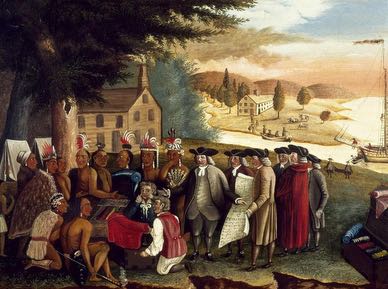
Hicks also painted the event as an independent subject. In Penn’s Treaty with the Indians, colonists offer cloth and goods while Penn presents an agreement. The story gave Hicks a historical counterpart to Isaiah: a moment when the peaceable kingdom seemed partly realized on American ground.
No document confirms the specific treaty shown, and the image idealizes colonial exchange. It views Lenape people through a story designed by white artists and patrons while overlooking land loss and later violence. The painting remains important precisely because it reveals how nineteenth-century Quakers remembered Pennsylvania’s founding and used that memory to define their own moral identity.
Beyond the Peaceable Kingdom, What Else Did Hicks Paint?
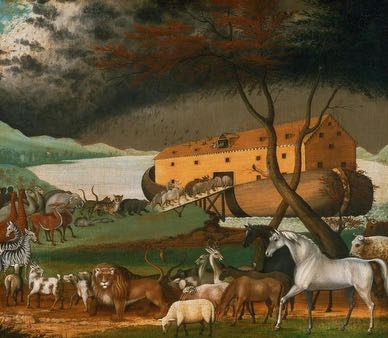
Hicks painted American history, scripture, local properties, and rural life. Noah’s Ark, made in 1846 from a recent Nathaniel Currier lithograph, returns to the idea of animals gathered under divine protection. Hicks rearranged the printed source and gave its orderly pairs the familiar character of his kingdoms.
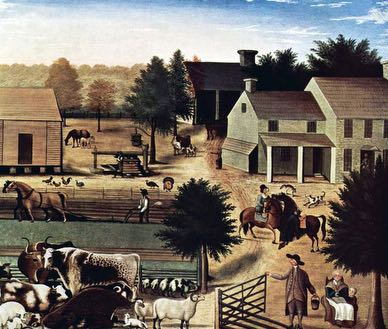
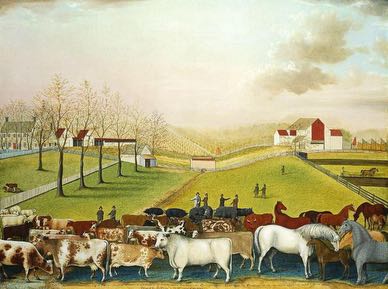
Farm portraits served local pride while preserving specific information. The Estate of David Twining remembers the household in which he was raised. The Cornell Farm records prize cattle, horses, sheep, pigs, workers, fences, buildings, and fields across a broad Bucks County landscape.
These paintings may look less symbolic than the Peaceable Kingdoms, but they share an interest in good order. Animals, people, property, and labor occupy clearly marked relationships. Hicks could celebrate agricultural achievement while quietly turning a commissioned view into another image of creation managed, cultivated, and held in balance.
Which Works Define Hicks’s Distinctive Vision?
Hicks’s catalog is concentrated, but it reaches from prophecy and scripture to history and carefully observed Pennsylvania farms. These six paintings show the range within his direct and deeply considered art:
- The Peaceable Kingdom, circa 1830–1834: Children and unlikely animal companions embody Isaiah’s prophecy while Penn’s meeting with the Lenape appears in the distance.
- A Peaceable Kingdom with Quakers Bearing Banners, circa 1830s: A familiar biblical vision expands to include the contested religious community Hicks hoped could recover harmony.
- Penn’s Treaty with the Indians, circa 1830–1840: Hicks turns an idealized colonial story into an independent image of Quaker identity and peaceful exchange.
- The Estate of David Twining, circa 1845–1848: The farm where Hicks grew up becomes a carefully patterned record of home, memory, and cultivated land.
- Noah’s Ark, 1846: Paired animals approach safety in a biblical scene that renews his lifelong hope for order after crisis.
- The Cornell Farm, 1848: Rows of individually described livestock fill an expansive portrait of a prize-winning Bucks County farm.
Why Has a Local Craftsman Become an American Folk-Art Icon?
Hicks was better known during his lifetime as a traveling minister than as a painter. He continued preaching, writing, and painting into old age, aware that his trade still helped support his family and religious service. He died in Newtown on 23 August 1849 and was buried at the local Friends meetinghouse.
His pictures slipped from broad attention until collectors and scholars rediscovered American folk art during the twentieth century. The label “naive” described his distance from academy training, but it could also make his choices seem accidental. Hicks knew exactly how repetition, outline, pattern, inscription, and borrowed imagery could communicate to the communities around him.
The Peaceable Kingdom remains appealing because its animals are memorable, but charm is only the surface. Beneath it lies a minister’s lifelong argument with anger, division, livelihood, history, and his own desire to paint. Hicks made peace look possible without making it easy, which is why the image survived far beyond the local world for which he created it.
Copyright © 2026 BrushWiz. All Rights Reserved.
About Our Edward Hicks Paintings
Are your Edward Hicks reproductions painted by hand?
Yes. Every reproduction is individually painted by hand in oil on canvas by a professional artist. We do not use prints, digital transfers, or mechanical reproduction methods.
How closely do your Hicks copies resemble the original?
Our artists work to capture the composition, colors, texture, and visual character of the original Hicks painting as closely as possible. Because every reproduction is painted by hand, small variations are natural and make each canvas unique.
How long does an Edward Hicks reproduction take to complete?
Most Edward Hicks reproductions require approximately two to three weeks to paint, dry, and inspect. Production time may vary depending on the artwork and canvas size, so check the estimate displayed on the product page.
Can I request an Edward Hicks painting that is not listed?
Yes. If you cannot find the Edward Hicks artwork you want in our catalog, send us the painting’s title or an image. Our team will review your request and confirm the available sizes, estimated production time, and price.
Will I receive approval photos before shipping?
Yes. We send high-resolution photographs of the completed painting for your approval. You can request adjustments if needed, and the painting will not be dispatched until the review process is complete.
Are custom canvas sizes available for Hicks paintings?
Yes. We offer custom dimensions in addition to the standard sizes shown on the product page. Select the dimensions you need directly from the available size options.
May I order my Edward Hicks painting with a frame?
Yes. High-quality frames in classic and modern designs are available for many paintings. You can view compatible framing options and add your preferred design from the product page. Professional canvas stretching is also available.
What determines the price of an Edward Hicks reproduction?
The price depends on the selected artwork, canvas dimensions, and framing option. Choose your preferred configuration on the product page to see the current price before ordering.
Is free express worldwide shipping included?
Yes. Edward Hicks reproductions qualify for free express worldwide shipping. After dispatch, delivery usually takes five to eight business days, although timing may vary by country and destination.
Which return policy covers Edward Hicks reproductions?
Orders are covered by our 90-day return policy. Review the current return-policy page before ordering for complete information about eligibility, time limits, and the return process.
Why BrushWiz?
100% Hand Painted
Every piece is entirely handmade
Museum Quality
Faithfully recreated by expert artists
Custom Framing
Choose from a wide range of frames
Free Shipping
Enjoy free shipping on all orders
Cash Back Rewards
Earn cash back with every purchase