
❄️ Winter Sale. Offer Ends 11/17/2026. View Details
❄️ Winter Sale. Ends 11/17/2026. View Details
❄️ Winter Sale. View Details
Artists
Subjects
Movements
Collections
Decor
Portraits
Commissions
Framing
Reviews
Gift Cards
On Sale
Maynard Dixon Oil Painting Reproductions
Shop museum-quality reproductions of Maynard Dixon’s most famous paintings, each hand-painted in oil on canvas by a professional artist.
Shop Art
Showing 1-10 of 10 results
Sort By
Most Popular
- Most Popular
- New Arrivals
- Best Sellers
- Alphabetical A-Z
- Alphabetical Z-A


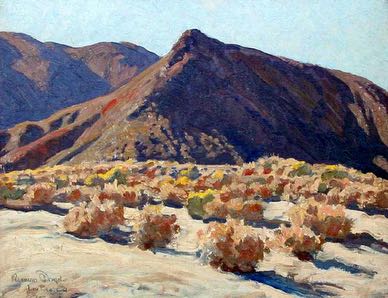
Can’t Find the Painting You Want?
Send us a reference image. We can recreate almost any artwork in the size and style you’re looking for.
Get a Free QuoteHand-Painted Maynard Dixon Reproductions
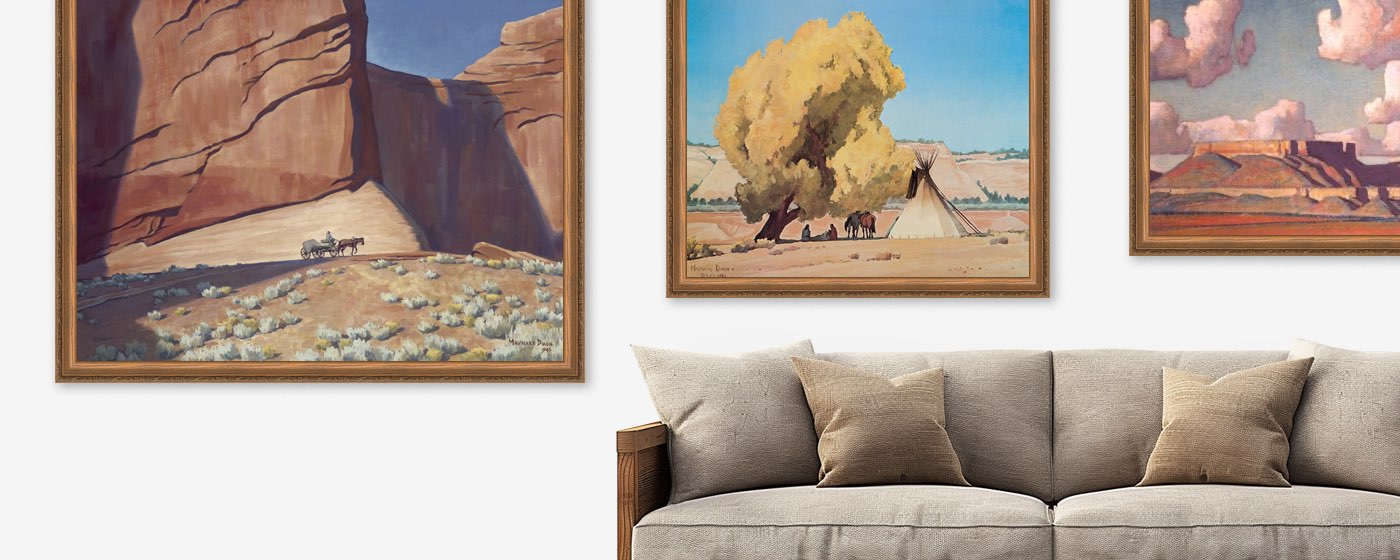
Bring Dixon’s art into your home with an oil-on-canvas reproduction hand-painted by a professional artist. Our collection includes a varied selection from across his career, including Home in the Desert, Lone Pine, Ponies Coming to Water, and Windmill on the Plains. Discover desert mesas, adobe homes, horses, and vast cloud-filled skies associated with Dixon. Every reproduction is a real oil painting, offering depth and texture that a print or digital transfer cannot provide. From familiar Western scenes to quieter studies, find a Dixon painting that suits your space.
The Making of a Maynard Dixon Oil Painting Replica
Creating a Maynard Dixon oil painting replica requires patience, precision, and an understanding of the original artwork. Our studio includes artists who specialize in Impressionist painting and understand the distinctive qualities of Dixon’s work. The artist begins by studying the source image, then recreates its broad color masses, firm contours, open skies, and Dixon’s carefully judged balance between monumental landforms and small figures using traditional oil-painting methods. After completion, the painting is inspected by our quality-control team and photographed for your approval. The result is a carefully executed oil painting that reflects the visual character of the original.
Custom Sizes and Frames for Your Dixon Painting
Your Dixon painting can be ordered in practically any size, from popular standard dimensions to custom canvas sizes selected directly on the product page. This flexibility lets you choose a painting that fits your wall and complements your room perfectly. After selecting the size, you can choose from high-quality frames in classic or modern designs, with professional canvas stretching also available. Our framing options complement the bold shapes and sun-warmed colors of Dixon’s paintings. With sizing, stretching, and framing arranged in one order, your artwork can arrive ready for display without a separate visit to a frame shop.
Order a Maynard Dixon Reproduction with Confidence
Buying hand-painted art online should feel clear and comfortable. After your Maynard Dixon reproduction is completed, we send high-resolution photographs for your review before shipping. You can inspect the composition, colors, details, and overall finish, then request adjustments if needed. The painting is dispatched only after you approve it, so you know what to expect when it arrives. Your order also includes free express worldwide shipping and is covered by our 90-day return policy. Together, these assurances help you purchase a Dixon oil painting with greater confidence and peace of mind.
The Life and Art of Maynard Dixon
Maynard Dixon was an American painter, illustrator, muralist, and poet who brought a modern visual language to the American West. Born near Fresno, California, in 1875, he briefly attended art school before building a successful career in publishing. Long journeys through Arizona, Nevada, New Mexico, Utah, and other western regions gradually moved his attention from narrative illustration toward simplified landscapes shaped by broad color, low horizons, and monumental clouds. Dixon also portrayed cowboys, horses, Native people, migrant laborers, and unemployed men during the Great Depression. His marriage to photographer Dorothea Lange deepened his engagement with contemporary hardship. Later homes in southern Utah and Tucson placed him close to the desert landscapes that sustained his art until 1946.
Read More
How Did a San Joaquin Valley Childhood Shape Dixon’s Imagination?
Maynard Dixon was born near Fresno, California, on 24 January 1875 and grew up in the ranching country of the San Joaquin Valley. Poor health often kept him indoors, where drawing became both occupation and escape. Beyond the house were horses, dry fields, working ranches, distant mountains, and the large skies that later dominated his paintings.
He was largely self-taught, learning from illustrated books and magazines as well as direct observation. At sixteen, Dixon sent sketches to Frederic Remington, already famous for pictures of the West. Remington’s encouraging reply urged him to keep drawing, advice that gave the young artist confidence without binding him to another painter’s style.
Dixon adopted the thunderbird as a personal emblem and eventually signed many works with it. The symbol became closely associated with his public identity, though it came from Native traditions that were not his own. That borrowing belongs to the wider history of how non-Native artists interpreted and used Indigenous imagery in the early twentieth century.
Why Did Three Months of Art School Prove Enough?
In 1893, Dixon enrolled at the California School of Design, also known as the Mark Hopkins Institute of Art, in San Francisco. He left after only a few months. Formal instruction felt confining, while newspapers, periodicals, and the city’s active publishing world offered immediate professional opportunities.
His first illustrations appeared in the Overland Monthly that year. Dixon went on to work for San Francisco newspapers and magazines including Sunset, then supplied images for books and national publications. Strong silhouettes, clear storytelling, and economical design became essential when pictures had to reproduce well in print.
Illustration provided income and made Dixon widely known, but it also encouraged familiar myths of cowboys, conflict, and frontier adventure. His early work owed something to Remington and other popular illustrators. Over time, direct travel made him impatient with borrowed formulas. He wanted to understand western places through sustained looking rather than repeat a story imagined from the studio.
Across the West, What Was Dixon Searching For?
Dixon began making long sketching trips at the turn of the century. In 1900, he traveled through Arizona and Mexico with writer and editor Charles Fletcher Lummis. The following year, he and artist Edward Borein rode roughly a thousand miles through Nevada, northeastern California, and Oregon, recording ranches and working life along the way.
Later journeys took him among Hopi, Navajo, Blackfeet, and other Native communities. Dixon sometimes stayed for extended periods and worked from observation, which distinguished his practice from studio invention. Even so, his images reflect an outsider’s viewpoint and an era that often treated Native people as symbols of a supposedly disappearing West.
Remembrance of the Tusayan reveals the reflective side of this engagement. Rather than crowd the scene with action, Dixon reduced architecture, land, and figures to a few stable relationships. The title itself suggests that memory, not documentary completeness, shaped the result.
When Did the Illustrator Become a Modern Landscape Painter?
By the 1910s, Dixon was growing dissatisfied with the demands of commercial illustration. Magazine assignments required readable action and recognizable types, while his own interests were moving toward stillness, structure, and open space. After about 1912, easel paintings and murals claimed more of his attention.
The 1915 Panama-Pacific International Exposition in San Francisco exposed West Coast artists to a wide range of European and American modern art. Dixon did not adopt one imported movement, but his compositions became flatter and more selective. He removed incident, strengthened contours, and allowed large areas of land and sky to carry the picture.
Mural commissions reinforced that change. Designs intended for broad architectural walls demanded simple shapes and clear visual rhythms. Dixon brought the same discipline to smaller canvases. His mature work connects with American Modernism, yet it remained rooted in specific western terrain rather than in allegiance to a formal group.
What Makes Dixon’s Desert Skies Feel Monumental?
Dixon often set the horizon low, giving clouds and open atmosphere much of the canvas. Rounded thunderheads rise like solid architecture, while shadows move across mesas and plains. The sky is not empty background. It establishes scale, weather, distance, and the emotional pressure of the scene.
His palette grew from close attention to arid light: pale blue, ocher, rust, violet, sage green, and sunlit cream. Instead of breaking the view into countless small touches, he organized it through broad planes. Roads, adobe walls, cliffs, and cloud banks become firm shapes whose edges remain clear at a distance.
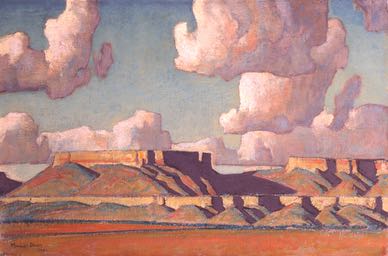
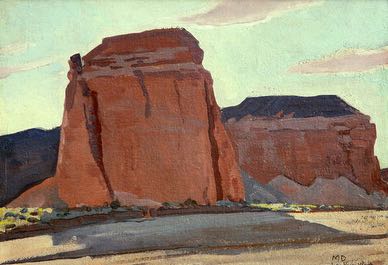
Buttes in Las Vegas depends on the balance between massive landforms and unoccupied space. Dixon’s restraint is crucial. By leaving out picturesque detail, he allowed proportion and color to suggest heat, silence, and exposure without turning the desert into an empty stage.
Who Was Dorothea Lange in Dixon’s Life and Changing Art?
Dixon married photographer Dorothea Lange in 1920. She had established a successful portrait studio in San Francisco, and the couple became part of a lively Bay Area network of artists, photographers, and writers. They had two sons and traveled together through the Southwest.
Their ways of seeing were different but increasingly connected. Dixon encouraged Lange to move beyond studio portraiture, while her alert response to contemporary life sharpened his attention to people living under economic pressure. Neither artist simply supplied the other with a style. Their exchange widened the subjects each believed serious art could address.
Time spent in Taos during 1931 and 1932 gave Dixon renewed access to New Mexico’s landscape, but the national crisis followed them. As Lange began photographing breadlines, demonstrations, and displaced laborers in San Francisco, Dixon turned from timeless-looking desert scenes toward unemployed men and public conflict. Their marriage ended in 1935, as both were entering decisive new phases of work.
How Did the Great Depression Alter His View of the Human Figure?
Dixon’s Depression paintings are among the darkest works of his career. Forgotten Man, No Place to Go, Keep Moving, and related pictures replace the active cowboy with men who wait, sit, or walk without a clear destination. Bodies become heavy shapes, and muted blues and grays suppress the bright desert palette.
These were not anonymous illustrations of an economic idea. Dixon observed San Francisco streets, labor unrest, and the growing visibility of unemployment. His figures often avoid dramatic gestures. Bent shoulders, lowered heads, worn coats, and empty surroundings communicate exhaustion more directly than an elaborate narrative would.
The series brought him near American Realism and social protest art, although it formed only a brief part of his long career. The paintings also changed how his earlier Western figures can be read. Dixon was increasingly concerned with endurance, displacement, and the difficult terms under which people occupy land.
Where Did Dixon Find a Final Home in the Desert?
In 1937, Dixon married the painter and muralist Edith Hamlin. They worked together on commissions, including murals for the Department of the Interior in Washington. Her practical support and shared artistic life became especially important as Dixon’s emphysema and other health problems worsened.
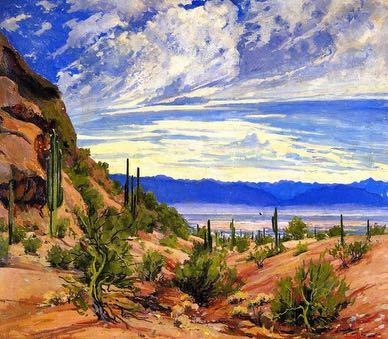
The couple established a summer home at Mount Carmel in southern Utah and a winter home in Tucson, Arizona. From Mount Carmel, Dixon could reach Zion and the plateaus, cottonwoods, cliffs, and roads of the surrounding region. In Arizona, saguaros, dry mountains, border towns, and desert light offered another landscape close at hand.
Home in the Desert, Lone Pine captures the plain architecture and open setting he valued. A small dwelling does not conquer the land; it measures human shelter against a much larger space. His late paintings grew quiet and concentrated as physical travel became more difficult.
Which Paintings Reveal the Breadth of Dixon’s Western Vision?
Dixon painted the West as landscape, workplace, homeland, memory, and modern construction. These works show how his subjects changed while the relationships among people, animals, architecture, and open space remained central:
- Buttes in Las Vegas: Simplified landforms and open atmosphere give the desert a monumental stillness.
- Home in the Desert, Lone Pine: A modest dwelling measures the scale and solitude of an arid landscape.
- Lone Pine, CA: Broad planes of color connect settlement, mountain terrain, and the clear light of the Eastern Sierra.
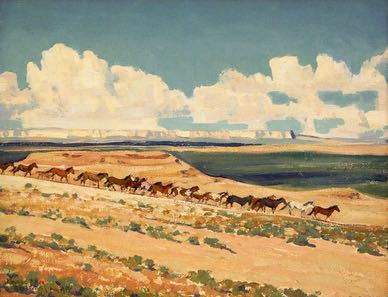
- Ponies Coming to Water: The movement of horses briefly animates a landscape governed by distance and thirst.
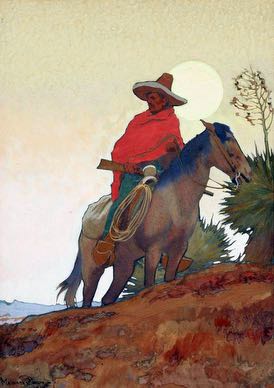
- The Insurrecto: A solitary revolutionary figure joins political history with Dixon’s strong, economical design.
- Washoe Wickiup: Shelter and surrounding land record a Native presence through an image shaped by Dixon’s outsider perspective.
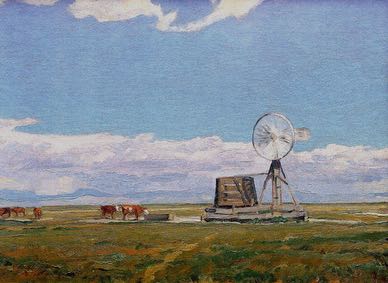
- Windmill on the Plains: A narrow human structure stands against the horizontal force of land and sky.
- Remembrance of the Tusayan: Memory simplifies place and figures into a measured composition of earthbound forms.
How Should Dixon’s Legacy in Western Art Be Understood?
Dixon died in Tucson on 11 November 1946. His ashes were later buried beneath a boulder above the Mount Carmel property, overlooking forms he had painted repeatedly. That resting place suited an artist who treated particular landscapes not as passing scenery but as sources of thought, recovery, and belonging.
His career helped move Western painting beyond the theatrical action that dominated nineteenth-century illustration. Simplified landforms, low horizons, and spacious skies made the region compatible with modern design while preserving its local color and geology. His Depression pictures also showed that Western art could address unemployment, protest, and displacement.
At the same time, Dixon’s portrayals of Native peoples must be considered within the unequal history of expansion, tourism, collecting, and cultural borrowing. They contain serious observation, but they remain interpretations made by a non-Native artist. Holding that context beside his formal achievement gives a fuller view of a painter who made the twentieth-century West appear both enduring and unsettled.
Copyright © 2026 BrushWiz. All Rights Reserved.
About Our Maynard Dixon Paintings
Are your Maynard Dixon reproductions painted by hand?
Yes. Every reproduction is individually painted by hand in oil on canvas by a professional artist. We do not use prints, digital transfers, or mechanical reproduction methods.
How closely do your Dixon copies resemble the original?
Our artists work to capture the composition, colors, brushwork, details, and visual character of the original Dixon painting as closely as possible. Because every reproduction is painted by hand, small variations are natural and make each canvas unique.
How long does a Dixon reproduction take to complete?
Most Dixon reproductions require approximately two to three weeks to paint, dry, and inspect. Production time may vary depending on the artwork and canvas size, so check the estimate displayed on the product page.
Can I request a Dixon painting that is not listed?
Yes. If you cannot find the Maynard Dixon artwork you want in our catalog, send us the painting’s title or an image. Our team will review your request and confirm the available sizes, estimated production time, and price.
Will I receive approval photos before shipping?
Yes. We send high-resolution photographs of the completed painting for your approval. You can request adjustments if needed, and the painting will not be dispatched until the review process is complete.
Are custom canvas sizes available for Dixon paintings?
Yes. We offer custom dimensions in addition to the standard sizes shown on the product page. Select the dimensions you need directly from the available size options.
May I order my Dixon painting with a frame?
Yes. High-quality frames in classic and modern designs are available for many paintings. You can view compatible framing options and add your preferred design from the product page. Professional canvas stretching is also available.
What determines the price of a Dixon reproduction?
The price depends on the selected artwork, canvas dimensions, and framing option. Choose your preferred configuration on the product page to see the current price before ordering.
Is free express worldwide shipping included?
Yes. Maynard Dixon reproductions qualify for free express worldwide shipping. After dispatch, delivery usually takes five to eight business days, although timing may vary by country and destination.
Which return policy covers Maynard Dixon reproductions?
Orders are covered by our 90-day return policy. Review the current return-policy page before ordering for complete information about eligibility, time limits, and the return process.
Why BrushWiz?
100% Hand Painted
Every piece is entirely handmade
Museum Quality
Faithfully recreated by expert artists
Custom Framing
Choose from a wide range of frames
Free Shipping
Enjoy free shipping on all orders
Cash Back Rewards
Earn cash back with every purchase