

❄️ Winter Sale. Offer Ends 11/19/2026. View Details
❄️ Winter Sale. Ends 11/19/2026. View Details
❄️ Winter Sale. View Details
Artists
Subjects
Movements
Collections
Decor
Portraits
Commissions
Framing
Reviews
Gift Cards
On Sale
Leonardo da Vinci Oil Painting Reproductions
Shop museum-quality reproductions of Leonardo da Vinci’s most famous paintings, each hand-painted in oil on canvas by a professional artist.
Shop Art
Showing 1-22 of 22 results
Sort By
Most Popular
- Most Popular
- New Arrivals
- Best Sellers
- Alphabetical A-Z
- Alphabetical Z-A





Can’t Find the Painting You Want?
Send us a reference image. We can recreate almost any artwork in the size and style you’re looking for.
Get a Free QuoteHand-Painted Leonardo da Vinci Reproductions
Bring da Vinci’s art into your home with an oil-on-canvas reproduction hand-painted by a professional artist. Our collection brings together da Vinci’s complete known body of work, including Mona Lisa, The Last Supper, and Lady with an Ermine. Discover enigmatic portraits, religious scenes, graceful figures, and carefully observed natural settings associated with da Vinci. Every reproduction is a real oil painting, offering depth and texture that a print or digital transfer cannot provide. From iconic masterpieces to lesser-known works, find a da Vinci painting that suits your space.
The Making of a Leonardo da Vinci Oil Painting Replica
Creating a Leonardo da Vinci oil painting replica requires patience, precision, and a careful understanding of the source artwork. Our studio includes artists who specialize in Renaissance painting and understand the refined qualities of Leonardo’s work. The artist studies the composition, gentle transitions between light and shadow, lifelike expressions, and carefully modeled figures before recreating them on canvas using traditional oil-painting methods. After completion, the painting is inspected by our quality-control team and photographed for your approval. The result is a carefully executed oil painting that reflects the visual character of the original.
Custom Sizes and Frames for Your da Vinci Painting
Your da Vinci painting can be ordered in practically any size, from popular standard dimensions to custom canvas sizes selected directly on the product page. This flexibility lets you choose a painting that fits your wall and complements your room. After selecting the size, you can choose from high-quality frames in classic or modern designs, with professional canvas stretching also available. Our framing options complement the balanced compositions and subtle colors of da Vinci’s paintings. With sizing, stretching, and framing arranged in one order, your artwork can arrive ready for display without a separate visit to a frame shop.
Order a Leonardo da Vinci Reproduction with Confidence
Buying hand-painted art online should feel clear and comfortable. After your Leonardo da Vinci reproduction is completed, we send high-resolution photographs for your review before shipping. You can inspect the composition, colors, facial details, and overall finish, then request adjustments if needed. The painting is dispatched only after you approve it, so you know what to expect when it arrives. Your order also includes free express worldwide shipping and is covered by our 90-day return policy. Together, these assurances help you purchase a da Vinci oil painting with greater confidence and peace of mind.
The Life and Art of Leonardo da Vinci
Leonardo da Vinci was an Italian Renaissance artist who brought painting and drawing into close contact with scientific observation and technical invention. Born near Vinci in 1452, he trained in Andrea del Verrocchio’s Florentine workshop before serving powerful patrons in Milan, Florence, Rome, and France. Only a small number of paintings are securely associated with him, but they include some of Western art’s most familiar images. Leonardo transformed Renaissance painting through subtle light, expressive gestures, and atmospheric landscapes. In thousands of notebook pages, the same searching attention turned toward anatomy, plants, water, optics, mechanics, and flight.
Read More
Who Was Leonardo da Vinci?
Leonardo was born on 15 April 1452 near Vinci, a Tuscan town west of Florence. His father was a notary named Ser Piero, and his mother was a woman named Caterina. Because they were unmarried, Leonardo spent much of his childhood within his father’s extended household. The familiar name da Vinci simply means “from Vinci,” rather than serving as a modern surname.
Painting was only one part of his working life. Leonardo drew, designed, investigated nature, and offered his abilities as an engineer and architect. He moved slowly through difficult projects, revising ideas and sometimes leaving them unfinished. Relatively few completed paintings survive, but thousands of drawings and notes preserve a mind moving between artworks, bodies, animals, plants, machines, water, and light.
Where Did Leonardo Learn to Paint?
As a young man, Leonardo entered the Florentine workshop of Andrea del Verrocchio. The busy studio produced sculpture, painting, metalwork, and decorative commissions, allowing him to learn across several practices. Leonardo joined Florence’s painters’ guild by 1472, though he continued working in connection with Verrocchio.
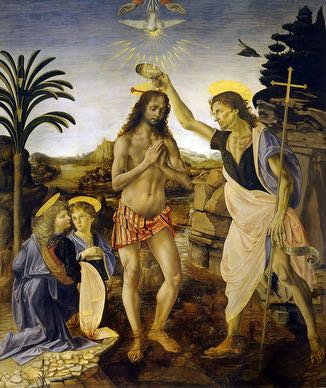
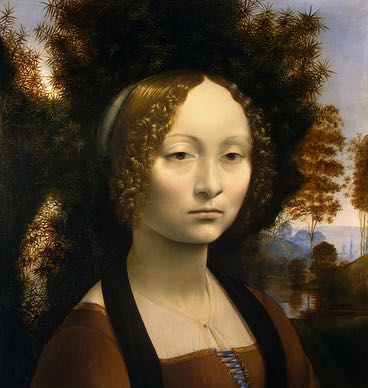
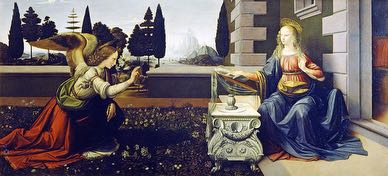
He contributed to The Baptism of Christ, made under Verrocchio’s direction. Early independent paintings include Annunciation and the portrait of Ginevra de’ Benci. Faces, plants, distant terrain, and the passage of light already receive unusually close attention.
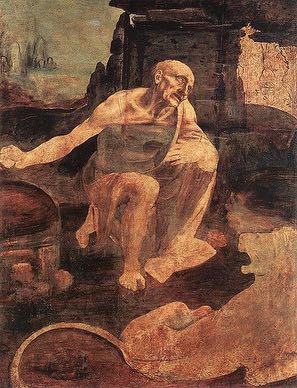
Leonardo also began ambitious works that he never completed, among them Adoration of the Magi and Saint Jerome in the Wilderness. Their exposed preparatory stages let us see him thinking through the picture. Figures shift, gestures develop, and forms gradually emerge from layers of drawing and paint.
What Roles Did Leonardo Take On in Milan?
Leonardo moved to Milan by 1483 and later entered the service of its ruler, Ludovico Sforza. He did far more than paint. Court entertainments, architecture, engineering, and plans for an enormous equestrian monument all occupied him, though the horse was never completed in bronze.
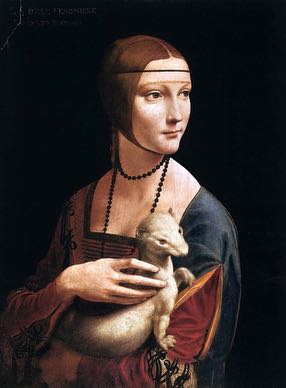
Some of Leonardo’s most important paintings belong to this first Milanese period. In Lady with an Ermine, Cecilia Gallerani turns as if someone just outside the picture has caught her attention. Her alert expression, the carefully observed animal, and the movement twisting through her body make the portrait feel suddenly alive.
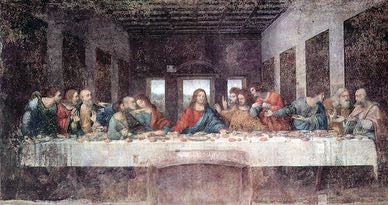
For the dining hall of Santa Maria delle Grazie, Leonardo painted The Last Supper. The mural captures the instant after Christ declares that one apostle will betray him. Each man responds differently through face and gesture, while Christ holds the still center of an intricately balanced group.
Leonardo altered the usual wall-painting method so he could work slowly and create effects closer to painting on panel. The experimental surface proved fragile and began deteriorating within decades. Long restoration history and heavy damage have not prevented The Last Supper from becoming a defining work of the fifteenth century.
Why Did Leonardo Study Nature and the Human Body?
Drawing was Leonardo’s way of thinking. He sketched to prepare paintings and test poses, but also to record expressions, understand natural forms, and explore machines that might never be built. Studies of a face, a geometric problem, flowing water, and a mechanical device can share the same sheet.
His anatomical work became remarkably detailed. Sometimes using dissections, Leonardo studied organs, bones, muscles, and bodily proportions. Anatomy was never separate from art in his mind. Understanding a body’s structure helped him explain its movement and see how a gesture could reveal an inner state.
Plants, rock formations, flight, optics, currents, weapons, and mechanical systems also drew his attention. Many designs remained on paper and were never functioning inventions. Their lasting interest lies in the method behind them: look closely, compare what changes, and use drawing to make an invisible process understandable.
The Vitruvian Man brings several of these concerns together. Its male figure occupies a circle and square while testing proportions described by the Roman architect Vitruvius. Anatomy, geometry, architecture, and ideas of ordered design meet on a single sheet.
When Did Leonardo Begin the Mona Lisa?
French forces overthrew Ludovico Sforza in 1499, bringing Leonardo’s long first stay in Milan to an end. After traveling through northern Italy, he returned to Florence in 1500. In 1502, he briefly worked for Cesare Borgia as a military architect and surveyor, examining defenses and producing maps before going back to Florence.
Leonardo began the Mona Lisa during this period. The sitter is traditionally identified as Lisa Gherardini. A gently turning pose and elusive expression connect her to a distant landscape through gradual changes of light and shadow. Leonardo continued refining the portrait for years and ultimately took it to France.
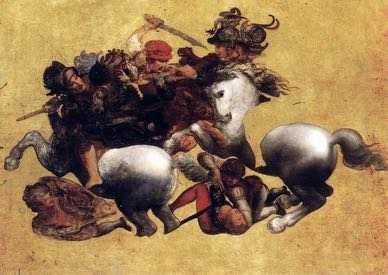
Florence also commissioned him to paint the Battle of Anghiari in the Palazzo Vecchio, with Michelangelo assigned a companion battle scene. Neither mural reached completion. Leonardo’s surviving studies and later copies nevertheless show a fierce knot of riders and horses struggling for a standard, a composition that later artists studied for its movement and conflict.
How Did Leonardo Spend His Final Years?
Leonardo returned to Milan in 1506 and worked under French rule for much of the next seven years. He continued painting, while anatomy, geology, water, mechanics, and plans for written treatises took more of his attention. The Virgin and Child with Saint Anne and Saint John the Baptist are associated with this later phase of his career.
In 1513, he entered the patronage of Giuliano de’ Medici in Rome. Leonardo remained there for about three years but found fewer major opportunities than Raphael and Michelangelo, who were already occupied with prominent papal commissions.
King Francis I invited him to France in 1516. Living near the royal residence at Amboise, Leonardo served as painter, engineer, architect, and designer. Buildings, court festivities, and other plans occupied the role more than the production of a large new group of paintings.
Leonardo died in France on 2 May 1519 at the age of 67. His pupil Francesco Melzi inherited the drawings and notebooks and tried to preserve and organize them. The papers later became dispersed, though important groups survive, including the collection at Windsor.
Why Is the Attribution of Salvator Mundi Debated?
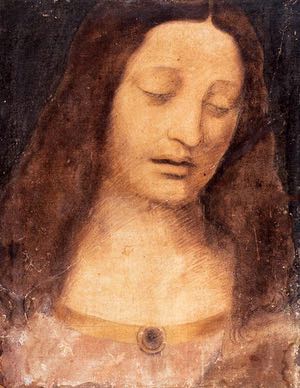
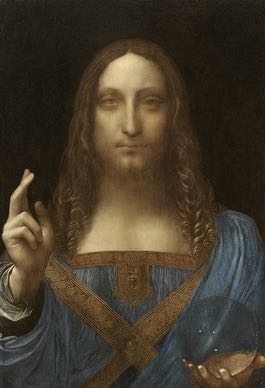
Salvator Mundi, or “Savior of the World,” shows Christ facing outward, blessing with his raised right hand and holding a transparent orb in his left. Many versions by Leonardo’s workshop and followers attest to the composition’s influence. They also complicate the effort to identify who painted each surviving example.
The version now famous worldwide resurfaced in 2005 and underwent years of restoration and examination. Presented as a rediscovered Leonardo, it appeared in the National Gallery’s 2011 exhibition of his Milanese work. Some specialists accept substantial painting by Leonardo, while others assign important passages to assistants or workshop members. Damage and extensive restoration make a firm judgment especially difficult.
Christie’s sold the painting in New York in November 2017 for $450.3 million including the buyer’s premium, then an auction record for any artwork. The extraordinary price drew worldwide attention. It could not, however, resolve the scholarly question of how much Leonardo himself contributed to the surviving surface.
Which Paintings Is Leonardo da Vinci Best Known For?
Only a small group of surviving paintings is widely accepted as Leonardo’s work, and scholars continue to debate several attributions. These are among those most closely associated with his career:
- Annunciation, about 1472–1475: The angel Gabriel approaches the Virgin Mary within a garden observed in remarkable detail.
- Ginevra de’ Benci, about 1474–1478: A reserved expression, dense juniper, and distant landscape give this early portrait its character.
- The Baptism of Christ, about 1470s: This collaborative painting from Verrocchio’s workshop includes important contributions by the young Leonardo.
- Lady with an Ermine, about 1489–1491: The sitter’s alert expression, turning body, and unusual animal companion animate this Milanese portrait.
- The Last Supper, about 1495–1498: Each apostle responds as Christ announces that one among them will betray him.
- Mona Lisa, begun about 1503: Subtle expression, atmospheric distance, and gentle tonal transitions define his most famous portrait.
- Salvator Mundi, about 1500: Christ appears as Savior of the World in a painting whose attribution remains disputed.
- The Virgin and Child with Saint Anne, mainly early sixteenth century: Glances and interlocking gestures draw the closely connected figures into a unified group.
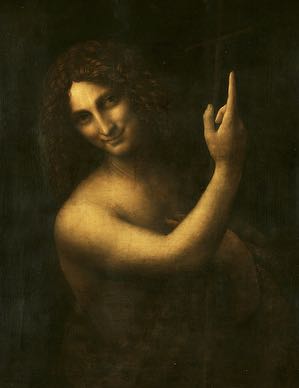
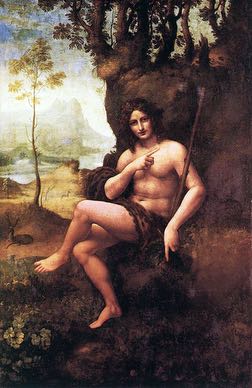
- Saint John the Baptist, probably early sixteenth century: The saint emerges from darkness with a mysterious smile and one hand pointing upward.
Leonardo’s surviving paintings account for only part of his artistic achievement. Preparatory cartoons, thousands of drawings, unfinished projects, and lost compositions preserved through copies also influenced how later artists worked and how his career is understood.
What Makes Leonardo da Vinci So Influential?
Leonardo transformed painting through patient observation and gradual transitions of tone. He allowed light and shadow to pass softly across a face, hand, or distant landscape instead of enclosing every form with a sharp line. This approach, associated with sfumato, gives his figures physical presence while leaving their thoughts difficult to read.
Movement and emotion also became matters of composition. The gestures in The Last Supper connect each apostle to the larger group. In the portraits, small turns of eyes, mouths, heads, and hands suggest a person responding to something beyond the still image. Winding water, rock, haze, and distant mountains carry the same sense of continuous change into his landscapes.
His drawings circulated among pupils and artists, and the paintings became models for expression, tonal unity, and the arrangement of figures. Painters of the High Renaissance and later generations borrowed poses and studied his ability to bring direct observation into harmony with ideal design.
Leonardo’s influence reaches well beyond painting because the notebooks show the same sustained curiosity applied to bodies, machines, optics, water, and other systems. Many projects remained incomplete, and many studies never became finished theories. What endures is the habit of using words and images together to ask how the visible world works.
Copyright © 2026 BrushWiz. All Rights Reserved.
About Our Leonardo da Vinci Paintings
Are your Leonardo da Vinci reproductions painted by hand?
Yes. Every reproduction is individually painted by hand in oil on canvas by a professional artist. We do not use prints, digital transfers, or mechanical reproduction methods.
How closely do your da Vinci copies resemble the original?
Our artists work to capture the composition, colors, texture, and visual character of the original da Vinci painting as closely as possible. Because every reproduction is painted by hand, small variations are natural and make each canvas unique.
How long does it take to complete a painting?
Most da Vinci reproductions require approximately two to three weeks to paint, dry, and inspect. Production time may vary depending on the artwork and canvas size, so check the estimate displayed on the product page.
Can I request a da Vinci painting that is not listed?
Yes. If you cannot find the Leonardo da Vinci artwork you want in our catalog, send us the painting’s title or an image. Our team will review your request and confirm the available sizes, estimated production time, and price.
Will I receive photos of my painting before it is shipped?
Yes. We send high-resolution photographs of the completed painting for your approval. You can request adjustments if needed, and the painting will not be dispatched until the review process is complete.
Can I order a custom canvas size?
Yes. We offer custom dimensions in addition to the standard sizes shown on the product page. Select the dimensions you need directly from the available size options.
Can I order my da Vinci painting with a frame?
Yes. High-quality frames in classic and modern designs are available for many paintings. You can view compatible framing options and add your preferred design from the product page. Professional canvas stretching is also available.
How much does a Leonardo da Vinci reproduction cost?
The price depends on the selected artwork, canvas dimensions, and framing option. Choose your preferred configuration on the product page to see the current price before ordering.
Do you offer free worldwide shipping?
Yes. Da Vinci reproductions qualify for free express worldwide shipping. After dispatch, delivery usually takes five to eight business days, although timing may vary by country and destination.
What is the return policy for da Vinci reproductions?
Orders are covered by our 90-day return policy. Review the current return-policy page before ordering for complete information about eligibility, time limits, and the return process.
Why BrushWiz?
100% Hand Painted
Every piece is entirely handmade
Museum Quality
Faithfully recreated by expert artists
Custom Framing
Choose from a wide range of frames
Free Shipping
Enjoy free shipping on all orders
Cash Back Rewards
Earn cash back with every purchase