

❄️ Winter Sale. Offer Ends 11/22/2026. View Details
❄️ Winter Sale. Ends 11/22/2026. View Details
❄️ Winter Sale. View Details
Artists
Subjects
Movements
Collections
Decor
Portraits
Commissions
Framing
Reviews
Gift Cards
On Sale
Claude Monet Oil Painting Reproductions
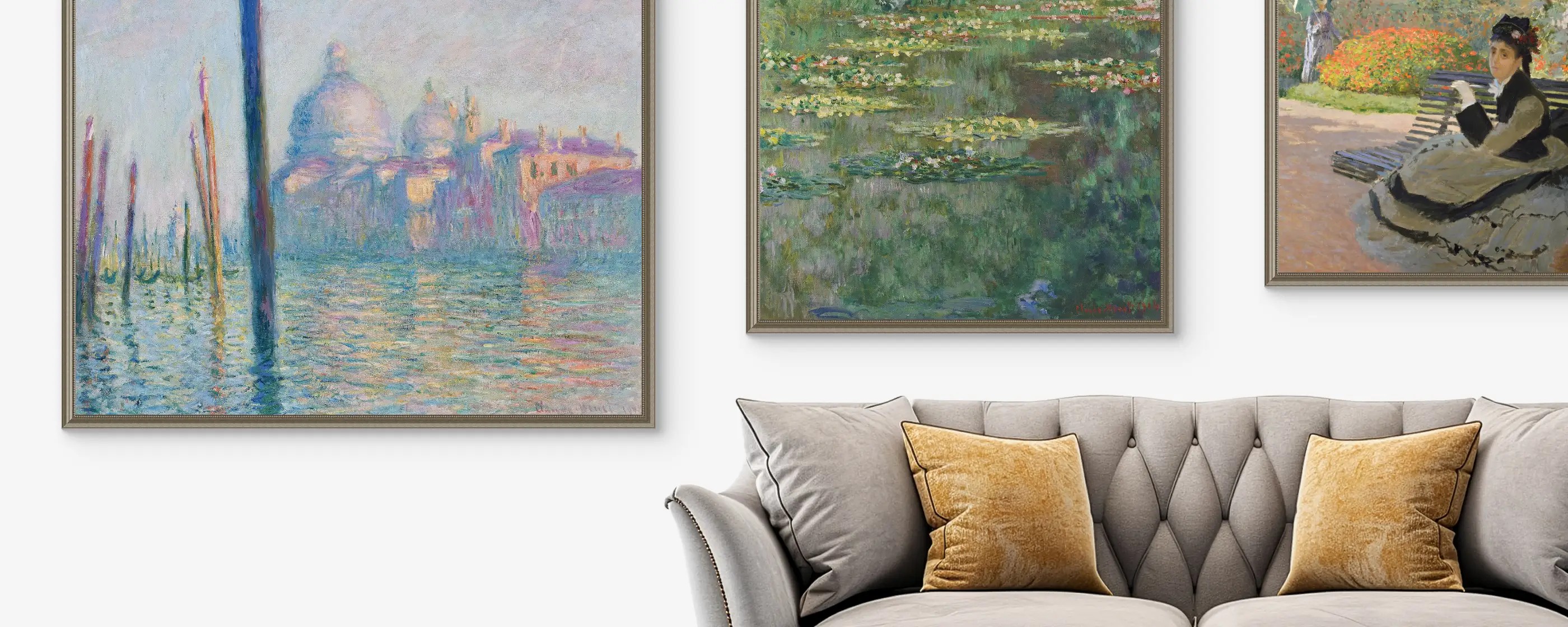
Shop museum-quality reproductions of Claude Monet’s most famous paintings, each hand-painted in oil on canvas by a professional artist.
Shop Art
Showing 1-40 of 1119 results
Sort By
Most Popular
- Most Popular
- New Arrivals
- Best Sellers
- Alphabetical A-Z
- Alphabetical Z-A


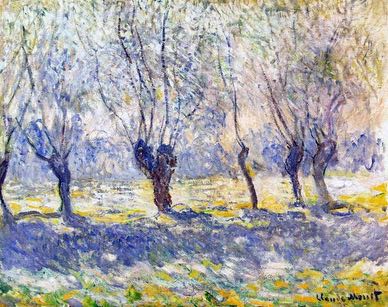
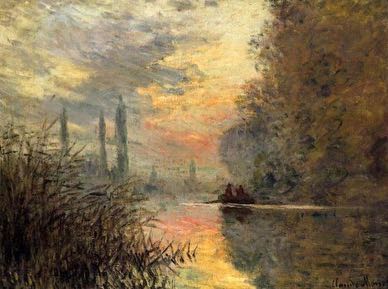
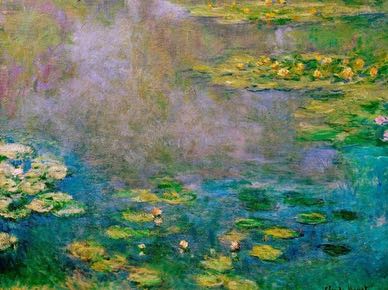

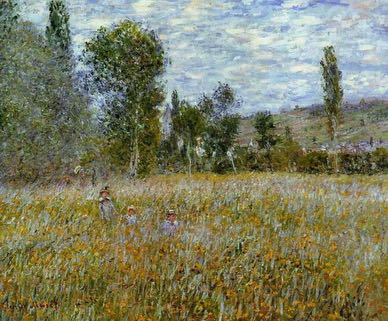
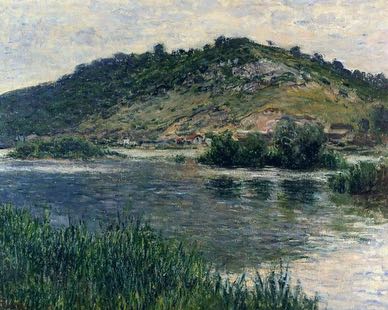
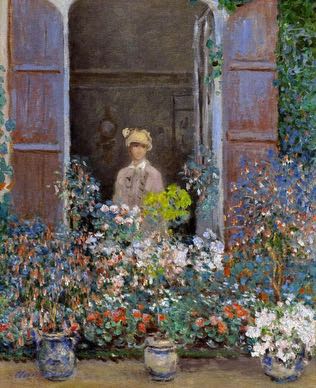
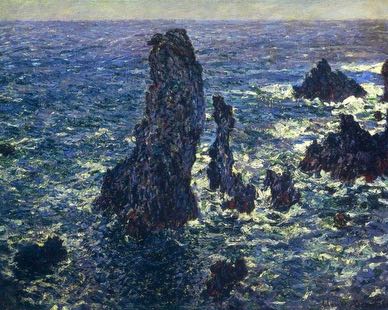




Can’t Find the Painting You Want?
Send us a reference image. We can recreate almost any artwork in the size and style you’re looking for.
Get a Free QuoteHand-Painted Claude Monet Reproductions
Bring Monet’s luminous art into your home with an oil-on-canvas reproduction hand-painted by a professional artist. Our collection features more than one thousand paintings from across his career, including Impression, Sunrise, Water Lilies, and The Japanese Bridge. Discover serene water lilies, flower-filled gardens, changing grainstacks, riverside landscapes, and other subjects closely associated with Monet. Every reproduction is a real oil painting, offering depth and texture that a print or digital transfer cannot provide. From iconic masterpieces to lesser-known works, find a Monet painting that suits your space.
The Making of a Claude Monet Oil Painting Replica
Creating a Claude Monet oil painting replica requires patience, careful observation, and an understanding of the original artwork. Our studio includes artists who specialize in Impressionist painting and understand the distinctive qualities of Monet’s work. The artist studies how Monet organized the scene and used color, light, and brushwork, then recreates these qualities on canvas using traditional oil-painting methods. After completion, the painting is inspected by our quality-control team and photographed for your approval. The result is a carefully executed oil painting that reflects the atmosphere and visual character of the original.
Custom Sizes and Frames for Your Monet Painting
Your Monet painting can be ordered in practically any size, from popular standard dimensions to custom canvas sizes selected directly on the product page. This flexibility lets you choose a painting that fits your wall and complements your room perfectly. After selecting the size, you can choose from high-quality frames in classic or modern designs, with professional canvas stretching also available. Our framing options complement the light, colors, and peaceful character of Monet’s paintings. With sizing, stretching, and framing arranged in one order, your artwork can arrive ready for display without a separate visit to a frame shop.
Order a Claude Monet Reproduction with Confidence
Buying hand-painted art online should feel clear and comfortable. After your Claude Monet reproduction is completed, we send high-resolution photographs for your review before shipping. You can inspect the composition, colors, and overall finish, then request adjustments if needed. The painting is dispatched only after you approve it, so you know what to expect when it arrives. Your order also includes free express worldwide shipping and is covered by our 90-day return policy. Together, these assurances help you purchase a Monet oil painting with greater confidence and peace of mind.
The Life and Art of Claude Monet
Claude Monet was a French painter and a leading founder of Impressionism. He became famous for landscapes, gardens, rivers, coastlines, and city views painted under changing conditions of light and weather. Rather than describe every detail precisely, Monet used color and visible brushwork to capture the atmosphere of a passing moment. Impression, Sunrise helped give the movement its name, while his later Water Lilies made his garden at Giverny one of the most recognizable subjects in art. Over a career lasting more than sixty years, Monet kept exploring how reflections, seasons, and the time of day could transform even a familiar view.
Read More
Who Was Claude Monet?
Oscar-Claude Monet was born in Paris on 14 November 1840. Five years later, his family moved to Le Havre on the Normandy coast, where his father ran a ship-supply business. The sea entered Monet’s life early: shifting weather, harbor traffic, and the long coastal horizon were part of the world he learned to look at.
As a teenager, he became locally known for charcoal caricatures of teachers, neighbors, and prominent residents. He displayed and sold them through a framing and art-supply shop in Le Havre, enjoying his first success before he had taken landscape painting seriously. It was there that an encounter with Eugène Boudin redirected him.
Caricature gradually gave way to painting. Monet would become one of the central figures in nineteenth-century French art, but he kept something of the caricaturist’s instinct: the ability to seize the feature that makes a subject immediately recognizable.
What Did Monet Learn from Eugène Boudin?
Eugène Boudin persuaded the young Monet to leave the studio and paint outdoors. Along the Normandy coast, he showed him that a landscape was never truly still. Clouds moved, reflections broke apart, and sunlight could alter the color of sea and sky within minutes.
Monet resisted at first. Landscape seemed less exciting than the sharp, profitable caricatures he already knew how to make. Once he began working outside, however, the difficulty itself caught him: instead of arranging a scene comfortably indoors, he had to respond while the conditions in front of him were changing.
Monet later spoke of Boudin as a crucial early teacher. The lesson was simple enough to last a lifetime: look closely, work before the moment passes, and trust color to carry more than description alone.
Where Did Monet Meet the Future Impressionists?
Monet went to Paris in 1859 with serious artistic ambitions but no desire for a rigid academic education. He visited exhibitions, met painters, and worked at the Académie Suisse, an informal studio where artists could draw from live models with more freedom than the official schools allowed.
Military service took him to Algeria for a time. Back in Paris, he entered Charles Gleyre’s studio and met Pierre-Auguste Renoir, Alfred Sisley, and Frédéric Bazille. Friendship mattered as much as instruction. They worked outdoors together and shared the feeling that academic formulas were poorly suited to contemporary experience.
The 1860s were a mixture of progress and strain. Monet attempted large figure paintings as well as compact landscapes, won occasional acceptance at the Paris Salon, and endured rejection, debt, and uncertain income. The lighter touch associated with his mature work was hard won, not an effortless discovery.
How Did Impression, Sunrise Give Impressionism Its Name?
During the Franco-Prussian War of 1870 and 1871, Monet lived in London. British landscape painting attracted his attention there, and he met the dealer Paul Durand-Ruel, whose support would later prove essential. On returning to France, Monet settled at Argenteuil, beside the Seine and within easy reach of Paris.
In 1874, he joined Renoir, Sisley, Camille Pissarro, Edgar Degas, Berthe Morisot, and other independent artists in an exhibition outside the official Salon. One of Monet’s entries was Impression, Sunrise, his 1872 view of Le Havre harbor.
There is remarkably little conventional description in the painting. Boats, water, mist, cranes, and chimneys hover around a small red sun, held together by quick touches of color. Critic Louis Leroy mocked the work’s title and called the exhibitors “Impressionists.” The insult stuck, then lost its sting, becoming the name by which the movement entered history.
Which Subjects Drew Monet’s Attention at Argenteuil?
Monet lived in Argenteuil from 1871 to 1878, years when the town became an informal meeting place for Impressionist painters. Renoir, Sisley, Édouard Manet, Gustave Caillebotte, and others visited or worked nearby. They did not form a school with fixed rules; they painted beside one another, borrowed ideas, and disagreed.
The Seine gave Monet boats, bridges, towpaths, gardens, and unstable reflections. It also gave him a landscape in the middle of modernization. Sailboats drift past railway bridges, while factories and new suburbs share the distance with trees. Industry was not always an intrusion in these pictures. Sometimes it was simply another shape catching the afternoon light.
Monet even used a small studio boat, putting himself directly on the water he wanted to paint. From there, shoreline and reflection could trade places. The Argenteuil canvases helped define his broken brushwork and clear color, but their freshness depends on something more basic: he kept changing where he stood.
Why Did Monet Paint the Same Subject Repeatedly?
By the 1890s, Monet was returning to the same motif with unusual persistence. These were not attempts to manufacture copies. A grainstack at dawn was not the same subject at noon, and winter fog did not leave Rouen Cathedral where summer sun had found it.
His celebrated series include grainstacks near Giverny, poplars along the Epte, and the façade of Rouen Cathedral. Monet might begin several canvases during one day, moving from one to the next as the light changed. He refined them later in the studio, trying to hold onto the atmosphere that had first distinguished each view.
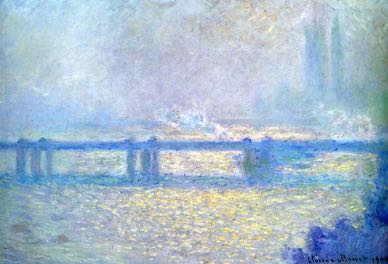
London and Venice offered different kinds of repetition. Bridges and palaces kept their outlines while fog, water, and reflected color loosened everything around them. The building may be named in the title, but the true event is the air between that building and the painter.
How Did Monet Turn His Garden at Giverny into Art?
Monet moved with his family to Giverny in 1883 and stayed there for the rest of his life. As sales brought greater security, he bought the property and reshaped its grounds over many years. The garden was not found waiting for him. It was planned, planted, revised, and then painted.
Flowerbeds were arranged with an eye to color and season. Later came the water garden: a pond, water lilies, willows, and a Japanese-style bridge. Gardeners helped maintain the site, but Monet directed its appearance with the attention of someone composing on a very large scale.
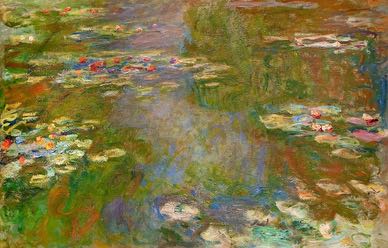
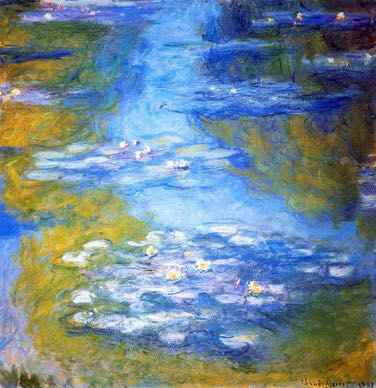
From the late 1890s onward, the pond increasingly occupied him. The Water Lilies collection eventually grew beyond 250 paintings. Early views still show the bridge and surrounding plants; others let the horizon disappear until flowers, reflected trees, clouds, and water become difficult to separate.
The later canvases grew larger and less like windows onto a distant landscape. Standing before them, the viewer has no firm bank on which to place a foot. Color and reflection spread outward, making the pond feel less pictured than entered.
Did Failing Eyesight Change Monet’s Painting?
Cataracts increasingly troubled Monet in old age, blurring detail and affecting his ability to distinguish colors. Some canvases from these years lean toward stronger reds, browns, and yellows. Eyesight mattered, but it does not explain every change. Monet was also choosing larger shapes, more forceful color, and compositions that had little need for a traditional horizon.
He underwent cataract surgery in 1923 and returned to work afterward. Painting could be difficult and frustrating, yet he continued with the monumental Water Lilies decorations that had come to dominate his final years.
After the First World War, Monet offered a group of large Water Lilies panels to France as a gesture of peace. The donation was formally arranged in 1922, and the paintings were installed according to his plans in two oval rooms at the Musée de l’Orangerie. They opened to the public in 1927, several months after his death.
Claude Monet died at Giverny on 5 December 1926. He was eighty-six and had spent more than six decades asking how paint could hold an experience that was already changing.
Which Paintings Is Claude Monet Best Known For?
Monet’s long career cannot be reduced to one garden. These paintings follow his path from the harbors and fields of the 1870s to the enveloping water surfaces of his last decades:
- Impression, Sunrise, 1872: A harbor assembled from mist, abbreviated boats, and a red sun gave Impressionism its accidental name.
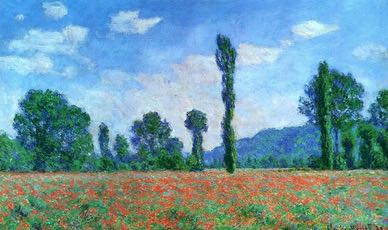
- Poppies, 1873: Figures descend through a field where scattered red flowers punctuate the green slope.
- Woman with a Parasol, 1875: Camille Monet and their son Jean are caught from below as wind presses through dress, veil, grass, and cloud.
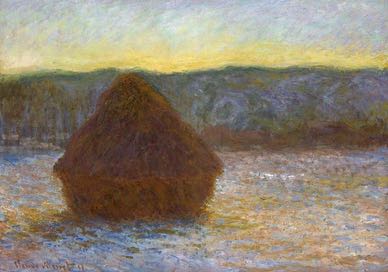
- Grainstacks, 1890–1891: One rural motif becomes many paintings as season, weather, and the angle of light alter its presence.
- Rouen Cathedral: Portal in the Sun, 1890s: Stone seems to dissolve into colored light across Monet’s repeated views of the façade.
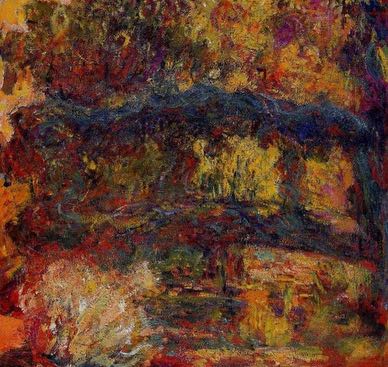
- The Japanese Bridge: The Water-Lily Pond, 1899: The bridge curves over the garden Monet designed, joining cultivated nature to its painted reflection.
- Water Lilies: Flowers, sky, trees, and water meet on a surface that can feel at once shallow and immeasurably deep.
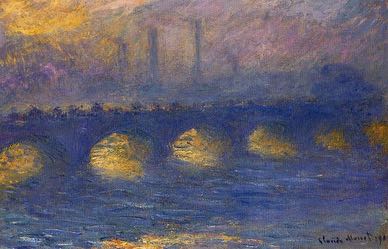
- Waterloo Bridge, London: Bridge and river repeatedly emerge from, and nearly vanish into, the city’s shifting fog.
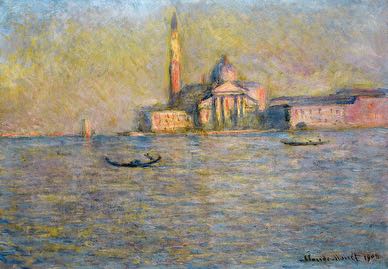
- San Giorgio Maggiore at Dusk, 1908: The Venetian church and skyline hover between glowing sky and their darker reflection.
Why Is Claude Monet So Influential?
Monet changed landscape painting by refusing to treat a view as a fixed inventory of objects. Its appearance depended on weather, season, hour, and the position of the observer. Return tomorrow, or turn slightly, and the painting had to begin again.
His visible brushwork challenged the smooth finish valued by academic institutions. Individual marks do not describe every leaf, ripple, or stone, yet together they recreate the experience of looking. Impressionism took much of its visual identity from that wager.
The series carried the idea further. Grainstacks, poplars, Rouen Cathedral, London bridges, and Water Lilies demonstrate that repetition can reveal difference. The motif remains in place while nearly everything that determines how it is seen keeps moving.
Monet’s late Water Lilies became especially important to twentieth-century artists. Their scale, open composition, and emphasis on color and surface anticipated aspects of abstraction and immersive art. Yet the paintings never entirely release the visible world. However far Monet pushed reflection toward abstraction, a flower, cloud, or patch of sky could still bring the eye back to Giverny.
Copyright © 2026 BrushWiz. All Rights Reserved.
About Our Claude Monet Paintings
Are your Claude Monet reproductions painted by hand?
Yes. Every reproduction is individually painted by hand in oil on canvas by a professional artist. We do not use prints, digital transfers, or mechanical reproduction methods.
How closely do your Monet copies resemble the original?
Our artists work to capture the composition, colors, atmosphere, reflections, and visual character of the original Monet painting as closely as possible. Because every reproduction is painted by hand, small variations are natural and make each canvas unique.
How long does it take to complete a painting?
ost Monet reproductions require approximately two to three weeks to paint, dry, and inspect. Production time may vary depending on the artwork and canvas size, so check the estimate displayed on the product page.
Can I request a Monet painting that is not listed?
Yes. If you cannot find the Claude Monet artwork you want in our catalog, send us the painting’s title or an image. Our team will review your request and confirm the available sizes, estimated production time, and price.
Will I receive photos before my painting is shipped?
Yes. We send high-resolution photographs of the completed painting for your approval. You can request adjustments if needed, and the painting will not be dispatched until the review process is complete.
Are custom canvas sizes available?
Yes. We offer custom dimensions in addition to the standard sizes shown on the product page. Select the dimensions you need directly from the available size options.
Is framing available for Monet paintings?
Yes. High-quality frames in classic and modern designs are available for many paintings. You can view compatible framing options and add your preferred design from the product page. Professional canvas stretching is also available.
What does a Claude Monet reproduction cost?
The price depends on the selected artwork, canvas dimensions, and framing option. Choose your preferred configuration on the product page to see the current price before ordering.
Do you offer free worldwide shipping?
Yes. Monet reproductions qualify for free express worldwide shipping. After dispatch, delivery usually takes five to eight business days, although timing may vary by country and destination.
What is the return policy for Monet reproductions?
Orders are covered by our 90-day return policy. Review the current return-policy page before ordering for complete information about eligibility, time limits, and the return process.
Why BrushWiz?
100% Hand Painted
Every piece is entirely handmade
Museum Quality
Faithfully recreated by expert artists
Custom Framing
Choose from a wide range of frames
Free Shipping
Enjoy free shipping on all orders
Cash Back Rewards
Earn cash back with every purchase