
❄️ Winter Sale. Offer Ends 11/20/2026. View Details
❄️ Winter Sale. Ends 11/20/2026. View Details
❄️ Winter Sale. View Details
Artists
Subjects
Movements
Collections
Decor
Portraits
Commissions
Framing
Reviews
Gift Cards
On Sale
Franz Marc Oil Painting Reproductions
Shop museum-quality reproductions of Franz Marc’s most famous paintings, each hand-painted in oil on canvas by a professional artist.
Shop Art
Showing 1-40 of 309 results
Sort By
Most Popular
- Most Popular
- New Arrivals
- Best Sellers
- Alphabetical A-Z
- Alphabetical Z-A
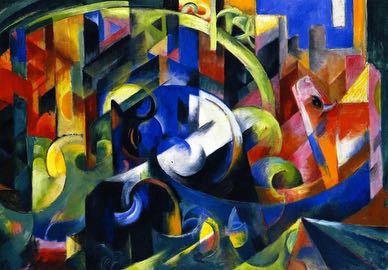
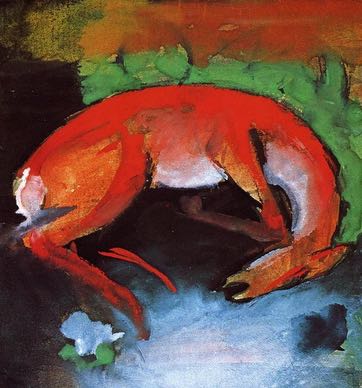
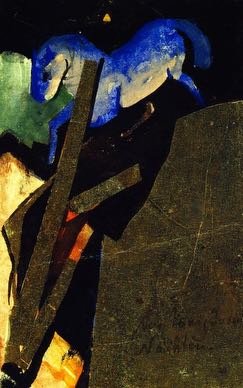
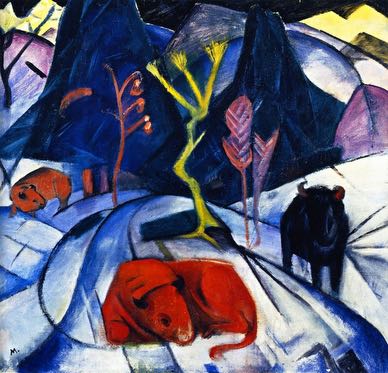
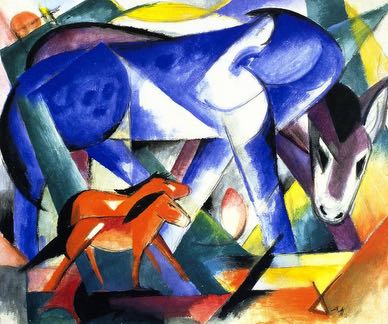
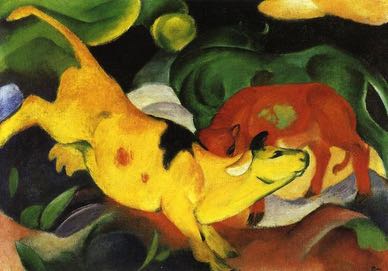
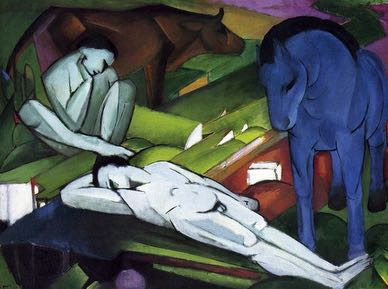
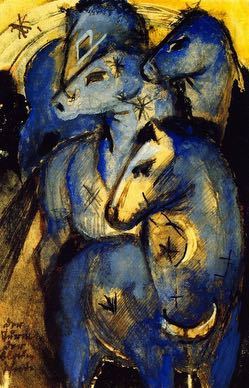
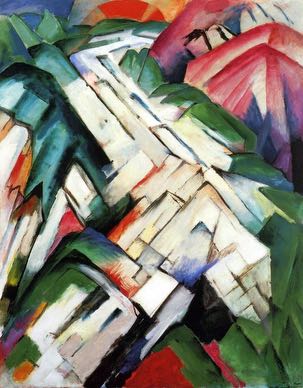
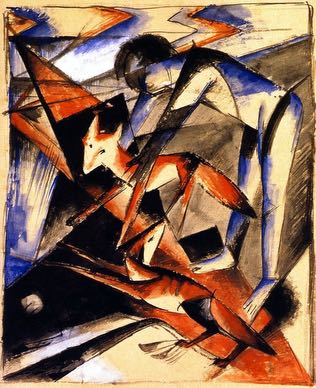
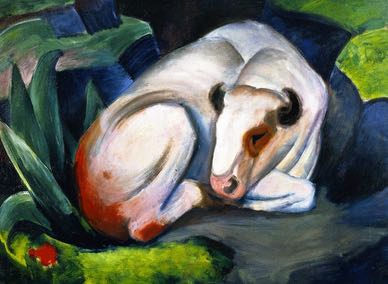
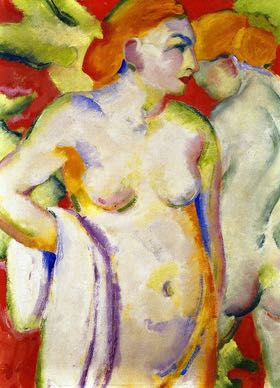
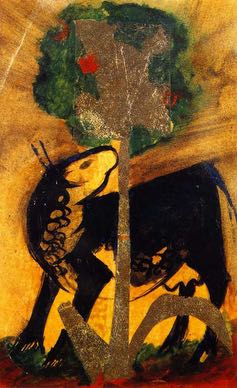
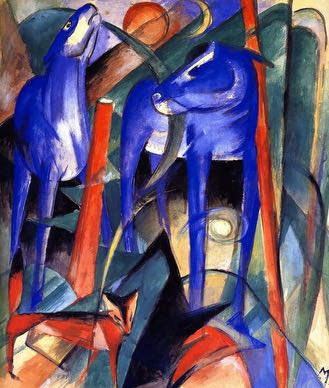
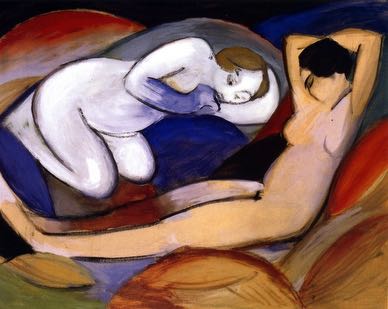
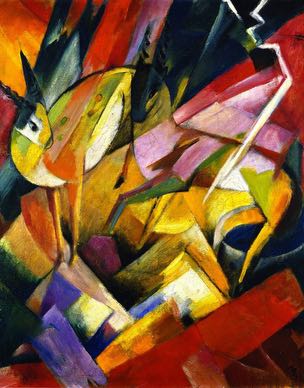



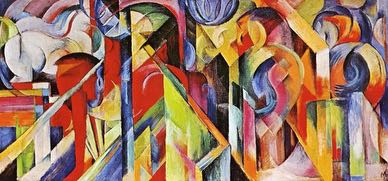
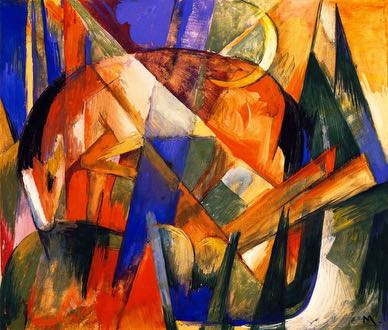
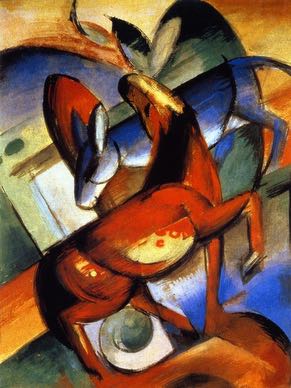


Can’t Find the Painting You Want?
Send us a reference image. We can recreate almost any artwork in the size and style you’re looking for.
Get a Free QuoteHand-Painted Franz Marc Reproductions
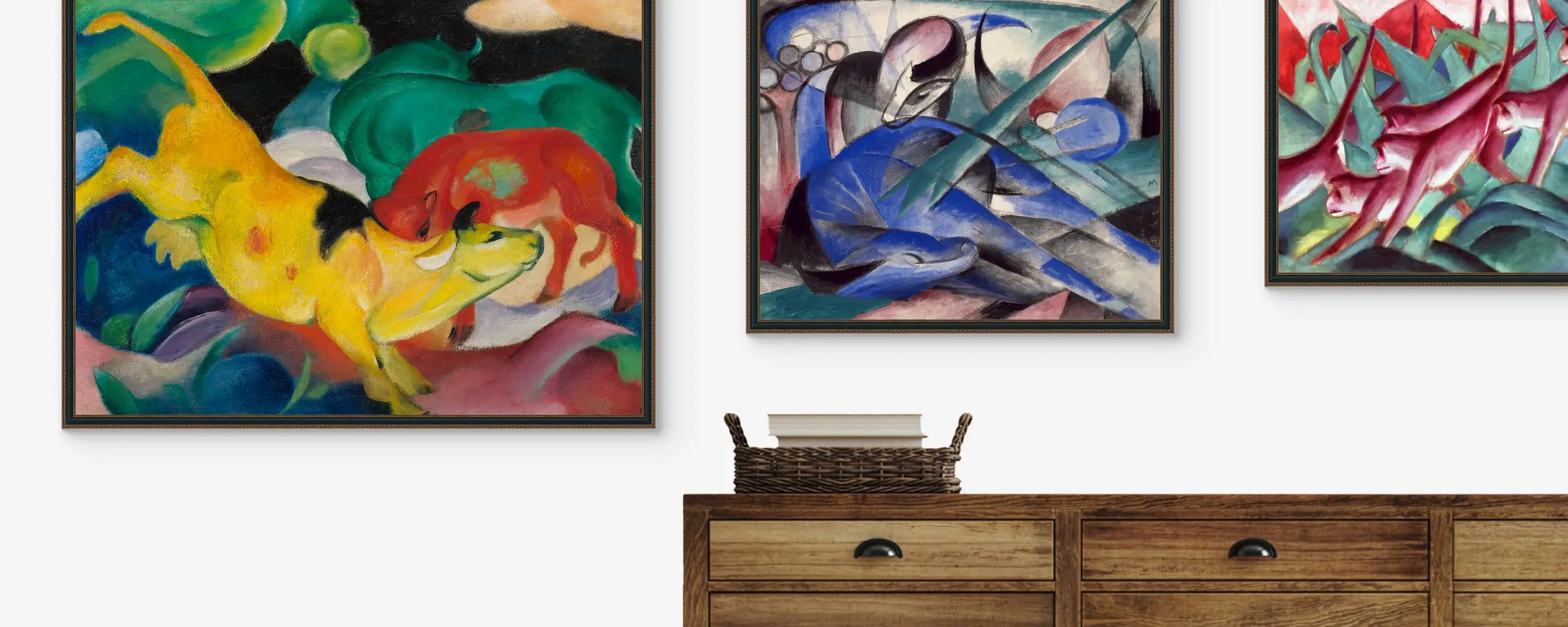
Bring Marc’s brilliantly colored animal world into your home with an oil-on-canvas reproduction hand-painted by a professional artist. Our collection features hundreds of paintings from across his career, including Blue Horse I, The Yellow Cow, and Fate of the Animals. Discover blue horses, red deer, yellow cattle, foxes, tigers, and increasingly abstract interpretations of nature closely associated with Marc. Every reproduction is a real oil painting, offering depth and texture that a print or digital transfer cannot provide. From iconic masterpieces to lesser-known works, find a Marc painting that suits your space.
The Making of a Franz Marc Oil Painting Replica
Creating a Franz Marc oil painting replica requires patience, precision, and an understanding of the original artwork. Our studio includes artists who specialize in Expressionist painting and understand the distinctive qualities of Marc’s work. Before painting begins, the artist studies the source image, paying close attention to its vivid color contrasts, simplified animal forms, interlocking planes, and Marc’s rhythmic integration of animals with their surroundings. These elements are recreated by hand in oil on canvas. Once complete, the painting is inspected by our quality-control team and photographed for your approval.
Custom Sizes and Frames for Your Marc Painting
Your Marc painting can be ordered in practically any size, from popular standard dimensions to custom canvas sizes selected directly on the product page. This flexibility lets you choose a painting that fits your wall and complements your room perfectly. After selecting the size, you can choose from high-quality frames in classic or modern designs, with professional canvas stretching also available. Our framing options complement the simplified forms, and expressive character of Marc’s paintings. With sizing, stretching, and framing arranged in one order, your artwork can arrive ready for display without a separate visit to a frame shop.
Order a Franz Marc Reproduction with Confidence
Buying hand-painted art online should feel clear and comfortable. After your Franz Marc reproduction is completed, we send high-resolution photographs for your review before shipping. You can inspect the composition, colors, and overall finish, then request adjustments if needed. The painting is dispatched only after you approve it, so you know what to expect when it arrives. Your order also includes free express worldwide shipping and is covered by our 90-day return policy. Together, these assurances help you purchase a Marc oil painting with greater confidence and peace of mind.
The Life and Art of Franz Marc
Franz Marc was a German Expressionist painter, printmaker, and art theorist who gave animal subjects new force through symbolic color, simplified forms, and increasingly abstract compositions. Born in Munich in 1880, he studied at the city’s Academy of Fine Arts before making animals and nature the center of his work. Marc believed that painting could reveal an inner or spiritual reality rather than simply record outward appearances. His friendship with Wassily Kandinsky and his leading role in the Blue Rider placed him at the heart of modern German art. His career ended during the First World War, but his blue horses, yellow cattle, and fractured landscapes remain immediately recognizable.
Read More
Who Was Franz Marc?
Franz Moritz Wilhelm Marc was born in Munich on 8 February 1880. His father, Wilhelm Marc, painted landscapes and genre scenes, while his mother, Sophie, came from a French-speaking Protestant family. Art, religious thought, and intellectual discussion were familiar parts of his childhood.
Marc initially considered studying theology and philosophy. After military service, however, he chose art and entered the Munich Academy of Fine Arts in 1900. The portraits, landscapes, figure studies, and rural scenes of these early years give little indication of the vivid animal paintings for which he would become known.
His working life was brief and unusually concentrated. From about 1907 until the First World War, Marc moved rapidly from close observation toward a personal form of abstraction. Animals became more than subjects. Through them, he explored the relationships between color, movement, the natural world, and the possibility of spiritual renewal.
What Led Marc Beyond His Academic Training?
Marc studied at the Munich Academy from 1900 to 1902, learning drawing, anatomy, and established painting traditions. Its conservative outlook soon frustrated him. After leaving, he pursued his education independently through travel, close looking, and long periods of work in the Bavarian countryside.
Visits to Paris in 1903 and 1907 introduced him to major developments in French art. The work of Vincent van Gogh and Paul Gauguin showed how strong colors and simplified forms could move beyond academic naturalism. Marc began to understand color as a source of structure and emotion, not merely a means of copying what stood before him.
He worked throughout the Bavarian Alpine foothills, including Kochel, Lenggries, Sindelsdorf, and the Staffelalm. Farms, mountains, forests, snow, and grazing animals filled his visual world. During the summer of 1908, while staying in Lenggries with the artist Maria Franck, Marc began developing the grouped horse compositions that would become central to his mature work.
Why Did Animals Become Marc’s Central Subject?
By around 1910, animals dominated Marc’s painting. His subjects included horses, cattle, dogs, cats, sheep, deer, foxes, tigers, and monkeys. He studied how they were built and how they moved, but accurate anatomy was only a starting point. Marc wanted to imagine an animal’s experience of its surroundings and bind creature and landscape into a single design.
He saw animals as possessing a direct relationship with nature that modern human society had lost. This belief could be idealized, yet it shaped his art profoundly. The animal is rarely a possession or a decorative detail in these paintings. It occupies the center of the scene, alert to or completely absorbed in the world around it.
In paintings of deer, tigers, foxes, and other wildlife, the surrounding landscape often seems to grow from the body itself. A curved back may repeat the shape of a hill; angular legs meet branches and intersecting planes. Such echoes suggest a natural order in which no living form exists alone.
What Did Color Mean in Franz Marc’s Paintings?
Marc gradually released color from the appearance of fur, fields, and trees. Blue horses, yellow cows, red deer, and violet or green landscapes allowed him to build each picture through contrast and balance. These choices were deliberate, part of a symbolic language that was still developing as he worked.
Writing to his friend August Macke, Marc associated blue with spirituality and severity, yellow with gentleness and sensuality, and red with materiality and violence. These were personal and historically specific ideas rather than a fixed code that unlocks every canvas.
Color also has a purely visual job in Marc’s work. Complementary contrasts create energy, repeated tones join an animal to its setting, and broad areas keep increasingly complicated scenes coherent. In Fighting Cows, the differently colored bodies circle around one another while the landscape adds to the tension.
How Did Marc Help Shape the Blue Rider?
Marc met August Macke early in 1910, beginning a friendship grounded in their shared interest in modern color. Later that year, his public defense of the New Artists’ Association of Munich brought him into contact with its members, among them Wassily Kandinsky.
Marc and Kandinsky soon became close collaborators. When disagreements split the association in 1911, they organized an independent exhibition that became known as the first Blue Rider show. It opened in Munich that December, bringing together artists with very different styles but a common interest in expressive color, spiritual experience, and artistic freedom.
The Blue Rider never imposed a single technique. Its exhibitions mixed paintings, drawings, prints, folk images, work connected with music, and art from many traditions. August Macke, Gabriele Münter, Paul Klee, Alexej von Jawlensky, Marianne von Werefkin, Robert Delaunay, and Henri Rousseau were among its participants and associates.
Marc and Kandinsky also edited the Blue Rider Almanac, published in 1912. Essays and musical examples appeared beside modern European art, folk objects, and children’s drawings. In his writing, Marc called for an art that could move beneath material appearances and express deeper bonds between people, animals, nature, and the spiritual world.
Which Modern Movements Changed Marc’s Style?
After 1911, Marc’s paintings became more angular and tightly structured. Cubism, Italian Futurism, and the color-based abstraction of Robert Delaunay each offered useful possibilities. Overlapping planes divided bodies and landscapes, while repeated curves and diagonals set the whole surface in motion.
Marc and Macke visited Delaunay in Paris in 1912. His translucent colors, circular rhythms, and fractured space suggested how firm structure could coexist with expressive intensity. Marc adapted these ideas to his own animals and landscapes, keeping the natural world as his point of departure.
In Tiger, sharp planes construct the crouching body and continue into its surroundings. The animal remains clearly visible, yet pose and setting now belong to the same tense structure. Later paintings pushed this fusion further until animal, landscape, movement, and color could no longer be easily separated.
When Did Marc’s Art Approach Complete Abstraction?
Between 1912 and 1914, Marc’s compositions grew denser and more fragmented, with animals becoming harder to distinguish. Nature remained his starting point. What changed was his effort to paint the forces and connections he believed existed beneath its visible surface.
In Fate of the Animals, painted in 1913, creatures and landscape break apart within a violent web of diagonals. Its turbulence is far removed from the calm unity of his earlier horses and deer. The work has often been read as a prophecy of war, although Marc developed its original meaning before the conflict began.
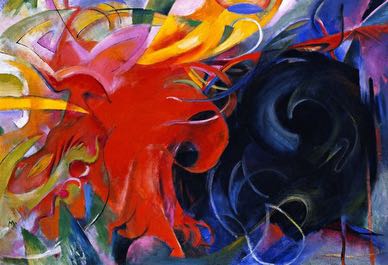
By 1914, Fighting Forms had moved close to complete abstraction. Sweeping areas of red, blue, green, and yellow collide without resolving into a recognizable animal. Their organic tension and curving motion nevertheless retain something of the bodies and landscapes that shaped Marc’s earlier art.
What Became of Franz Marc During the First World War?
Marc entered military service when war began in August 1914. Like a number of European artists and intellectuals, he initially imagined that the conflict might clear away an exhausted social order and allow cultural renewal. The reality he encountered quickly challenged that hope.
August Macke’s death in September 1914 affected him deeply. Marc continued to write and draw at the front, filling what became known as his Sketchbook from the Field with thirty-six compact images. Animals, fragments of landscape, and abstract forms appear within the tight limits imposed by military life.
Marc was killed on 4 March 1916 while conducting reconnaissance near Verdun. He was 36. In little more than a decade, his art had traveled from academic studies through symbolic animal painting to the edge of abstraction.
Maria Franck-Marc took responsibility for his estate. By organizing the surviving work and supporting publications and exhibitions, she helped preserve the record through which later audiences came to understand his career.
Which Paintings Is Franz Marc Best Known For?
Marc’s major paintings reveal how quickly his treatment of animals, landscape, color, and abstraction changed between 1910 and 1914:
- Blue Horse I, 1911: A solitary horse with simplified contours stands against a bright landscape organized through color and rhythm.
- The Large Blue Horses, 1911: Three curving bodies form a close group, their shapes repeated in the hills around them.
- The Yellow Cow, 1911: A brilliantly colored cow leaps through a landscape of rounded forms and strong contrasts.
- Fighting Cows, 1911: Interlocking bodies and symbolic colors turn physical conflict into a circular visual rhythm.
- Tiger, 1912: Angular planes join the crouching animal to a fractured and tense environment.
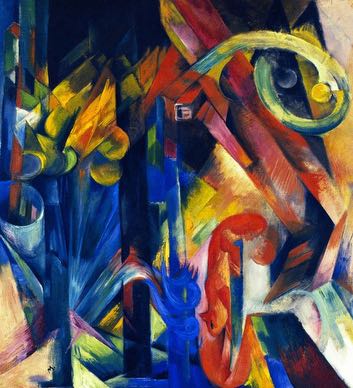
- Foxes, 1913: Intersecting facets break apart the animals and merge them with the space around them.
- Fate of the Animals, 1913: Forceful diagonals and splintered forms trap animals and landscape within the same turbulent structure.
- The Tower of Blue Horses, 1913: Four horses rise in a vertical formation surrounded by increasingly abstract color and pattern.
- The Mandrill, 1913: Broken planes and strong contrasts alternately reveal and conceal the animal in its setting.
- Fighting Forms, 1914: Large, curving masses of color confront one another in one of Marc’s most completely abstract paintings.
Why Does Franz Marc Remain Influential?
Marc made animals the focus of serious modern experimentation rather than treating them as decoration or exercises in naturalistic description. His paintings invite viewers to imagine nature outside an exclusively human point of view. Body, landscape, and color become elements of one living system.
His work with Kandinsky and the Blue Rider placed him at the center of early twentieth-century art. The group looked widely, finding value in abstraction, music, folk traditions, children’s drawings, and art beyond Europe. That openness helped expand modern ideas about where artistic meaning could be found.
The Nazi regime later condemned Marc’s work as “degenerate” and removed approximately 130 pieces from German public collections. The campaign failed to erase his reputation, and museums eventually restored him to a central place in German modernism.
Marc’s approach continues to resonate in symbolic color, expressive animal imagery, and abstract treatments of nature. His blue horses, yellow cattle, red deer, and splintered landscapes remain unmistakable because their visual force is inseparable from his distinctive view of the natural world.
Copyright © 2026 BrushWiz. All Rights Reserved.
About Our Franz Marc Paintings
Are your Franz Marc reproductions painted by hand?
Yes. Every reproduction is individually painted by hand in oil on canvas by a professional artist. We do not use prints, digital transfers, or mechanical reproduction methods.
How closely do your Marc copies resemble the original?
Our artists work to capture the composition, colors, texture, and visual character of the original Marc painting as closely as possible. Because every reproduction is painted by hand, small variations are natural and make each canvas unique.
How long does it take to complete a painting?
Most Marc reproductions require approximately two to three weeks to paint, dry, and inspect. Production time may vary depending on the artwork and canvas size, so check the estimate displayed on the product page.
Can I request a Marc painting that is not listed?
Yes. If you cannot find the Franz Marc artwork you want in our catalog, send us the painting’s title or an image. Our team will review your request and confirm the available sizes, estimated production time, and price.
Will I receive photos of my painting before it is shipped?
Yes. We send high-resolution photographs of the completed painting for your approval. You can request adjustments if needed, and the painting will not be dispatched until the review process is complete.
Are custom canvas sizes available?
Yes. We offer custom dimensions in addition to the standard sizes shown on the product page. Select the dimensions you need directly from the available size options.
Can I order my Marc painting with a frame?
Yes. High-quality frames in classic and modern designs are available for many paintings. You can view compatible framing options and add your preferred design from the product page. Professional canvas stretching is also available.
How much does a Franz Marc reproduction cost?
The price depends on the selected artwork, canvas dimensions, and framing option. Choose your preferred configuration on the product page to see the current price before ordering.
Do you offer free worldwide shipping?
Yes. Marc reproductions qualify for free express worldwide shipping. After dispatch, delivery usually takes five to eight business days, although timing may vary by country and destination.
What is the return policy for Marc reproductions?
Orders are covered by our 90-day return policy. Review the current return-policy page before ordering for complete information about eligibility, time limits, and the return process.
Why BrushWiz?
100% Hand Painted
Every piece is entirely handmade
Museum Quality
Faithfully recreated by expert artists
Custom Framing
Choose from a wide range of frames
Free Shipping
Enjoy free shipping on all orders
Cash Back Rewards
Earn cash back with every purchase