
❄️ Winter Sale. Offer Ends 11/26/2026. View Details
❄️ Winter Sale. Ends 11/26/2026. View Details
❄️ Winter Sale. View Details
Artists
Subjects
Movements
Collections
Decor
Portraits
Commissions
Framing
Reviews
Gift Cards
On Sale
Robert Delaunay Oil Painting Reproductions
Shop museum-quality reproductions of Robert Delaunay’s most famous paintings, each hand-painted in oil on canvas by a professional artist.
Shop Art
Showing 1-40 of 126 results
Sort By
Most Popular
- Most Popular
- New Arrivals
- Best Sellers
- Alphabetical A-Z
- Alphabetical Z-A



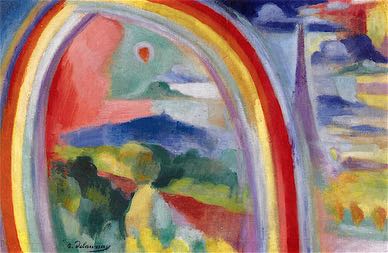

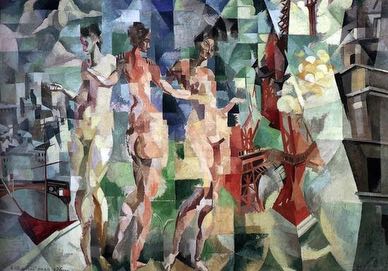
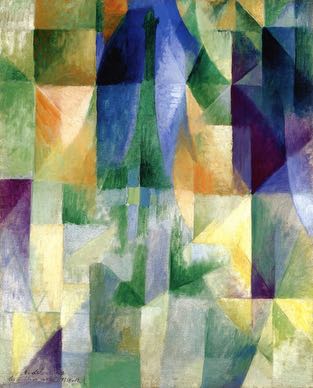
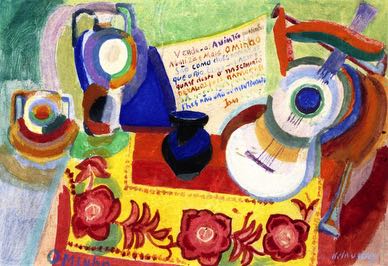




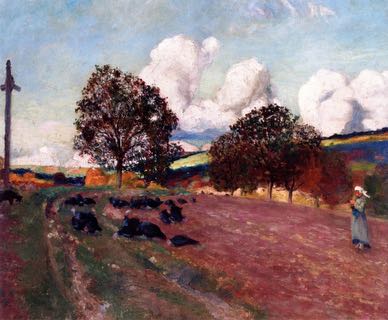
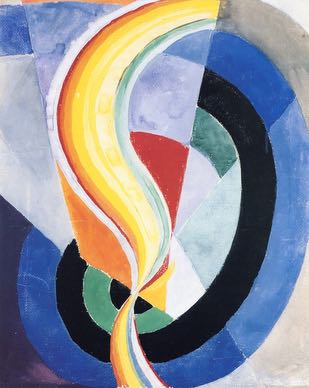

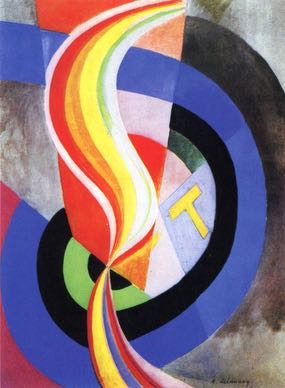
Can’t Find the Painting You Want?
Send us a reference image. We can recreate almost any artwork in the size and style you’re looking for.
Get a Free QuoteHand-Painted Robert Delaunay Reproductions
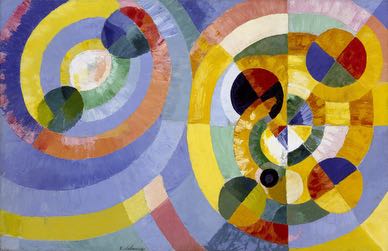
Bring Delaunay’s art into your home with an oil-on-canvas reproduction hand-painted by a professional artist. Our collection features more than one hundred paintings from across his career, including Eiffel Tower, The Cardiff Team, and Circular Forms. Discover fragmented city views, windows, towers, rotating disks, athletic scenes, and other subjects closely associated with Delaunay. Every reproduction is a real oil painting, offering depth and texture that a print or digital transfer cannot provide. From iconic masterpieces to lesser-known works, find a Delaunay painting that suits your space.
The Making of a Robert Delaunay Oil Painting Replica
Creating a Robert Delaunay oil painting replica requires patience, precision, and an understanding of the original artwork. Our studio includes artists who specialize in Orphist painting and understand the distinctive qualities of Delaunay’s work. The artist studies the source image, then recreates its interlocking color planes, fragmented architecture, circular rhythms, and Delaunay’s carefully balanced contrasts using traditional oil-painting methods. After completion, the painting is inspected by our quality-control team and photographed for your approval. The result is a carefully executed oil painting that reflects the energy and visual character of the original.
Custom Sizes and Frames for Your Delaunay Painting
Your Delaunay painting can be ordered in practically any size, from popular standard dimensions to a custom canvas size selected directly on the product page. This flexibility lets you choose a painting that fits your wall and complements your room perfectly. After selecting the size, you can choose from high-quality frames in classic or modern designs, with professional canvas stretching also available. Our framing options complement the radiant colors and geometric rhythms of Delaunay’s paintings. With sizing, stretching, and framing arranged in one order, your artwork can arrive ready for display without a separate visit to a frame shop.
Order a Robert Delaunay Reproduction with Confidence
Buying hand-painted art online should feel clear and comfortable. After your Robert Delaunay reproduction is completed, we send high-resolution photographs for your review before shipping. You can inspect the composition, colors, and overall finish, then request adjustments if needed. The painting is dispatched only after you approve it, so you know what to expect when it arrives. Your order also includes free express worldwide shipping and is covered by our 90-day return policy. Together, these assurances help you purchase a Delaunay oil painting with greater confidence and peace of mind.
The Life and Art of Robert Delaunay
Robert Delaunay was a French painter and a pioneer of Orphism, an early form of abstraction driven by color, light, and movement. Born in Paris in 1885, he moved from Neo-Impressionist color experiments and Cubist structure toward paintings in which contrasting hues do most of the constructive work. The Eiffel Tower, Parisian architecture, windows, aviation, sport, and spinning disks kept his art closely tied to modern urban life even as it approached complete abstraction. In a long creative dialogue with Sonia Delaunay, he developed theories of simultaneous color that reached artists across Europe. His later architectural projects carried those ideas into public space and confirmed his importance to twentieth-century abstract art.
Read More
Who Was Robert Delaunay?
Robert Victor Félix Delaunay was born in Paris on 12 April 1885. After his parents separated, relatives near Bourges largely raised him. His path into painting was not conventionally academic. Delaunay trained instead in a theater-design workshop, where work with large surfaces, decorative color, and staged effects prepared him for an art that would eventually exceed the scale of the easel.
Delaunay became a central figure in the Parisian avant-garde before the First World War. Recognizable portraits and landscapes gradually gave way to fractured cities, translucent windows, and abstract fields of colored disks. His work intersected with Cubism, but light and color became structural forces rather than additions to line and modeled volume.
How Did Delaunay Find His Way toward Cubism?
From about 1902 to 1904, Delaunay worked in Eugène Ronsin’s theatrical design studio in Belleville. The job gave him practical experience of decorative production, though as a painter he was mostly self-taught. In 1904, the open Salon des Indépendants gave him an early chance to show his work publicly beyond the official Salon system.
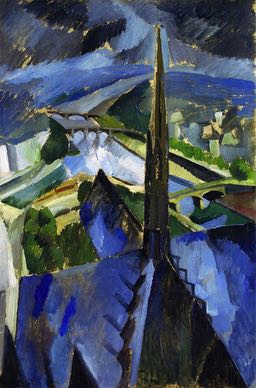
Impressionist light and the separated marks of Neo-Impressionism appear in his first landscapes. The color research of Georges Seurat and Paul Signac led him to consider how neighboring hues change one another in the eye. Fauvism’s increasingly independent color and the constructive example of Paul Cézanne offered further possibilities.
No single style held Delaunay for long. His Brittany landscapes, early portraits, and Parisian views became a laboratory for firmer surfaces and stronger contrasts. By the decade’s end, modern architecture and the city itself allowed him to bring recognizable space into contact with a radical new kind of pictorial structure.
The great Cézanne retrospective held in Paris in 1907 deepened Delaunay’s interest in simplifying objects into connected planes and constructing form with color. Soon, streets, buildings, and distant horizons broke into facets. Yet unlike the muted grays and browns of much early Cubism, increasingly vivid hues remained essential to his pictures.
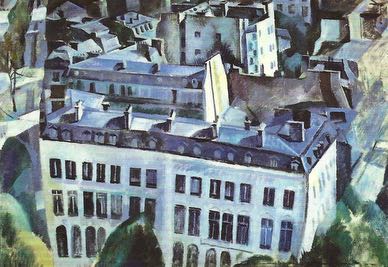
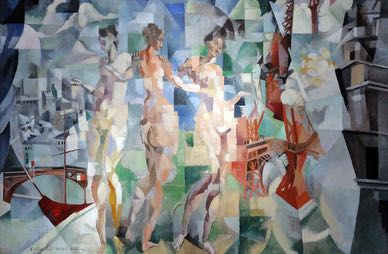
The City series, painted from 1909 to 1911, records this shift. Paris seen from above divides into small planes, while the Eiffel Tower in the distance acts simultaneously as familiar landmark and anchoring vertical. In works such as The City of Paris, buildings, bodies, and color transform the urban panorama into something much more complex.
Delaunay therefore used Cubism selectively. Fractured volumes and changing viewpoints captured the instability of modern sight, but color remained his main tool for creating rhythm, depth, and energy. Critics soon connected his work with a more chromatic branch of the movement.
Why Did Delaunay Keep Painting the Eiffel Tower?
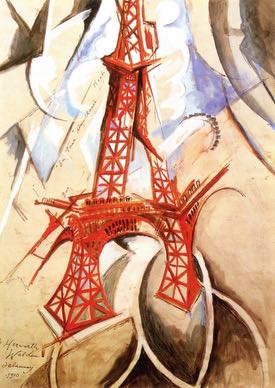
Delaunay began drawing and painting the Eiffel Tower repeatedly in 1909. Built for the 1889 Exposition Universelle, it embodied modern Paris, engineering, communication, and an unfamiliar experience of height. Its open iron structure allowed views through and around it, while its famous silhouette survived even the most drastic fragmentation.
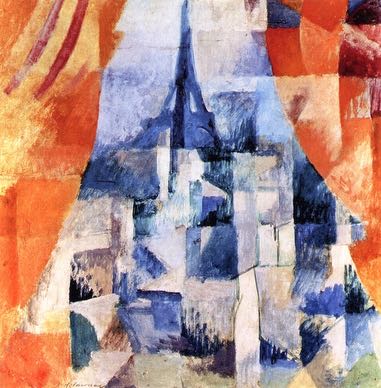
In The Red Tower, the monument seems to bend, rotate, and rise as nearby buildings tilt around it. Delaunay combined views from across the city, from above, and from below instead of fixing the scene to one stable vantage point. Intense reds against surrounding blues make architecture itself seem activated by light.
He returned to the tower in later periods, pairing it at times with windows, aircraft, and other signs of modern technology. The motif gave his changing art a point of continuity. It could become a Cubist framework, a fragment inside color, or a monumental emblem joining movement, space, and the city.
What Did Simultanism and Orphism Mean for Delaunay?
Delaunay’s Simultanism grew from studying relationships between colors, particularly Michel-Eugène Chevreul’s nineteenth-century theories. Simultaneous contrast describes how one color alters our perception of the hue beside it. Delaunay turned the idea into a working method, placing complementary and opposing colors together until the surface seems to move and vibrate.
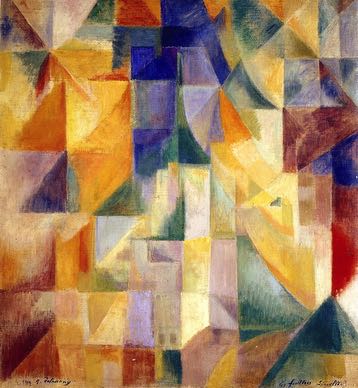
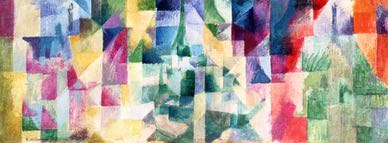
The Windows series of 1912 moved decisively toward nonfigurative art. In The Windows, transparent-seeming planes overlap until traces of the city become inseparable from colored light. The poet Guillaume Apollinaire named this new direction Orphism, linking its luminous color and visual rhythms to music.
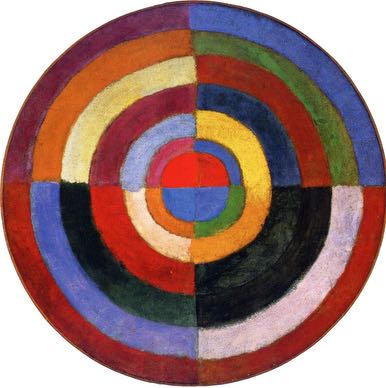
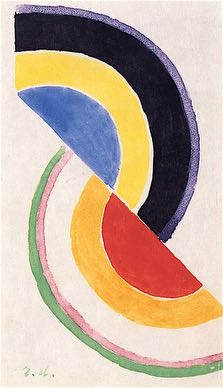
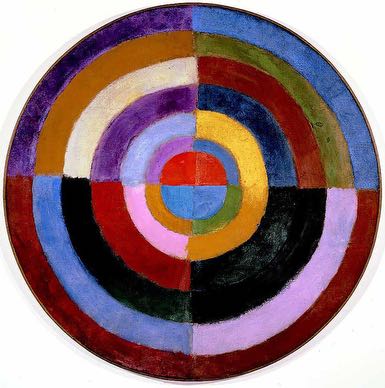
Sun and Moon, Simultaneous No. 1 and The First Disk largely or entirely abandon recognizable objects. Arcs, wedges, and interlocking disks generate their own rhythm and light. With such works, Delaunay joined the first European painters to treat color relations as a sufficient subject for abstraction.
How Did Sonia Delaunay Shape the Simultanist Partnership?
Robert met the Ukrainian-born artist Sonia Terk in Paris, and they married in 1910. Their creative partnership was fundamental to Simultanism, though each pursued its ideas differently. Both studied the movement created by color contrast. Robert concentrated mainly on painting and theory, while Sonia brought simultaneous color into clothes, textiles, books, interiors, stage design, and many other parts of modern visual culture.
Artists and writers such as Guillaume Apollinaire and Blaise Cendrars gathered in their home. Conversations moved among poetry, painting, fashion, dance, music, and technology. This lively exchange encouraged both Delaunays to imagine color as an active force able to reshape daily life rather than something confined to canvas.
Their work is best understood as a sustained dialogue, not a shared movement created by one partner alone. Sonia’s independent achievements and Robert’s experiments developed side by side over decades. Exhibitions, publications, friendships, decorative projects, and international networks carried their Simultanist ideas widely.
What Drew Delaunay to Aviation, Sport, and Modern Spectacle?
Delaunay was fascinated by the new forms of motion appearing throughout the modern city. Airplanes, electric light, radio towers, propellers, advertising signs, and competitive sports all suggested circulation, speed, and technological change. He did not record them through conventional realism, but merged their outlines with repeated curves, bright hues, and several moments of perception at once.
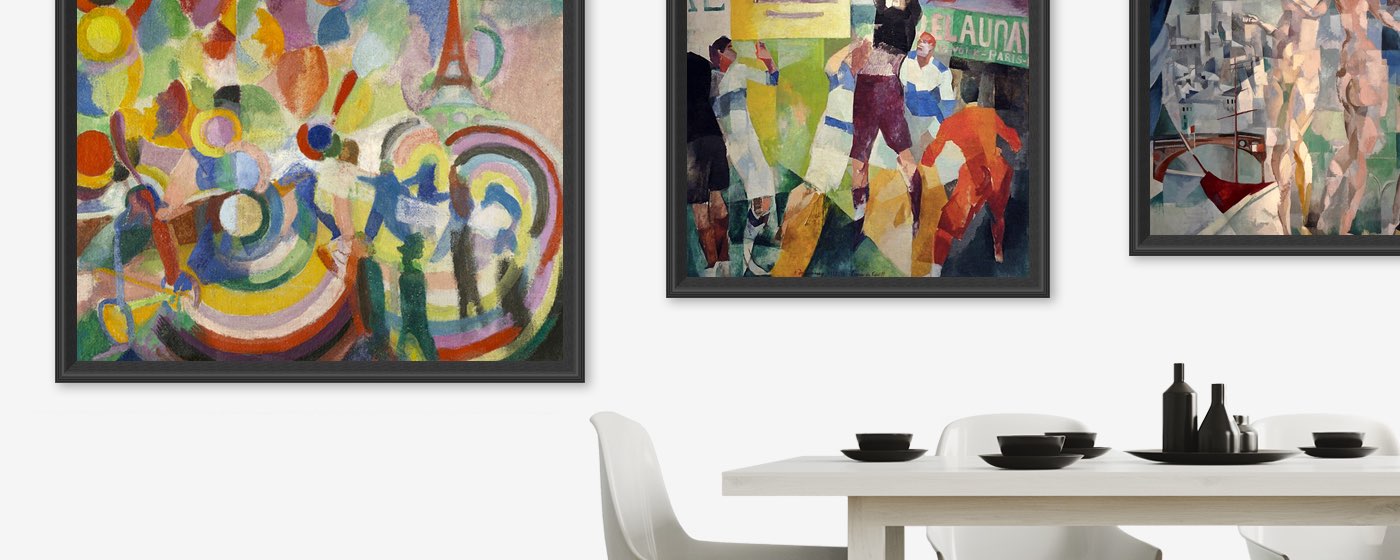
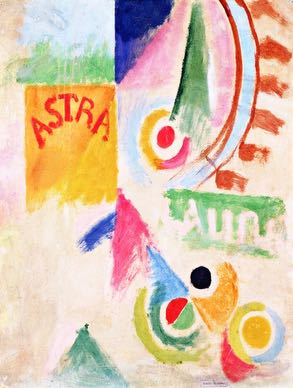
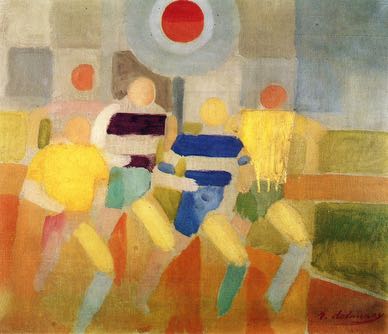
The Cardiff Team compresses lettering, rugby players, a Ferris wheel, an airplane, and the Eiffel Tower into one field. Sport meets advertising and urban spectacle, giving the sense of several impressions arriving at the same moment.
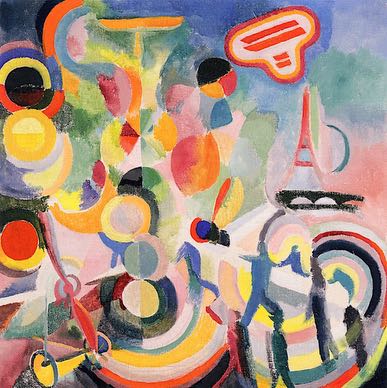
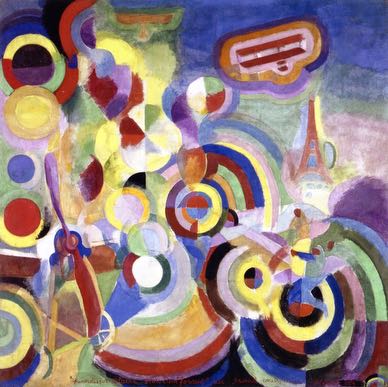
In Homage to Blériot, references to aviator Louis Blériot, an aircraft, a propeller, and the Eiffel Tower appear among radiant disks. Circles suggest rotating machinery and expanding light at once. The painting celebrates flight while showing how a modern subject could support an increasingly abstract design.
Where Did the War Years Lead Robert and Sonia Delaunay?
Robert and Sonia were in the Iberian Peninsula when the First World War began in 1914. Rather than returning immediately to France, they remained in Portugal and Spain through much of the conflict. Southern light, dancers, markets, domestic objects, and unfamiliar social settings entered their art, while contact with performers drew them into projects for ballet and theater.
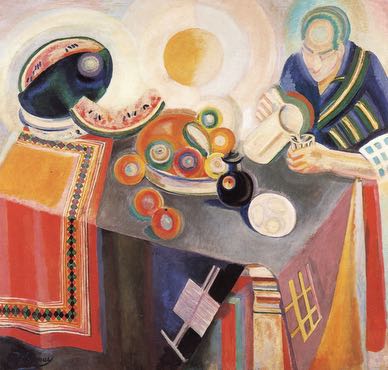
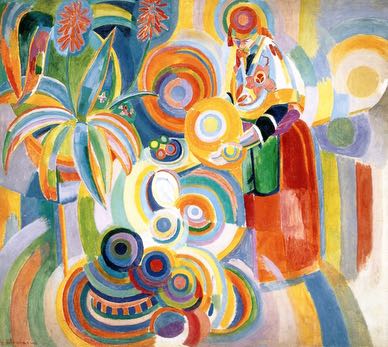
In Robert’s Portuguese paintings, recognizable bodies and objects return without surrendering the organizing power of simultaneous color. The Large Portuguese joins a figure to vessels, clothing, and curving forms, allowing abstraction and observation to coexist. Color did not require him to abandon recognizable imagery permanently.
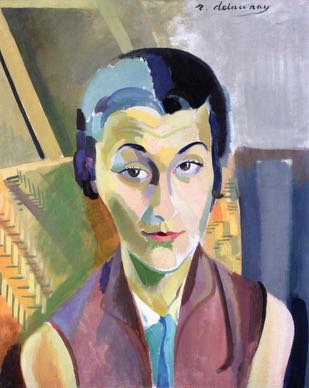
After returning to Paris in 1921, Delaunay painted portraits and reengaged with the city. He revisited the Eiffel Tower as well, now with greater color and monumentality. These works linked his prewar research to the transformed culture of the 1920s and prepared his eventual return to nonobjective circles.
How Did Delaunay Carry Painting into Architecture?
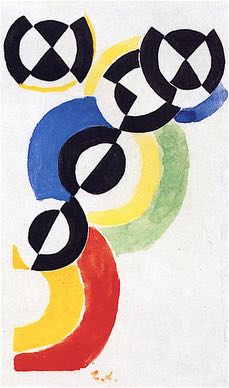
During the 1930s, Delaunay returned to spirals, disks, arcs, and bands of color. In Endless Rhythm, circular units rise and fall along a path that seems capable of continuing outside the canvas. The forms’ clarity and scale made them especially well suited to architecture.
Delaunay experimented with relief and durable modern materials as he sought to integrate color into building surfaces. Abstraction, he believed, could work publicly and monumentally instead of remaining in private collections. His ambitions found their fullest outlet at the 1937 International Exposition in Paris.
Robert and Sonia worked with architect Félix Aublet and a large team on immense decorations for the Palais de l’Air and Palais des Chemins de Fer. Robert designed monumental rhythms, reliefs, and spatial arrangements related to transport and aviation. Decades of color research became an environment in which modern technology, architecture, and the visitors’ own movement formed a single experience.
Which Paintings Trace Delaunay’s Development?
Delaunay moved from observed landscape and fractured cities toward luminous abstraction, yet repeatedly returned to modern life and monumental rhythm. These works mark important points along that path:
- Eiffel Tower: Shifting angles and fractured planes turn the Paris landmark into a dynamic Cubist structure.
- The City of Paris: Buildings, figures, and the tower meet in a large composition bridging Cubist construction and expansive color.
- The Windows: Overlapping translucent planes allow colored light to overtake conventional description.
- Sun and Moon, Simultaneous No. 1: Contrast, rotation, and light govern an abstract field of interlocking disks and arcs.
- The Cardiff Team: Advertising, sport, flight, and Parisian landmarks converge in a vivid modern spectacle.
- Homage to Blériot: Radiant circles and images of aviation celebrate technological innovation through simultaneous color.
- The First Disk: A compact circular design makes color relations entirely independent of recognizable objects.
- Endless Rhythm: Repeated circles generate the continuous optical movement of Delaunay’s renewed 1930s abstraction.
Why Does Robert Delaunay Matter to Modern Art?
Delaunay helped make color an independent means of constructing a modern painting. He accepted Cubism’s challenge to fixed perspective but refused the idea that rigorous structure required a muted palette. In his mature work, adjacent hues produce depth, edges, vibration, and movement without modeled volume or one stable viewpoint.
His influence reached well beyond France. Writings and paintings traveled through avant-garde journals and exhibitions, bringing his color research to artists associated with German abstraction and Expressionism. Wassily Kandinsky, Paul Klee, and August Macke encountered aspects of his work, while later geometric abstraction continued to pursue related rhythms of form and hue.
Delaunay left Paris during the German invasion of 1940 and died of cancer in Montpellier on 25 October 1941. His legacy rests on the continuity of a search running from early landscape and Eiffel Towers through windows, disks, flight, relief, and architectural design. Whatever the subject, he treated seeing as an active experience and color as a force capable of organizing a canvas or an entire public space.
Copyright © 2026 BrushWiz. All Rights Reserved.
About Our Robert Delaunay Paintings
Are your Robert Delaunay reproductions painted by hand?
Yes. Every reproduction is individually painted by hand in oil on canvas by a professional artist. We do not use prints, digital transfers, or mechanical reproduction methods.
How closely do your Delaunay copies resemble the original?
Our artists work to capture the composition, colors, texture, and visual character of the original Delaunay painting as closely as possible. Because every reproduction is painted by hand, small variations are natural and make each canvas unique.
How long does it take to complete a painting?
Most Delaunay reproductions require approximately two to three weeks to paint, dry, and inspect. Production time may vary depending on the artwork and canvas size, so check the estimate displayed on the product page.
Can I request a Delaunay painting that is not listed?
Yes. If you cannot find the Robert Delaunay artwork you want in our catalog, send us the painting’s title or an image. Our team will review your request and confirm the available sizes, estimated production time, and price.
Will I receive photos of my painting before it is shipped?
Yes. We send high-resolution photographs of the completed painting for your approval. You can request adjustments if needed, and the painting will not be dispatched until the review process is complete.
Can I order a custom canvas size?
Yes. We offer custom dimensions in addition to the standard sizes shown on the product page. Select the dimensions you need directly from the available size options.
Can I order my Delaunay painting with a frame?
Yes. High-quality frames in classic and modern designs are available for many paintings. You can view compatible framing options and add your preferred design from the product page. Professional canvas stretching is also available.
How much does a Robert Delaunay reproduction cost?
The price depends on the selected artwork, canvas dimensions, and framing option. Choose your preferred configuration on the product page to see the current price before ordering.
Do you offer free worldwide shipping?
Yes. Delaunay reproductions qualify for free express worldwide shipping. After dispatch, delivery usually takes five to eight business days, although timing may vary by country and destination.
What is the return policy for Delaunay reproductions?
Orders are covered by our 90-day return policy. Review the current return-policy page before ordering for complete information about eligibility, time limits, and the return process.
Why BrushWiz?
100% Hand Painted
Every piece is entirely handmade
Museum Quality
Faithfully recreated by expert artists
Custom Framing
Choose from a wide range of frames
Free Shipping
Enjoy free shipping on all orders
Cash Back Rewards
Earn cash back with every purchase