
❄️ Winter Sale. Offer Ends 11/16/2026. View Details
❄️ Winter Sale. Ends 11/16/2026. View Details
❄️ Winter Sale. View Details
Artists
Subjects
Movements
Collections
Decor
Portraits
Commissions
Framing
Reviews
Gift Cards
On Sale
Thomas Moran Oil Painting Reproductions
Shop museum-quality reproductions of Thomas Moran’s most famous paintings, each hand-painted in oil on canvas by a professional artist.
Shop Art

Showing 1-40 of 396 results
Sort By
Most Popular
- Most Popular
- New Arrivals
- Best Sellers
- Alphabetical A-Z
- Alphabetical Z-A
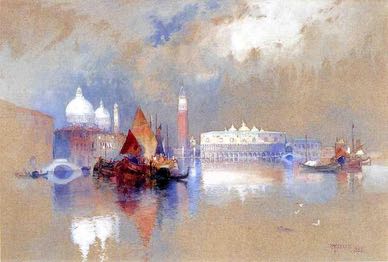
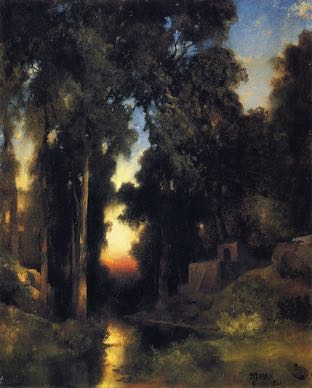
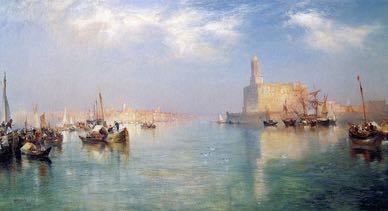



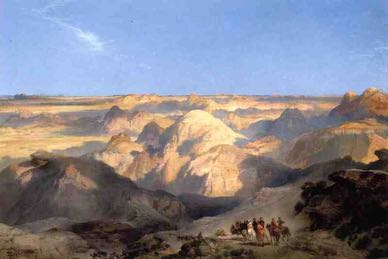
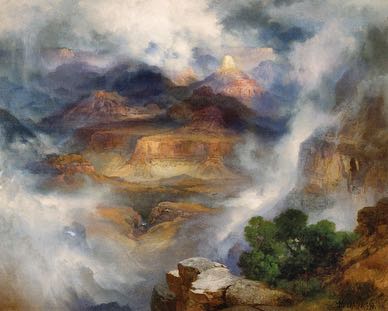
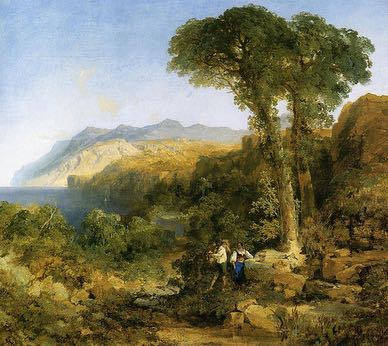
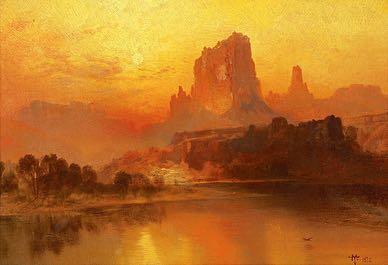


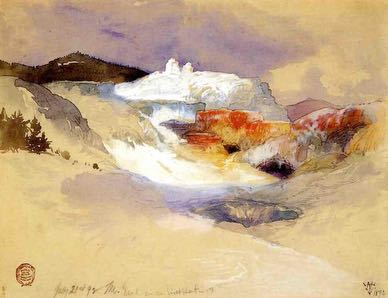
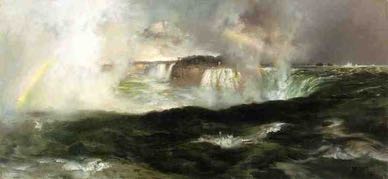
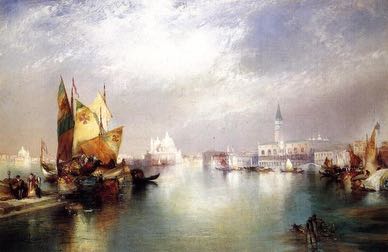
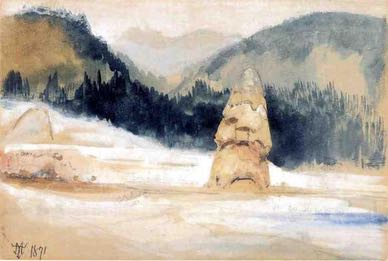


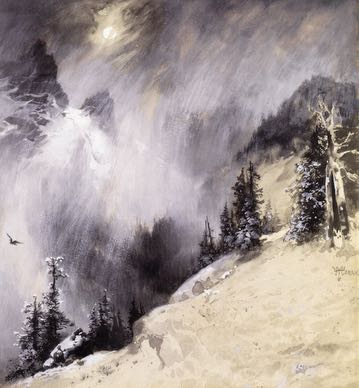

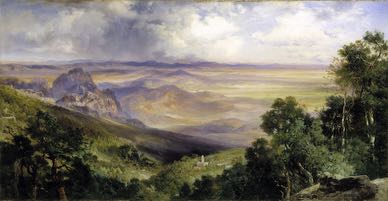


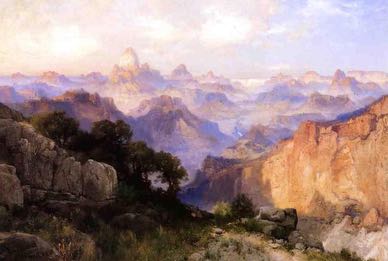
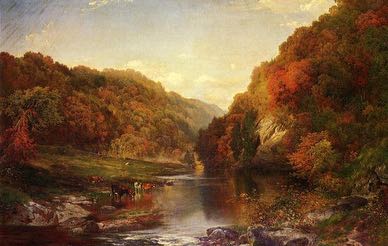
Can’t Find the Painting You Want?
Send us a reference image. We can recreate almost any artwork in the size and style you’re looking for.
Get a Free QuoteHand-Painted Thomas Moran Reproductions
Bring Moran’s art into your home with an oil-on-canvas reproduction hand-painted by a professional artist. Our collection features hundreds of paintings from across his career, including Grand Canyon of the Yellowstone, Chasm of the Colorado, and Cliffs of Green River. Discover monumental canyons, Yellowstone waterfalls, Rocky Mountain peaks, luminous Western skies, Venetian waterways, and other subjects closely associated with Moran. Every reproduction is a real oil painting, offering depth and texture that a print or digital transfer cannot provide. From iconic masterpieces to lesser-known works, find a Moran painting that suits your space.
The Making of a Thomas Moran Oil Painting Replica
Creating a Thomas Moran oil painting replica requires patience, precision, and an understanding of the original artwork. Our studio includes artists who specialize in Romantic landscape painting and understand the distinctive qualities of Moran’s work. Before painting begins, the artist studies the source image, paying close attention to its panoramic composition, luminous color, atmospheric depth, dramatic terrain, and Moran’s contrasts of light and shadow. These elements are recreated by hand in oil on canvas using an approach suited to the original. Once complete, the painting is inspected by our quality-control team and photographed for your approval.
Custom Sizes and Frames for Your Moran Painting
Your Moran painting can be ordered in practically any size, from popular standard dimensions to a custom canvas size selected directly on the product page. This flexibility lets you choose a painting that fits your wall and complements your room perfectly. After selecting the size, you can choose from high-quality frames in classic or modern designs, with professional canvas stretching also available. Our framing options complement the luminous colors and expansive compositions of Moran’s paintings. With sizing, stretching, and framing arranged in one order, your artwork can arrive ready for display without a separate visit to a frame shop.
Order a Thomas Moran Reproduction with Confidence
Buying hand-painted art online should feel clear and comfortable. After your Thomas Moran reproduction is completed, we send high-resolution photographs for your review before shipping. You can inspect the composition, colors, and overall finish, then request adjustments if needed. The painting is dispatched only after you approve it, so you know what to expect when it arrives. Your order also includes free express worldwide shipping and is covered by our 90-day return policy. Together, these assurances help you purchase a Moran oil painting with greater confidence and peace of mind.
The Life and Art of Thomas Moran
Thomas Moran was an English-born American landscape painter whose views of Yellowstone, the Grand Canyon, the Rocky Mountains, and Green River helped generations of viewers picture the American West. Born in 1837, he came to the United States as a child and learned his craft in Philadelphia through illustration, engraving, watercolor, and oil painting. Moran combined careful fieldwork with the glowing color, changing atmosphere, and dramatic scale he admired in J. M. W. Turner. His images from western survey expeditions reached people who would never see those regions firsthand, and they became closely tied to the early American movement for scenic preservation.
Read More
Who Was Thomas Moran?
Thomas Moran was born on 12 February 1837 in Bolton, Lancashire, England, into a family of handloom weavers. As industrial change made it harder for his parents to earn a living, the family left for the United States in 1844. They eventually settled near Philadelphia, where Thomas grew up in a household that would produce several artists.
His older brother Edward Moran, a successful marine painter, gave him an early example of what a professional artist’s life could be. Thomas went on to work in oil, watercolor, drawing, etching, wood engraving, lithography, and magazine illustration. Because he understood so many media, his pictures could travel well beyond galleries and private collections.
Moran is remembered chiefly as a painter of the American West, though he spent most of his life in the eastern United States. In the studio, he worked from sketches, watercolors, photographs, written notes, and memory. The finished landscapes join firsthand knowledge with carefully planned effects of light, distance, scale, and atmosphere.
Where Did Moran Learn His Craft?
At sixteen, Moran was apprenticed to Scattergood and Telfer, a Philadelphia wood-engraving firm. Translating pictures into reproducible blocks trained his eye for line and tonal contrast. He found the repetitive cutting tedious, but the work gave him a practical understanding of illustration and the rapidly expanding publishing trade.
After leaving the firm, Moran pursued painting and illustration more freely. He learned from Edward, sketched in and around Philadelphia, and studied landscapes in books, prints, exhibitions, and private collections. Early journeys through Pennsylvania and the Lake Superior region deepened his interest in scenery that could carry poetry and historical meaning as well as observed detail.
Books and magazines, including Scribner’s Monthly, remained an important part of his career. Illustration was not simply a step on the way to oil painting. It taught Moran how a picture could clarify a distant place, work alongside a written account, and speak to a large national audience.
What Did Moran Learn from J. M. W. Turner?
The British painter J. M. W. Turner was Moran’s most lasting artistic model. Turner showed how radiant color, mist, storms, fire, and changing light could intensify the experience of landscape. Moran borrowed no single formula; he adapted that sense of atmosphere and drama to American geography and to the expectations of a nineteenth-century audience.
Moran traveled to Britain in 1862 to study Turner’s paintings firsthand. He copied works, followed routes connected with the artist, and broadened his knowledge of European landscape traditions. John Ruskin’s writings also encouraged him to examine the structure of nature closely, even when he later rearranged what he had seen to give a composition greater clarity and force.
Observation and transformation remained inseparable in Moran’s mature work. He studied rocks, waterfalls, clouds, and mountains with care, then shifted or combined them to strengthen the finished picture. His western landscapes are neither straightforward records nor unfettered fantasies, but interpretations shaped by nature, memory, precedent, and studio judgment.
How Did Yellowstone Transform Moran’s Career?
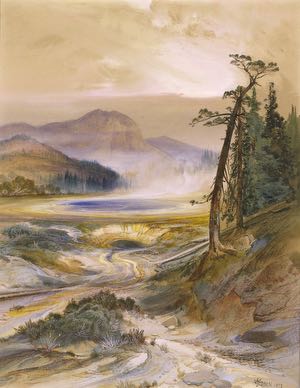
The decisive turn came in 1871, when Moran joined Ferdinand V. Hayden’s geological survey of Yellowstone as a guest artist. Support from Scribner’s Monthly and the railroad financier Jay Cooke helped him make the journey. He sketched canyons, geysers, hot springs, waterfalls, lakes, and mountain formations that many eastern viewers could scarcely imagine.
He worked beside photographer William Henry Jackson, whose camera provided a different kind of visual evidence. Moran’s color studies, Jackson’s photographs, survey reports, maps, and published illustrations together shaped public and congressional ideas about Yellowstone. They formed part of the wider campaign preceding the creation of Yellowstone National Park in 1872.
Back in the East, Moran turned his field studies into the monumental Grand Canyon of the Yellowstone. Congress bought the canvas for $10,000 and displayed it in the United States Capitol. The sale secured Moran’s reputation as a leading painter of western scenery and permanently joined his name to Yellowstone.
Why Did the Grand Canyon Demand a New Approach?
In 1873, Moran accompanied an expedition led by John Wesley Powell into the Colorado River and Grand Canyon region. Its terrain posed a different challenge from Yellowstone. Here he faced immense depth, bands of rock, unstable weather, and distances that resisted the familiar conventions of landscape composition.
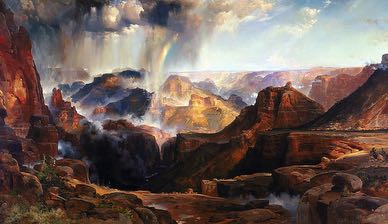
The resulting Chasm of the Colorado opened a vast descending space beneath shifting light. Congress purchased this large painting for the same amount paid for the Yellowstone canvas. Hanging in the Capitol, the pair offered viewers a powerful vision of the western landscape.
Moran returned to the Grand Canyon many times. Later visits and railroad commissions gave him fresh vantage points, while old sketches and memory continued to feed his studio work. He never treated the canyon as one fixed view, instead exploring sunset, rainbows, mist, shadow, and the changing tension between nearby ledges and distant formations.
By What Process Did Moran Build His Western Views?
In the field, Moran made drawings and watercolors that recorded geology, weather, color relationships, and memorable viewpoints. He also used photographs and survey material. Once home, he selected, enlarged, combined, and adjusted those observations, aiming to convey the force of being there rather than produce a strictly literal transcription.
His oil paintings often guide the eye from a detailed foreground toward a brilliant opening, a distant peak, or a sudden drop. Tiny figures, animals, and paths establish scale. Dark cliffs frame glowing skies, while mist and reflected light blur the passage between solid rock and air. The result feels geographically grounded but emotionally heightened.
Moran belonged to the Hudson River School tradition and the broader current of luminous American landscape painting. Like Frederic Edwin Church and Albert Bierstadt, he used grand scale and carefully controlled light to make nature magnificent. What set him apart was the chromatic drama and geological imagination he brought to western scenery.
Why Did Moran Keep Returning to Green River?
Moran first saw the remarkable formations near Green River, Wyoming, on his way to Yellowstone in 1871. Their layered cliffs and solitary buttes stayed with him. Over the following decades, he returned to the subject repeatedly, changing the viewpoint, sky, figures, and weather while retaining the land’s unmistakable profile.
Paintings such as Cliffs of Green River show how freely he could reshape a remembered place. He often reduced or left out the growing railroad settlement, while travelers, Indigenous people, or distant animals suggested an older idea of the West. These are constructed visions, marked by contemporary beliefs about wilderness, expansion, and national identity rather than neutral records of a particular day.
The series also gave Moran room to test new color effects. Warm cliffs stand against cooler distances, wide skies hover over thin strips of land, and reflected light makes massive rock seem both solid and atmospheric. Repetition allowed him to rethink a successful subject instead of merely copying it.
Where Else Did Moran Find His Subjects?
Moran’s interests reached far beyond Yellowstone and the Grand Canyon. He painted the mountains of Colorado, waterfalls in Idaho and Wyoming, the Pennsylvania countryside, Long Island’s coast and dunes, and scenery seen in Mexico and Cuba. The snow formation on Mountain of the Holy Cross became one of the best-known natural landmarks in his western art.
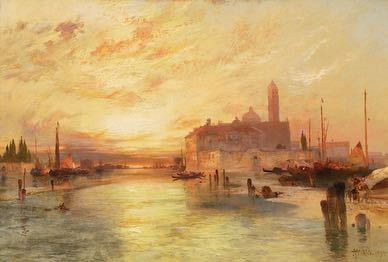
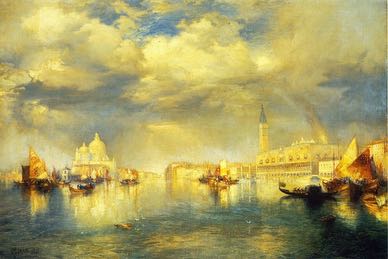
Europe remained just as important. Moran returned several times to Venice, painting its canals, boats, architecture, sunsets, and moonlit water. These subjects let him respond directly to Turner’s Venetian paintings while finding his own balance of reflection, silhouette, and glowing air. The West and Venice may seem far apart, but in both places water and light organize the view.
In 1884, Moran and his wife, the accomplished etcher Mary Nimmo Moran, built a home and studio in East Hampton, New York. The nearby coast inspired marine subjects and quieter local landscapes. Painting, printmaking, travel, and close attention to nature were woven into their life together.
Which Paintings Capture the Range of Moran’s Career?
From Yellowstone and the Grand Canyon to Wyoming, Colorado, and Venice, these works reveal the breadth of Moran’s landscape art:
- Grand Canyon of the Yellowstone: The monumental vision that made Moran nationally famous, uniting geological scale with radiant color.
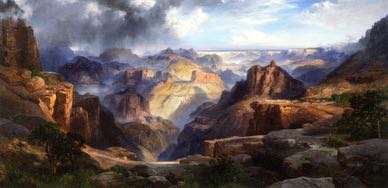
- Chasm of the Colorado: A vast Grand Canyon scene built from plunging depth, layered stone, and restless light.
- Cliffs of Green River: One of Moran’s recurring Wyoming subjects, balancing massive formations against luminous open space.
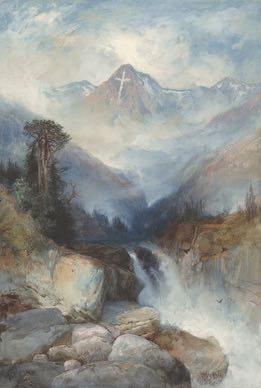
- Mountain of the Holy Cross: An expansive Colorado landscape centered on a distant, cross-shaped field of snow.
- Shoshone Falls, Snake River, Idaho: A commanding waterfall surrounded by mist, fractured terrain, and a dramatic vertical drop.
- Canyon Mists, Zoroaster Peak, Grand Canyon, Arizona: A later vision of the canyon transformed by vapor, distance, and passing weather.
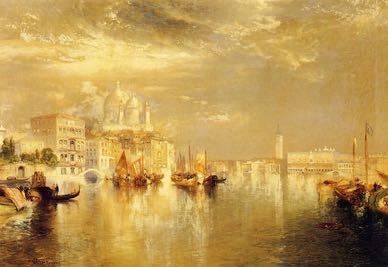
- Entrance to the Grand Canal, Venice: A Venetian scene in which architecture, reflective water, and atmospheric light work as one.
- Grand Canyon with Rainbows: A mature canyon painting whose fleeting weather heightens the grandeur of the land.
What Place Does Thomas Moran Hold in American Art?
Moran gave nineteenth-century audiences memorable access to landscapes most would never visit. Through paintings, watercolors, and illustrations, he turned scientific expeditions and geographic reports into compelling visual experiences. Alongside photographs, maps, writing, and political advocacy, his work helped bring Yellowstone and other western regions into the national imagination.
Those images also carry the assumptions of their time. They celebrate geological grandeur while reflecting contemporary beliefs about rail travel, tourism, wilderness, westward expansion, and national identity. Viewers today can admire Moran’s skill while also asking which histories were highlighted, altered, or left outside the frame when the West was presented to eastern audiences.
Moran kept painting and traveling well into old age. He moved to Santa Barbara, California, in 1922 and died there on 25 August 1926. He is now regarded as one of the leading American landscape painters of the nineteenth century. By joining field observation, illustration, European precedent, and studio invention, he gave the American West some of its most enduring painted forms.
Copyright © 2026 BrushWiz. All Rights Reserved.
About Our Thomas Moran Paintings
Are your Thomas Moran reproductions painted by hand?
Yes. Every reproduction is individually painted by hand in oil on canvas by a professional artist. We do not use prints, digital transfers, or mechanical reproduction methods.
How closely do your Moran copies resemble the original?
Our artists work to capture the composition, colors, texture, and visual character of the original Moran painting as closely as possible. Because every reproduction is painted by hand, small variations are natural and make each canvas unique.
How long does it take to complete a painting?
Most Moran reproductions require approximately two to three weeks to paint, dry, and inspect. Production time may vary depending on the artwork and canvas size, so check the estimate displayed on the product page.
Can I request a Moran painting that is not listed?
Yes. If you cannot find the Thomas Moran artwork you want in our catalog, send us the painting’s title or an image. Our team will review your request and confirm the available sizes, estimated production time, and price.
Will I receive photos of my painting before it is shipped?
Yes. We send high-resolution photographs of the completed painting for your approval. You can request adjustments if needed, and the painting will not be dispatched until the review process is complete.
Can I order a custom canvas size?
Yes. We offer custom dimensions in addition to the standard sizes shown on the product page. Select the dimensions you need directly from the available size options.
Can I order my Moran painting with a frame?
Yes. High-quality frames in classic and modern designs are available for many paintings. You can view compatible framing options and add your preferred design from the product page. Professional canvas stretching is also available.
How much does a Thomas Moran reproduction cost?
The price depends on the selected artwork, canvas dimensions, and framing option. Choose your preferred configuration on the product page to see the current price before ordering.
Do you offer free worldwide shipping?
Yes. Moran reproductions qualify for free express worldwide shipping. After dispatch, delivery usually takes five to eight business days, although timing may vary by country and destination.
What is the return policy for Moran reproductions?
Orders are covered by our 90-day return policy. Review the current return-policy page before ordering for complete information about eligibility, time limits, and the return process.
Why BrushWiz?
100% Hand Painted
Every piece is entirely handmade
Museum Quality
Faithfully recreated by expert artists
Custom Framing
Choose from a wide range of frames
Free Shipping
Enjoy free shipping on all orders
Cash Back Rewards
Earn cash back with every purchase