
❄️ Winter Sale. Offer Ends 11/20/2026. View Details
❄️ Winter Sale. Ends 11/20/2026. View Details
❄️ Winter Sale. View Details
Artists
Subjects
Movements
Collections
Decor
Portraits
Commissions
Framing
Reviews
Gift Cards
On Sale
Caravaggio Oil Painting Reproductions
Shop museum-quality reproductions of Caravaggio’s most famous paintings, each hand-painted in oil on canvas by a professional artist.
Shop Art
Showing 1-40 of 76 results
Sort By
Most Popular
- Most Popular
- New Arrivals
- Best Sellers
- Alphabetical A-Z
- Alphabetical Z-A
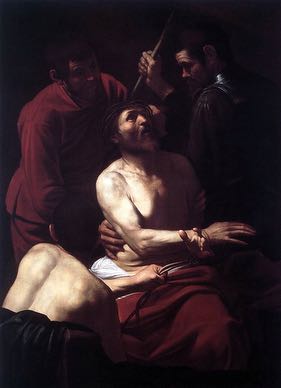
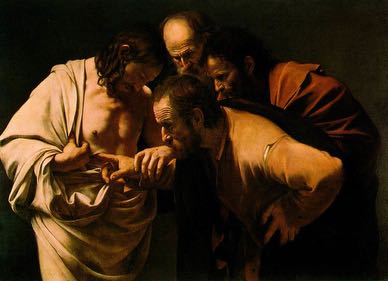
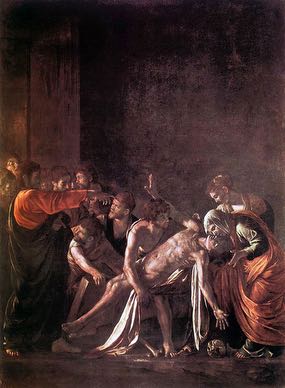
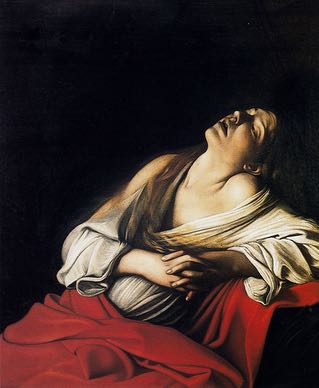
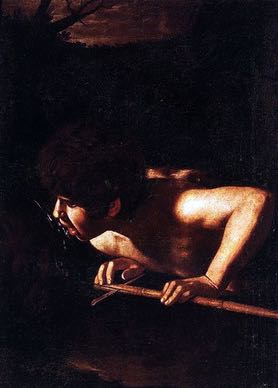
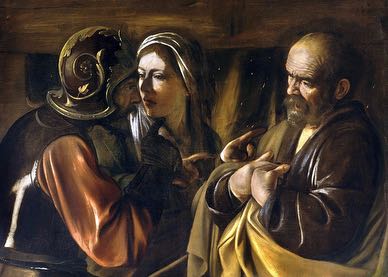
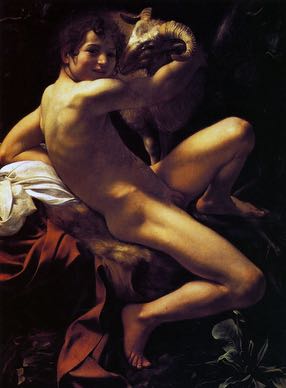
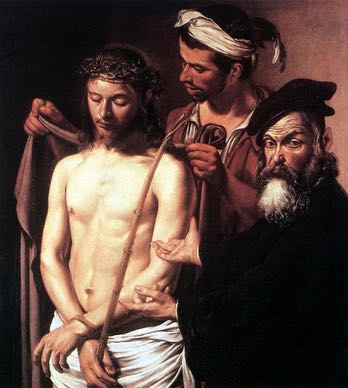
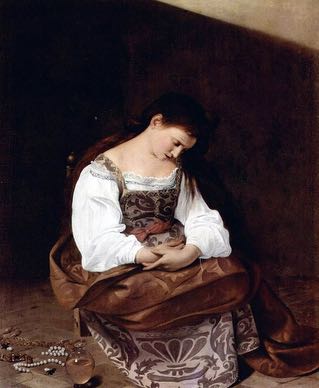
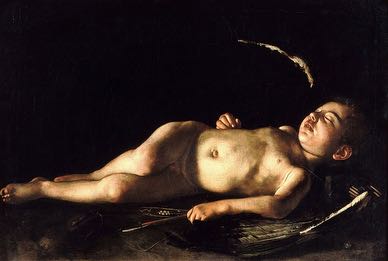
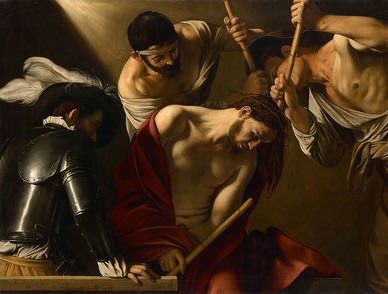
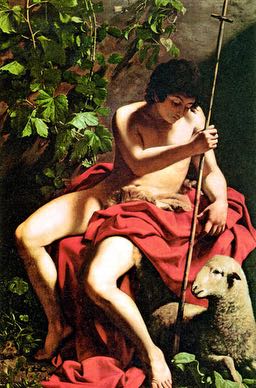

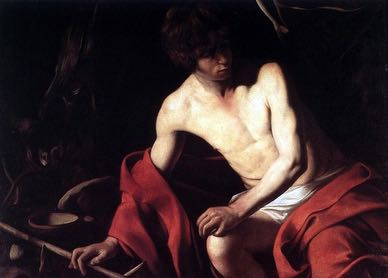
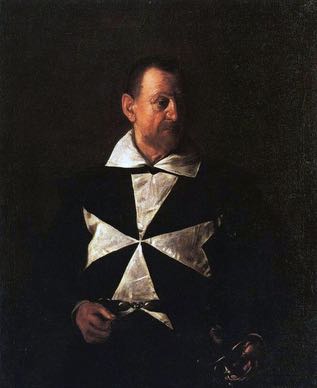
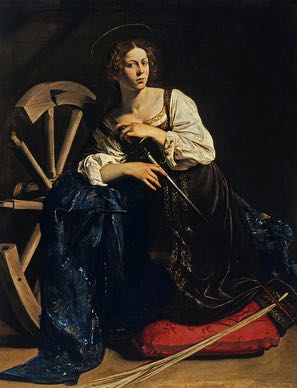
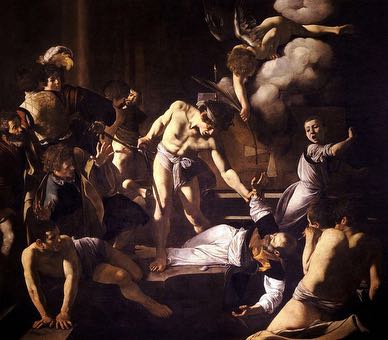

Can’t Find the Painting You Want?
Send us a reference image. We can recreate almost any artwork in the size and style you’re looking for.
Get a Free QuoteHand-Painted Caravaggio Reproductions
Bring Caravaggio’s art into your home with an oil-on-canvas reproduction hand-painted by a professional artist. Our collection brings together Caravaggio’s complete catalog of known paintings, including The Calling of Saint Matthew, Judith Beheading Holofernes, and Supper at Emmaus. Discover dramatic biblical narratives, saints, musicians, fortune tellers, card players, and other subjects closely associated with Caravaggio. Every reproduction is a real oil painting, offering depth and texture that a print or digital transfer cannot provide. From iconic masterpieces to lesser-known works, find a Caravaggio painting that suits your space.
The Making of a Caravaggio Oil Painting Replica
Creating a Caravaggio oil painting replica requires patience, precision, and an understanding of the original artwork. Our studio includes artists experienced in Baroque painting who understand the distinctive qualities of Caravaggio’s work. Before painting begins, the artist studies the source image, paying close attention to its concentrated light, deep shadows, naturalistic figures, close staging, restrained palette, and physical detail. These elements are recreated by hand in oil on canvas using an approach suited to the original. Once complete, the reproduction is inspected by our quality-control team and photographed for your approval.
Custom Sizes and Frames for Your Caravaggio Painting
Your Caravaggio painting can be ordered in practically any size, from standard dimensions to custom canvas sizes selected on the product page. This flexibility lets you choose a painting that fits your wall and complements your room perfectly. After selecting the size, you can choose from high-quality frames in classic or modern designs, with canvas stretching available. Our framing options complement Caravaggio’s dramatic light, dark backgrounds, and powerful figure compositions. With sizing, stretching, and framing arranged in one order, your artwork can arrive ready for display without a separate visit to a frame shop.
Order a Caravaggio Reproduction with Confidence
Buying hand-painted art online should feel clear and comfortable. After your Caravaggio reproduction is completed, we send high-resolution photographs for your review before shipping. You can inspect the composition, colors, lighting, details, and overall finish, then request adjustments if needed. The painting is dispatched only after you approve it, so you know what to expect when it arrives. Your order also includes free express worldwide shipping and is covered by our 90-day return policy. Together, these assurances help you purchase a Caravaggio oil painting with greater confidence and peace of mind.
The Life and Art of Caravaggio
Caravaggio was an Italian Baroque painter whose direct naturalism and dramatic use of light and shadow transformed European art. Born Michelangelo Merisi in 1571, he trained in Lombardy before moving to Rome, where his early genre scenes and still lifes won influential patrons. Major church commissions followed. In these religious paintings, closely observed figures, contemporary clothing, and forceful gestures brought sacred events into a familiar human world. His turbulent life later took him to Naples, Malta, and Sicily, where he continued to develop his art. Despite a brief career, Caravaggio influenced generations of painters across Italy, Spain, France, and the Netherlands, becoming a central figure in early seventeenth-century painting.
Read More
Who Was Caravaggio?
Michelangelo Merisi, known as Caravaggio, was born in Milan on 29 September 1571. He took his professional name from the Lombard town of Caravaggio, where his family had connections. Plague and instability shaped his early years, and he lost both parents while still young.
His paintings give unusual weight to the things other artists might soften or overlook: a weathered face, dirty feet, worn clothes, bruised fruit. Close observation and carefully directed light make these details tangible. Even in biblical or mythological scenes, the people seem to belong to the viewer’s own world.
Caravaggio’s career lasted only about two decades, yet it changed the course of seventeenth-century painting. Professional success came alongside lawsuits, violence, flight, and repeated efforts to find security. His biography follows both the rise of an influential painter and the increasingly unsettled life behind the work.
What Did Caravaggio Learn During His Training in Lombardy?
In 1584, Caravaggio began an apprenticeship with Simone Peterzano in Milan. Trained in the Venetian tradition, Peterzano taught drawing, figure painting, composition, and the preparation of large religious pictures. Lombard painting offered another important foundation, with its close observation and direct treatment of sacred subjects, often less idealized than the art associated with central Italy.
Paintings in Milan, Bergamo, Brescia, and nearby cities gave the young artist much to study. The northern Italian interest in naturalistic portraits, food, fruit, humble objects, and solidly modeled bodies would reappear in his Roman work. He also learned the practical demands of making altarpieces, a form whose conventions he would later test so forcefully.
Little securely documented work survives from before his move to Rome, so the exact steps of his development remain difficult to trace. His mature painting nevertheless owes much to Lombardy. The ordinary models, tangible bodies, and closely observed objects had roots in the visual culture of his youth.
How Did Caravaggio Establish Himself in Rome?
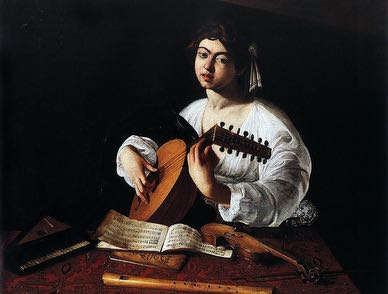
Caravaggio arrived in Rome around 1592. The city offered opportunities, but competition was fierce and his first years were hard. He worked for other painters, made small pictures for sale, and spent time in hospital after a serious illness. Early half-length scenes gave him room to demonstrate his skill with faces, fruit, glass, fabric, and musical subjects.
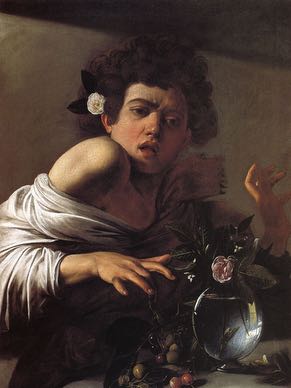
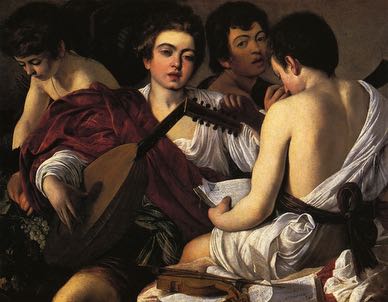
In Boy with a Basket of Fruit, Boy Bitten by a Lizard, and The Cardsharps, precise observation meets a gift for gesture and implied narrative. The musicians, fortune tellers, and gamblers of his early work belonged to contemporary life. Viewers could recognize their clothes, occupations, and behavior.
Cardinal Francesco Maria del Monte became his most important early patron. A place in Del Monte’s household brought financial security and access to collectors and cultivated Roman society. These private commissions built Caravaggio’s reputation before church paintings introduced him to a much larger audience.
Which Chapel Commissions Brought Caravaggio Public Recognition?
The paintings of Saint Matthew for the Contarelli Chapel in San Luigi dei Francesi marked Caravaggio’s public breakthrough. In The Calling of Saint Matthew, Christ enters a shadowed room where men sit in contemporary dress. A beam of light crosses the scene, guiding the eye toward the moment when an apparently ordinary encounter becomes a spiritual summons.
The Martyrdom of Saint Matthew gathers violence, panic, and the reactions of witnesses around the saint’s death. In The Inspiration of Saint Matthew, the evangelist receives divine guidance. The subjects are monumental, but their force comes from gestures and responses that remain recognizably human.
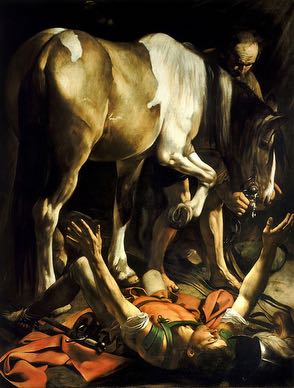
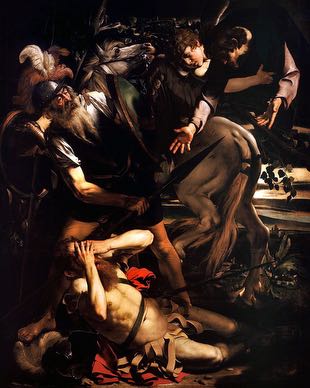
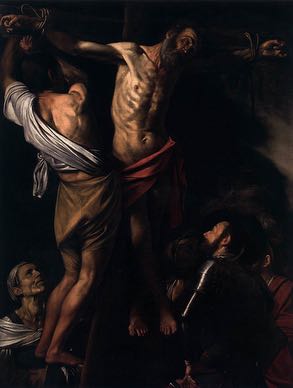
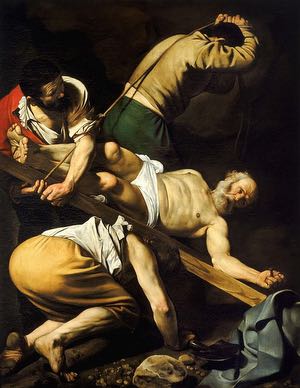
A commission for the Cerasi Chapel in Santa Maria del Popolo soon followed. The Crucifixion of Saint Peter and The Conversion of Saint Paul place their figures in dark, shallow spaces. The physical effort of lifting a body and the vulnerability of a fallen man make the sacred events feel close and immediate.
How Did Caravaggio Transform Light and Naturalism?
Strong contrasts of light and dark existed long before Caravaggio. His distinction was the concentration with which he used them. Faces, hands, fabric, metal, and flesh emerge from deep shadow, apparently lit by a source just outside the picture. Less essential details recede, leaving the viewer little doubt about where to look.
This dramatic use of illumination against darkness is often called tenebrism. In Caravaggio’s hands, it helps tell the story. Light can isolate a gesture, expose an expression, or mark the instant when someone understands what is happening. An ordinary room can acquire spiritual significance through the way it is lit.
Posed models and close study gave his naturalism its foundation. He brought bodies toward the front of the picture, limited distant scenery, and arranged figures in compact groups. With so little space separating viewer and action, fear, pain, disbelief, recognition, and mercy become difficult to observe at a comfortable distance.
Did Patrons Always Welcome Caravaggio’s Religious Paintings?
Not every patron welcomed this directness. Sacred figures could seem too ordinary, too exposed, or too emotionally troubling for their intended setting. Questions of scale and interpretation also mattered. A rejected painting might nevertheless find an appreciative collector almost immediately.
The Death of the Virgin is a famous example. The weight of the body, bare feet, grieving figures, and somber room give death an uncompromising physical presence. Its original commissioners rejected the altarpiece, but the Duke of Mantua later acquired it on the advice of Peter Paul Rubens.
Such disputes were part of a successful Roman career, during which collectors sought his work and prestigious commissions continued to arrive. They show how sharply he challenged expectations about beauty, dignity, and decorum from within the religious culture in which he worked.
Why Did Caravaggio Flee Rome?
Arrests, lawsuits, street disputes, and weapons charges recur in the records of Caravaggio’s Roman years. In May 1606, a confrontation involving the painter and several companions ended in the death of Ranuccio Tomassoni. The cause of the fight remains disputed, but its consequence was decisive: Caravaggio faced a capital sentence.
With assistance from patrons and members of the Colonna family, he fled Rome. He found protection first outside direct papal control, then made his way to Naples. The departure divided his career. Having established his name in Rome, he now had to build new relationships across southern Italy and the Mediterranean.
He kept painting while efforts continued to obtain a papal pardon. In the late works, darkness often occupies more of the canvas, figures become fewer, and passages of paint grow quicker and more abbreviated. Practical pressures, personal circumstances, and artistic choices may all have contributed. Whatever their causes, these changes give the final paintings a particular gravity.
Where Did Caravaggio Live and Paint After Leaving Rome?
In Naples, Caravaggio arrived with the reputation of a celebrated Roman painter. The Seven Works of Mercy draws several acts of charity into one crowded street at night. Its interwoven action and urgent lighting left a strong impression on Neapolitan painting, including the work of Jusepe de Ribera and later artists in the city.
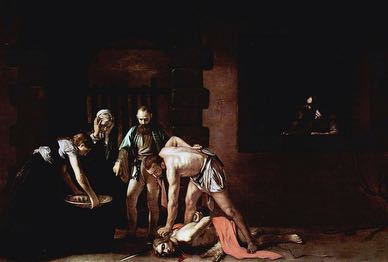
Caravaggio traveled to Malta in 1607, seeking the protection and status offered by the Knights of Saint John. For the order’s oratory, he painted the monumental The Beheading of Saint John the Baptist, his only known signed painting. Another violent dispute led to imprisonment. He escaped and was formally expelled from the order.
He then worked in Syracuse, Messina, and Palermo before returning to Naples. His final documented painting, The Martyrdom of Saint Ursula, brings its figures together in a close, dark confrontation. In 1610, traveling north in expectation of a pardon, Caravaggio died at Porto Ercole. The exact cause of his death remains uncertain.
Which Paintings Is Caravaggio Best Known For?
Caravaggio’s range extends from youthful genre scenes and still lifes to private devotional pictures and major church commissions. These works offer a sense of how he adapted his approach to different subjects:
- Bacchus: A youthful god, wine, fruit, and glassware bring a classical subject into the closely observed material world.
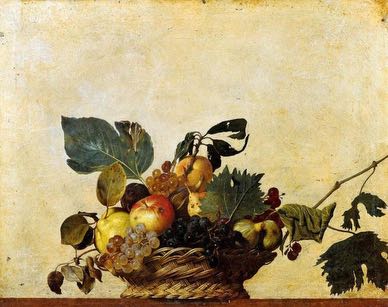
- Basket of Fruit: Ripening and damaged fruit reveal the painter’s attention to texture, still life, and natural imperfection.
- Judith Beheading Holofernes: Expressions, concentrated action, and directed light sharpen the violence of a biblical turning point.
- Supper at Emmaus: Expansive gestures register sudden recognition as the table and its objects seem to project toward the viewer.
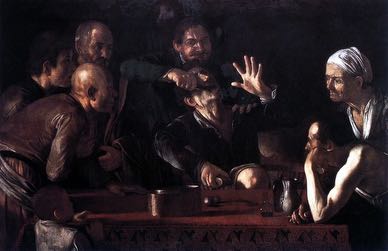
- The Incredulity of Saint Thomas: Four figures gather closely around Christ’s wound, making touch and physical evidence central to the scene.
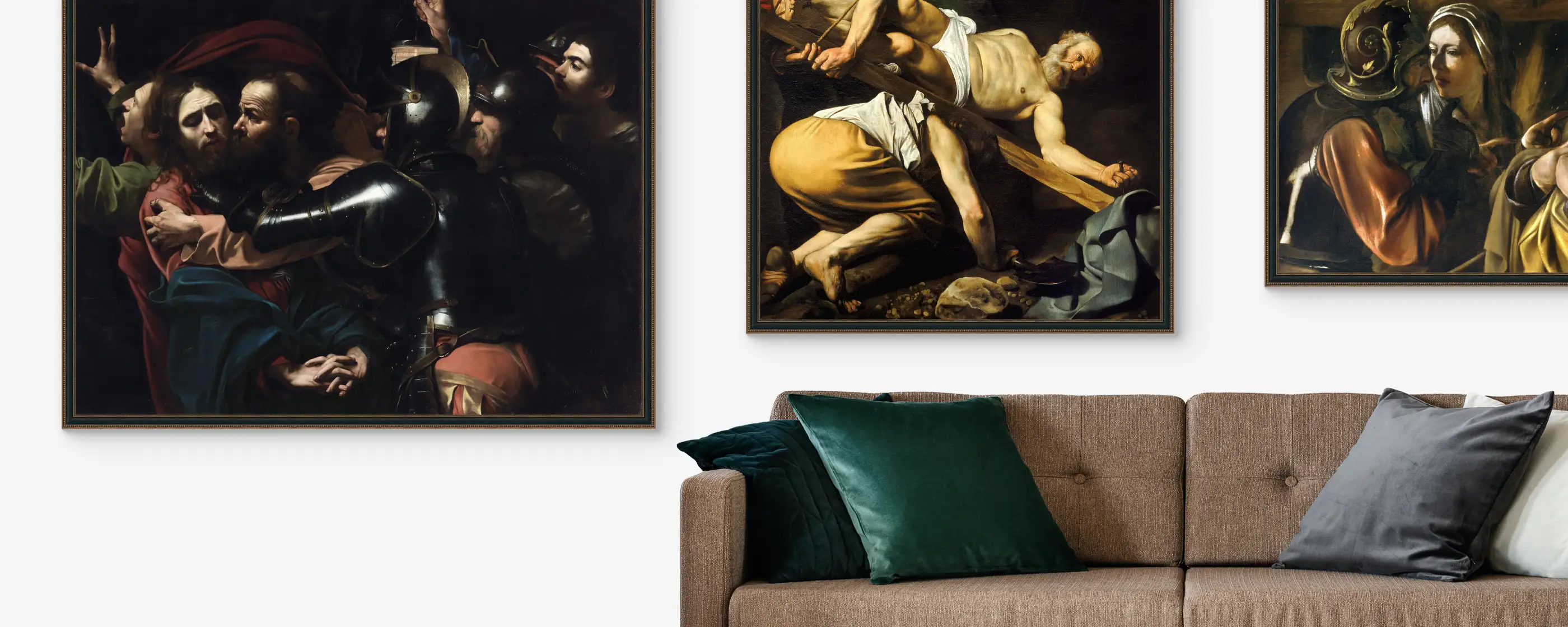
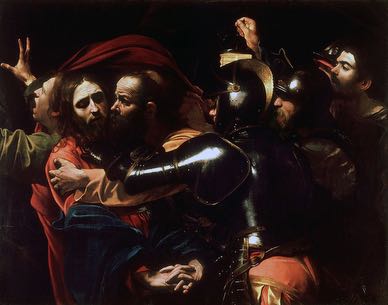
- The Taking of Christ: Faces, hands, armor, and a raised lantern crowd together in a tense nighttime arrest.
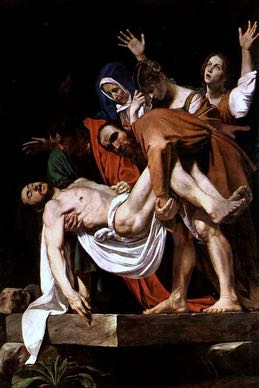
- The Entombment of Christ: Mourners lower Christ’s body toward a stone slab that projects into the viewer’s space.
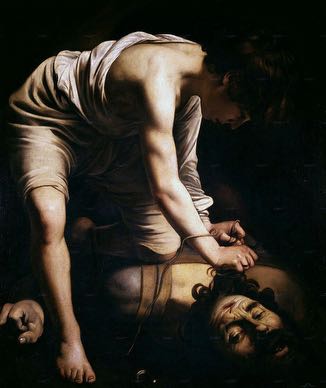
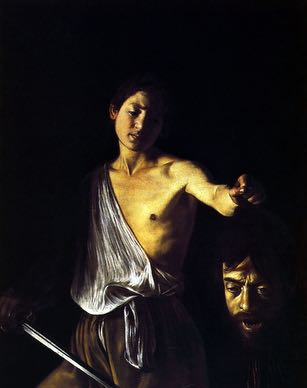
- David with the Head of Goliath: David’s restrained expression and the troubled face of Goliath turn victory toward pity and reflection.
Across these paintings, Caravaggio varies the scale, gestures, lighting, and spacing of his figures. Familiar stories gain urgency from the way people look at, reach toward, or recoil from one another. Each scene depends on the precision of those interactions.
Why Is Caravaggio So Influential?
Artists began responding to Caravaggio during his lifetime. They studied his paintings in Rome, encountered copies, and carried what they had learned elsewhere. Orazio Gentileschi brought his naturalism into increasingly refined compositions, while Artemisia Gentileschi developed forceful narratives shaped by concentrated action and strong light.
Hendrick ter Brugghen and other Utrecht painters brought Caravaggesque figures and lighting to the Netherlands. In France, Georges de La Tour used candlelight to create quieter nocturnal scenes. Spanish and Neapolitan artists applied a similarly direct naturalism to saints, philosophers, and martyrdoms, adapting the example to their own concerns.
Caravaggio left no formal school, and few drawings can be securely linked to his working process. His paintings themselves supplied the lesson: ordinary models, contemporary surroundings, compact staging, and purposeful light could make an old story feel newly urgent. Later scholarship and exhibitions restored his central place in art history. His handling of bodies and illumination continues to resonate in painting, photography, cinema, and theater.
Copyright © 2026 BrushWiz. All Rights Reserved.
About Our Caravaggio Paintings
Are your Caravaggio reproductions painted by hand?
Yes. Every reproduction is individually painted by hand in oil on canvas by a professional artist. We do not use prints, digital transfers, or mechanical reproduction methods.
How closely do your Caravaggio copies resemble the original?
Our artists work to capture the composition, colors, dramatic lighting, texture, and visual character of the original Caravaggio painting as closely as possible. Because every reproduction is painted by hand, small variations are natural and make each canvas unique.
How long does it take to complete a painting?
Most Caravaggio reproductions require approximately two to three weeks to paint, dry, and inspect. Production time may vary depending on the artwork and canvas size, so check the estimate displayed on the product page.
Can I request a Caravaggio painting that is not listed?
Yes. If you cannot find the Caravaggio artwork you want in our catalog, send us the painting’s title or an image. Our team will review your request and confirm the available sizes, estimated production time, and price.
Will I receive photos of my painting before it is shipped?
Yes. We send high-resolution photographs of the completed painting for your approval. You can request adjustments if needed, and the painting will not be dispatched until the review process is complete.
Can I order a custom canvas size?
Yes. We offer custom dimensions in addition to the standard sizes shown on the product page. Select the dimensions you need directly from the available size options.
Can I order my Caravaggio painting with a frame?
Yes. High-quality frames in classic and modern designs are available for many paintings. You can view compatible framing options and add your preferred design from the product page. Professional canvas stretching is also available.
How much does a Caravaggio reproduction cost?
The price depends on the selected artwork, canvas dimensions, and framing option. Choose your preferred configuration on the product page to see the current price before ordering.
Do you offer free worldwide shipping?
Yes. Caravaggio reproductions qualify for free express worldwide shipping. After dispatch, delivery usually takes five to eight business days, although timing may vary by country and destination.
What is the return policy for Caravaggio reproductions?
Orders are covered by our 90-day return policy. Review the current return-policy page before ordering for complete information about eligibility, time limits, and the return process.
Why BrushWiz?
100% Hand Painted
Every piece is entirely handmade
Museum Quality
Faithfully recreated by expert artists
Custom Framing
Choose from a wide range of frames
Free Shipping
Enjoy free shipping on all orders
Cash Back Rewards
Earn cash back with every purchase