
🔥 Limited-Time Sale. Offer Ends 11/10/2026. View Details
🔥 Limited-Time Sale. Ends 11/10/2026. View Details
🔥 Limited-Time Sale. View Details
Artists
Subjects
Movements
Collections
Decor
Portraits
Commissions
Framing
Reviews
Gift Cards
On Sale
Rococo Oil Paintings
Shop famous Rococo painting reproductions, each hand-painted in oil on canvas by a professional artist.
Shop Art
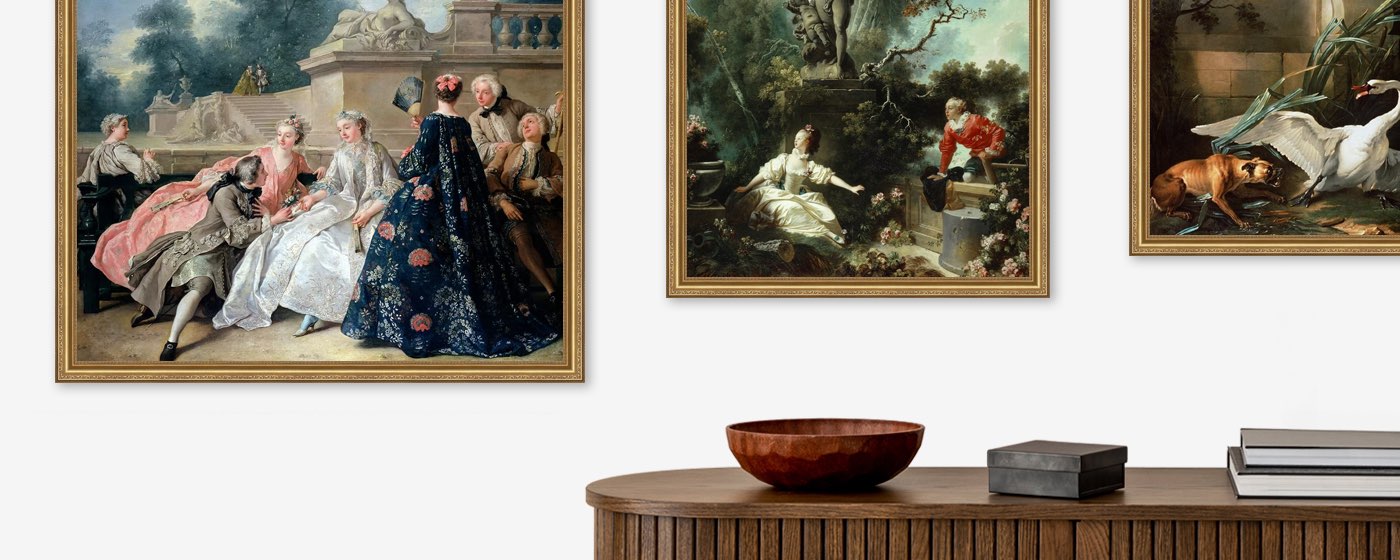
Showing 241-280 of 2810 results
Sort By
Most Popular
- Most Popular
- New Arrivals
- Best Sellers
- Alphabetical A-Z
- Alphabetical Z-A






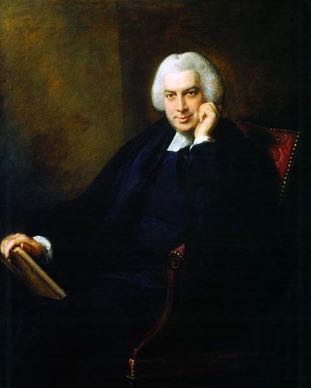
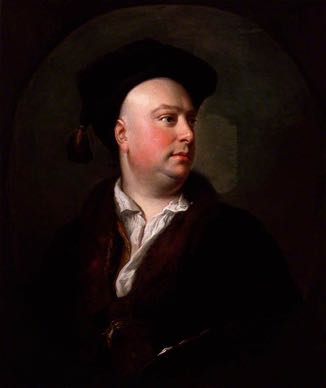
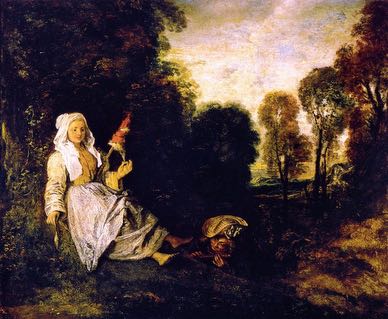
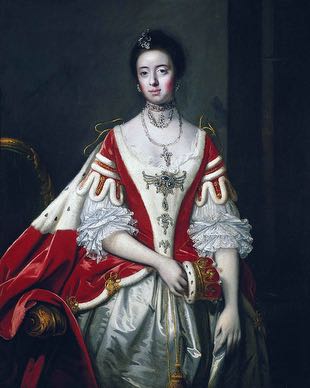






Can’t Find the Painting You Want?
Looking for a specific painting that isn’t in our catalog? Just let us know. We can recreate almost any artwork in the size and style you’re looking for.
Request a PaintingHand-Painted Rococo Oil Paintings
Bring the warmth and playful elegance of Rococo art into your space with an oil painting created entirely by hand. Our collection features thousands of works, including Pilgrimage to Cythera by Antoine Watteau, The Toilette of Venus by François Boucher, and The Swing by Jean-Honoré Fragonard. Browse garden gatherings, theatrical figures, mythological scenes, elegant portraits, and moments of private leisure from across the movement’s history. Each reproduction is painted in oil on canvas, giving the composition a physical surface with variations of color and brushwork that a print cannot provide.
Recreating Rococo Color and Brushwork by Hand
Famous Rococo painters developed distinct ways of working with color, composition, and brushwork. Antoine Watteau used delicate gestures to suggest courtship, François Boucher combined luminous flesh tones with decorative settings, and Jean-Honoré Fragonard used fluid, energetic strokes. To recreate these works, the assigned artist studies the original composition, luminous color relationships, flowing drapery, and varied brushwork. The painting is then recreated by hand in oil on canvas using techniques suited to the original artwork. Once complete, the reproduction is inspected by our quality-control team and photographed for your approval.
Custom Sizes and Frames for Rococo Art
Your Rococo painting can be ordered in standard dimensions or a custom canvas size selected directly on the product page. Choose dimensions that give the figures and decorative details enough space while fitting the wall you have in mind. After selecting the size, you can add a high-quality frame in a classic or modern design. Our framing options complement the luminous colors and flowing compositions found in Rococo art. Professional canvas stretching is also available, allowing the finished painting to arrive prepared for display without a separate visit to a frame shop.
Order a Rococo Painting with Confidence
Buying a hand-painted Rococo reproduction online should feel clear and comfortable. Once your painting is complete, we send high-resolution photographs so you can inspect its colors, figures, brushwork, and overall finish before shipping. You may request adjustments if needed, and the artwork is dispatched only after you approve the finished result. Your order also includes free express worldwide shipping and is covered by our 90-day return policy. Together, these assurances help you purchase a Rococo oil painting with greater confidence and peace of mind.
The History and Development of Rococo Art
Rococo painting invites close attention to gestures that can be easy to miss: a hesitant greeting, a turned shoulder, a reader absorbed in a book. Developing in early eighteenth-century France alongside new forms of interior decoration, it gave unusual prominence to courtship, pleasure, private life, and imagined worlds. Watteau’s elusive encounters, Boucher’s sumptuous mythologies, and Fragonard’s energetic inventions reveal different possibilities within the style. Its history also reaches beyond French gardens and drawing rooms, encompassing portraiture, decorative painting, and the movement of artists and ideas across Europe.
Read More
What Does Rococo Mean in Painting?
Rococo is a style of European art and design associated especially with eighteenth-century France. In painting, it often appears through curving compositions, light or luminous colors, richly varied surfaces, and subjects concerned with love, sociability, mythology, or leisure. The label brings together related approaches rather than a group of artists who signed one manifesto.
The word’s history belongs partly to the style’s later critics. One frequently cited account traces its mocking use to pupils in Jacques-Louis David’s studio in the late 1790s. The exact coinage is uncertain, but its association with rocaille, ornamental rockwork, is widely recognized. It became a retrospective label, carrying a judgment about an earlier taste rather than naming a movement its painters had collectively announced.
Designers adapted natural forms into irregular scrolls, curling leaves, and asymmetrical decoration. Paintings could participate in that environment through their colors, shapes, subjects, and placement. Yet a Rococo picture does not need a shell motif or an entirely pastel palette: shadow, saturated color, stillness, and melancholy also belong to its range.
Where Did the Taste for Rococo Develop?
France provided the central setting for its emergence. Early eighteenth-century patrons increasingly valued rooms suited to conversation, collecting, and less ceremonial forms of social life. Rococo decoration developed particularly during the 1720s and 1730s, although Watteau’s earlier paintings had already established subjects and moods that became important to the style.
Rococo differs from Baroque chiefly in emphasis, scale, and setting. Baroque painters often used dramatic illumination, forceful movement, and large compositions to address religious, courtly, or civic audiences. French Rococo more often brought curving movement and decorative richness into intimate interiors, favoring sociability, courtship, and lighter color effects. The distinction is not absolute: Baroque includes quiet domestic pictures, and Rococo also flourished in monumental churches and palaces. The styles overlap rather than form a simple opposition between solemnity and pleasure.
Rococo was a luxury culture, supported by skilled makers as well as wealthy buyers. Paintings shared interiors with carved woodwork, mirrors, tapestries, porcelain, and fashionable furniture. The connection mattered in practical terms: a picture might be designed for a particular wall or an overdoor rather than conceived as an isolated rectangle.
Why Are Watteau’s Garden Gatherings So Elusive?
Antoine Watteau brought together theatrical costume, aristocratic manners, and imaginary landscape in scenes known as fêtes galantes. The phrase describes elegant outdoor gatherings, often involving music or courtship. His figures seem to have histories and intentions, but their relationships rarely resolve into one easily explained incident.
In Pilgrimage to Cythera, submitted as his Royal Academy reception painting in 1717, couples occupy a landscape associated with Venus and the island of love. The passage from one pair to another suggests stages of approach, persuasion, and movement. Rather than supplying a clear moral or a single decisive action, the picture asks the viewer to follow the intervals between people.
Watteau drew on the color of Venetian painting and Peter Paul Rubens, but made their richness serve a more hesitant emotional world. His influence continued through Jean-Baptiste Joseph Pater and other painters of sociable outdoor scenes. That legacy is easy to miss if Rococo is treated as uniformly cheerful: in Watteau, pleasure can already seem temporary.
How Do Color and Brushwork Create Rococo Movement?
A curving branch, a tilted head, and a sweep of fabric can carry the eye through a Rococo composition without a rigid central axis. Light often moves unevenly across the picture, catching a sleeve or a cheek before disappearing into trees or upholstery. These contrasts give pale colors their brilliance; the effect depends on surrounding tones as much as on the use of pink, cream, or blue.
Painters also differed in the degree to which they exposed their handling. Boucher could polish a small mythological painting until skin and luxurious fabrics seemed delicately finished. Fragonard often allowed separate strokes to remain conspicuous, making the act of painting part of the viewer’s enjoyment. Neither method describes the entire style.
A Young Girl Reading provides a quieter example of movement within a still subject. A yellow dress, lilac cushion, and ribbons surround the reader’s profile. Fluid marks describe these materials, while the held book and lowered gaze keep the figure absorbed. The painting’s energy comes from the surface rather than from dramatic action.
What Did Boucher Bring to Mythology and Pastoral Painting?
François Boucher developed a more openly decorative and sensuous kind of Rococo. His gods, goddesses, shepherds, and shepherdesses inhabit settings filled with cushions, flowers, foliage, clouds, and theatrical drapery. His pastoral scenes offer an imagined countryside in which courtship takes precedence over agricultural labor.
These images belong to a culture of performance as well as painting. Boucher worked on stage and costume designs and supplied designs for tapestries and porcelain. Motifs could move between media, reaching audiences beyond the owner of an original canvas. Decorative work was central to his practice, rather than a minor sideline to easel painting.
The Toilette of Venus makes the relationship between mythology and luxury especially clear. The goddess prepares herself among attendants and sumptuous furnishings. Classical identity supplies the subject, but the objects and setting bring the scene close to the pleasures of a fashionable interior. Boucher’s success rested partly on making that distance between antiquity and contemporary taste feel small.
Who Paid for These Imagined Worlds?
Royal and aristocratic patrons were important, but Rococo painting also circulated among financiers, dealers, and prosperous private collectors. Different audiences supported different formats, from paintings incorporated into decorative schemes to smaller works intended for close viewing. The private setting could allow subjects that would have carried a different meaning in a public exhibition.
Madame de Pompadour, Louis XV’s influential companion and a major patron of Boucher, commissioned The Toilette of Venus for her Château de Bellevue. The painting was made for a particular domestic environment, with the goddess’s toilette suited to its setting. This is the 1751 version now in the Metropolitan Museum of Art. Such commissions helped connect an individual patron’s taste with the visual identity of an entire interior.
Patronage could also be unstable. In 1771–1772, Fragonard painted four principal scenes of The Progress of Love for Madame du Barry’s pavilion at Louveciennes. She returned them, and they were replaced by paintings by Joseph-Marie Vien in a newer classical manner. The precise reason for the rejection remains uncertain. It is evidence of a particular commission’s difficulties, not proof that every patron abandoned Rococo at the same moment.
Can Rococo’s Pleasure Scenes Be Taken at Face Value?
Jean-Honoré Fragonard trained with Boucher, won the Prix de Rome in 1752, and studied in Italy. He later pursued a career strongly supported by private patrons. That setting allowed him to develop flirtation, fantasy, and domestic feeling with a freedom different from the expectations surrounding an official history painter.
The Swing, painted around 1767–1768, makes looking itself part of the subject. A woman in a pink dress rises above a young man concealed in the foliage, while another figure controls the swing from behind. The flying slipper and the separation between the figures turn a garden amusement into a scene of privileged access, secrecy, and desire.
Its commission is known through an account by the writer Charles Collé, who recorded an approach first made to the painter Gabriel-François Doyen. The patron has often been identified as Baron de Saint-Julien, but the Wallace Collection notes that Collé did not name him and that the identification remains unconfirmed. The account documents the kind of private fantasy requested without securely identifying the customer.
The pleasure represented in such pictures also depended on unequal relationships between patrons, viewers, and models. Boucher’s Resting Girl is traditionally identified as Marie-Louise O’Murphy, who modeled for him as a teenager and later became Louis XV’s mistress. Her history gives the broader culture of erotic painting a different weight from a harmless game of flirtation. A luxurious setting does not tell us how much choice the person represented possessed.
Did Rococo Leave Room for Family Life and Quiet Attention?
Courtship and mythological nudes are only part of the story. Nicolas Lancret painted fashionable society in gardens, including a scene cataloged here as Lady and Gentleman with Two Girls and a Servant. A mother offers a child a taste from her cup while a servant pours coffee. The small exchange brings family affection, consumption, and learned manners into the same setting. Coffee drinking, and the sugar commonly served with it, belonged to a wider colonial economy. Caribbean sugar production relied on enslaved labor. These histories extend beyond the garden’s image of cultivated leisure.
Quiet domestic painting also flourished beside the better-known pleasure scenes. Jean-Siméon Chardin gave household occupations a gravity and concentration unlike Boucher’s mythologies. His subdued colors and measured figures show why not every French painting of the period fits a single decorative formula. Works of private attention belong to the broader artistic world in which Rococo developed, even when their handling and mood resist its most familiar features.
How Did Rococo Change Beyond France?
Artists, collectors, prints, and decorative objects carried related ideas across borders. Venetian artist Rosalba Carriera became celebrated for pastel portraiture, a medium whose soft transitions suited skin, powdered hair, and fabric. Her Paris visit in 1720–1721 brought commissions from prominent patrons and contact with French painters. She demonstrates that the exchange was not simply a French invention exported to passive neighbors.
In Italy and Central Europe, Giovanni Battista Tiepolo developed a much larger scale of pictorial fantasy. His frescoes at the Würzburg Residenz, painted between 1750 and 1753, open architecture onto a brilliantly lit sky. Gods and figures around the edges respond to a visitor’s movement through the space. His work connects eighteenth-century lightness and imaginative freedom with the continuing ambitions of Baroque monumental decoration.
Britain developed its own Rococo ornament through immigrant craftspeople, designers, engravings, and pattern books. Curved frames and furnishings helped reshape the environments in which paintings were seen. These regional histories overlap, but they should not be flattened into one French garden scene repeated across Europe. A Venetian pastel, a German palace ceiling, and a Parisian cabinet painting served different purposes.
When Did Taste Begin to Turn Against Rococo?
Criticism grew before the French Revolution. Denis Diderot admired Boucher’s ability but objected to the artificiality and lack of truth he found in parts of his work. The dispute concerned what painting should ask of a viewer: pleasure and invention alone, or a stronger commitment to believable experience and moral purpose.
By the later eighteenth century, Neoclassicism offered increasingly influential alternatives through more restrained ornament and a renewed interest in antique forms. Yet the transition was uneven. Rococo and classical tastes could coexist, and an artist’s career did not end automatically when a new label became fashionable.
Fragonard’s Progress of Love makes that continuity tangible. After the original panels were returned, he kept them and eventually installed them at his cousin’s house in Grasse around 1790–1791, adding further canvases. Paintings rejected in one setting became the center of another. Their later collection history helped preserve Rococo as a living object of attention rather than simply the defeated taste of a vanished court.
Which Paintings Reveal Rococo’s Range?
These works offer different points of entry into the style, from theatrical uncertainty and mythological luxury to energetic romance and quieter domestic experience:
- Pilgrimage to Cythera by Antoine Watteau, 1717: Couples in an imagined landscape make courtship a subject of shifting gestures rather than a clearly resolved story.
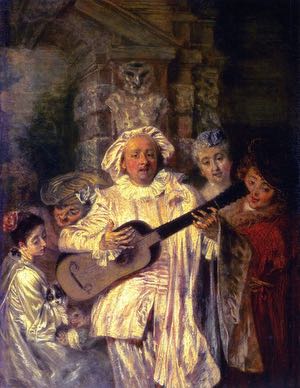
- Pierrot by Antoine Watteau, circa 1718–1719: A solitary white-clad theatrical figure complicates the association of Rococo with effortless sociability; the painting’s original purpose remains uncertain.
- The Toilette of Venus by François Boucher, 1751: The goddess and her luxurious surroundings bring classical mythology into an intimate decorative world.
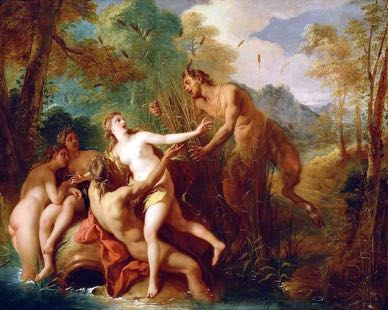
- Diana Leaving Her Bath by François Boucher, 1742: A mythological subject becomes an occasion to explore flesh, fabric, and the imagined privacy of a woodland setting.
- The Swing by Jean-Honoré Fragonard, circa 1767–1768: A diagonal arc and a glowing pink dress organize a private comedy of desire within dense foliage.
- A Young Girl Reading by Jean-Honoré Fragonard, circa 1769: Animated brushwork gives visual energy to a subject absorbed in an ordinary, quiet activity.
- The Progress of Love: The Meeting by Jean-Honoré Fragonard, 1771–1772: Garden architecture and a sudden encounter make courtship part of an encompassing decorative narrative.
- Lady and Gentleman with Two Girls and a Servant by Nicolas Lancret, probably 1742: Coffee, family interaction, and a garden setting show the style’s interest in cultivated everyday sociability.
Why Does Rococo Still Reward Close Looking?
The style’s appeal can begin with color, but its lasting interest often lies in less obvious details. Watteau leaves an exchange unresolved; Lancret makes a cup of coffee the occasion for a family encounter; Fragonard turns a reader’s stillness into an active painted surface. Looking across these works reveals more than an age devoted to amusement.
For a home or collection, those differences matter. A theatrical figure creates a different mood from a mythological scene, while a garden gathering offers another balance of figures and space. Choosing a Rococo reproduction means choosing among those individual effects. The painted surface gives small transitions of color and touch a presence that encourages the viewer to return.
Copyright © 2026 BrushWiz. All Rights Reserved.
About Our Rococo Paintings
Are your Rococo reproductions painted by hand?
Yes. Every reproduction is individually painted by hand in oil on canvas by a professional artist. We do not use prints, digital transfers, or mechanical reproduction methods.
How do your artists recreate Rococo brushwork?
Our artists study how the chosen painting handles figures, fabric, light, and foliage. They adapt the oil-painting technique to that work, whether it calls for Boucher’s delicately finished surfaces, Watteau’s subtle transitions, or Fragonard’s more visible and energetic strokes.
What makes a Rococo painting distinctive?
Rococo paintings often combine flowing compositions, luminous colors, rich fabrics, and subjects involving courtship, mythology, or leisure. Their moods vary from playful and sensuous to reflective or uncertain. Not every work uses pale colors or an elaborate setting.
Which Rococo artists can I find in the collection?
The catalog includes paintings by Antoine Watteau, François Boucher, Jean-Honoré Fragonard, and Nicolas Lancret. Their works offer different approaches to theatrical subjects, mythology, garden gatherings, private life, and decorative painting.
What subjects appear in Rococo art?
Common subjects include lovers in parks, musicians, theatrical characters, gods and goddesses, idealized shepherds, elegant figures, and family life. The wider eighteenth-century tradition also includes portraiture and ambitious decorative paintings for palaces and churches.
Can I request a Rococo painting that is not listed?
Yes. Send us the artwork’s title or an image. Our team will review the request and confirm whether it can be reproduced, together with the available sizes, estimated production time, and price.
How closely will my painting resemble the original?
Our artists work to capture the original painting’s composition, colors, figures, brushwork, and overall character as closely as possible. Because every reproduction is painted by hand, small variations are natural and make each canvas unique.
Are custom sizes and frames available?
Yes. Standard and custom canvas dimensions can be selected through the product options. High-quality frames in classic and modern designs are also available, together with professional canvas stretching. Check the individual product page for compatible options.
Will I receive photographs before shipping?
Yes. We send high-resolution photographs of the completed painting for your approval. You may request adjustments if needed, and the artwork is dispatched only after you approve the finished result.
Do Rococo reproductions include worldwide shipping and returns?
Yes. Orders qualify for free express worldwide shipping. After dispatch, delivery normally takes five to eight business days, depending on the destination. Orders are covered by our 90-day return policy, subject to its current eligibility requirements and procedures.
Why BrushWiz?
100% Hand Painted
Every piece is entirely handmade
Museum Quality
Faithfully recreated by expert artists
Custom Framing
Choose from a wide range of frames
Free Shipping
Enjoy free shipping on all orders
Cash Back Rewards
Earn cash back with every purchase