

🔥 Limited-Time Sale. Offer Ends 11/10/2026. View Details
🔥 Limited-Time Sale. Ends 11/10/2026. View Details
🔥 Limited-Time Sale. View Details
Artists
Subjects
Movements
Collections
Decor
Portraits
Commissions
Framing
Reviews
Gift Cards
On Sale
Famous Animal Oil Paintings
Shop reproductions of famous animal paintings, each hand-painted in oil on canvas. Explore domestic animals, wildlife, and marine life from across art history.
Shop Art
Showing 1-40 of 4272 results
Sort By
Most Popular
- Most Popular
- New Arrivals
- Best Sellers
- Alphabetical A-Z
- Alphabetical Z-A












Can’t Find the Painting You Want?
Looking for a specific painting that isn’t in our catalog? Just let us know. We can recreate almost any artwork in the size and style you’re looking for.
Request a PaintingHand-Painted Animal Oil Paintings
Bring the beauty and character of the animal world into your space with an oil painting created entirely by hand. Our collection includes thousands of animal paintings by famous artists, ranging from celebrated masterpieces to lesser-known works. Discover The Horse Fair by Rosa Bonheur, Monarch of the Glen by Edwin Landseer, and The Sleeping Gypsy by Henri Rousseau. Browse wildlife, birds, marine life, horses, companion animals, and farm scenes from different periods. Each reproduction is individually recreated in oil on canvas, giving the animals, landscapes, and surrounding details the color, texture, and presence of a real painting.
The Making of an Animal Oil Painting Reproduction
Creating an animal oil painting reproduction requires understanding its subject and the original style. Jean-Baptiste Oudry produced detailed hunting and animal studies, Paulus Potter placed livestock within observed landscapes, and Franz Marc transformed animals through expressive color and simplified forms. Before painting begins, our artist studies the source image, focusing on the animal’s pose, proportions, features, and relationship with its surroundings. The artist then recreates the composition by hand in oil on canvas, adapting the technique to the style and character of the original. Once complete, it is inspected and photographed for your approval.
Custom Sizes and Frames for Animal Wall Art
Your animal painting reproduction can be ordered in practically any size, whether you need a compact canvas for a reading corner or a large statement piece for a living room or office. Standard and custom dimensions are available directly from the product page. After selecting the size, choose from high-quality frames in classic or modern designs, with professional canvas stretching also available. Different presentations can emphasize the energy of a horse, the scale of wildlife, or the intimacy of a familiar companion. With sizing, stretching, and framing arranged together, your painting can arrive ready to complement your wall and interior.
Order an Animal Painting with Confidence
Every animal oil painting reproduction is recreated by a professional artist and reviewed by our quality-control team. Once the work is complete, we send high-resolution photographs so you can inspect the animals, surrounding landscape, colors, details, and overall finish before shipping. You may request adjustments if needed, and the painting is dispatched only after your approval. Your order includes free express worldwide shipping and is covered by our 90-day return policy. From the first layers of paint to the final inspection, the process is designed to make ordering hand-painted animal artwork clear, personal, and reassuring.
The History of Animals in Art
Animals have appeared in art for tens of thousands of years, long before written history. They have been portrayed as sources of food and labor, companions, deities, symbols of power, and independent inhabitants of the natural world. As artistic traditions changed, animals moved between sacred imagery, scientific observation, sporting scenes, portraiture, landscape painting, and modern experimentation. Artists have studied anatomy and movement to represent them convincingly, while also using familiar species to communicate courage, loyalty, freedom, danger, or vulnerability. This long and varied history helps explain why animal paintings continue to connect viewers with nature, culture, and personal experience.
Read More
Why Were Animals Important in the Earliest Art?
Some of the oldest surviving images made by humans are representations of animals. Prehistoric cave sites contain horses, bison, deer, aurochs, lions, rhinoceroses, and other creatures rendered with close attention to profile, movement, and physical character. At Lascaux, for example, the Hall of the Bulls presents large groups of animals using mineral pigments and charcoal. Their exact purposes remain debated, but the images show that early communities observed animals carefully and gave them a central place in visual expression.
These animals were not simply decorative. They belonged to the environments on which human communities depended and may have carried social, spiritual, ceremonial, or narrative meanings. Even where those meanings cannot now be recovered, the confidence of the outlines and the selection of particular species reveal an enduring fascination with animal movement and presence.
What Did Animals Represent in Ancient Civilizations?
In ancient Egypt, animals were associated with divine qualities, royal authority, protection, fertility, and the forces of the natural world. Falcons, cats, crocodiles, jackals, bulls, and lions appeared in sculpture, reliefs, funerary objects, and temple imagery. Hybrid figures joined human and animal characteristics to express the powers of particular deities. Lions were especially connected with strength and kingship, while domesticated cattle and geese also appeared in detailed scenes of agricultural life.
Greek and Roman artists used animals in mythology, hunting scenes, mosaics, domestic decoration, and public monuments. Horses accompanied gods, heroes, soldiers, and athletes; eagles could signal divine or imperial authority; and marine creatures populated images connected with the sea. Across other cultures, animals likewise served as clan emblems, spiritual intermediaries, royal symbols, and metaphors for human behavior.
How Did Medieval Art Use Animal Symbolism?
Medieval European bestiaries combined descriptions of real and imagined creatures with religious and moral interpretations. Lions, pelicans, lambs, eagles, serpents, and unicorns were understood through stories that connected their supposed behavior with Christian teachings. Illustrated manuscripts made these meanings memorable through vivid, often highly stylized images.
Animals also appeared in church sculpture, tapestries, heraldry, and scenes of courtly life. A lion might suggest courage, sovereignty, or Christ; a lamb could signify innocence and sacrifice; and a dog could represent fidelity. The physical accuracy of an animal was often less important than the idea it was intended to communicate.
How Did Observation Change Animal Art?
During the Renaissance, artists increasingly joined symbolic traditions with direct study. Albrecht Dürer produced detailed studies of animals and natural specimens, while Leonardo da Vinci examined horses, birds, anatomy, and motion in his notebooks. Improved knowledge of proportion and structure helped artists give animals greater weight, balance, and physical credibility.
This development did not eliminate symbolism or storytelling. Animals continued to appear in biblical, mythological, and allegorical compositions, but artists could now make those scenes more persuasive through observation. Horses in battle scenes, dogs in portraits, livestock in landscapes, and exotic creatures in court collections all benefited from a growing interest in the visible natural world.
Access to living animals remained uneven. Artists might study familiar livestock and horses directly while learning about rarer species through royal menageries, travelers’ accounts, prints, or preserved specimens. As a result, animal art often combined accurate details with inherited poses and imaginative reconstruction.
When Did Animal Painting Become a Specialty?
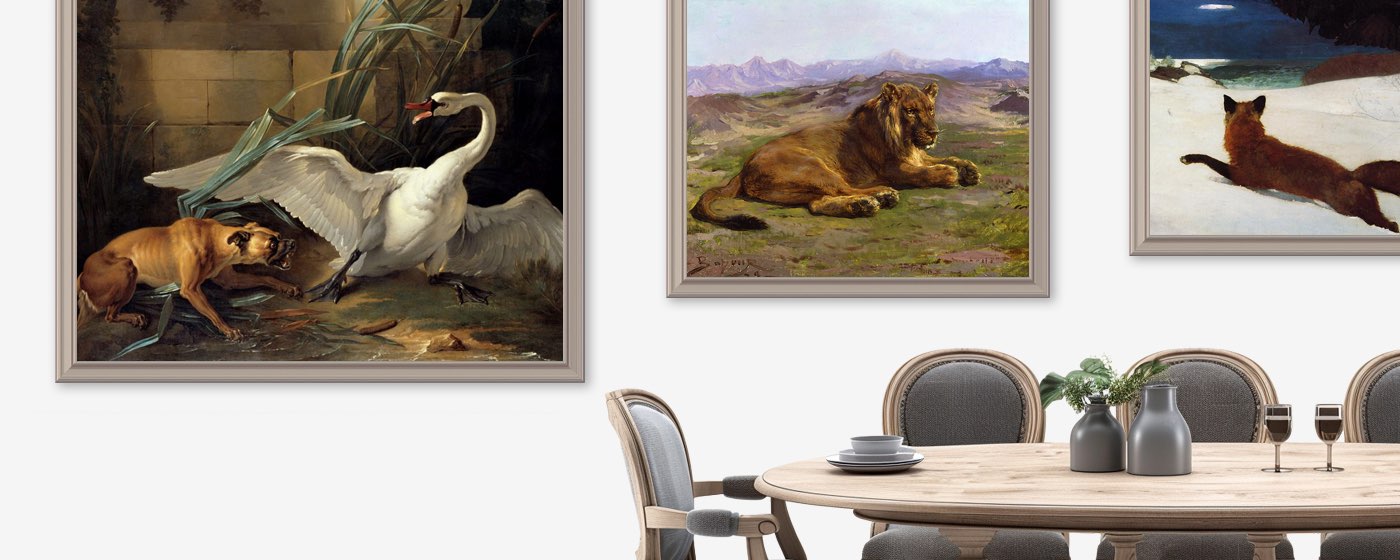
Animal painting developed into a recognized specialty in early modern Europe. Dutch and Flemish artists included cattle, birds, horses, and game in landscapes, market scenes, hunting pictures, and still lifes. Frans Snyders became known for energetic hunting and market compositions, Melchior de Hondecoeter created elaborate gatherings of birds, and Paulus Potter gave livestock unusual prominence within the landscape. Jan Asselijn’s The Threatened Swan transformed a single bird into a forceful central subject.
In eighteenth-century France, Jean-Baptiste Oudry painted royal hunts, dogs, game, exotic animals, and decorative designs with close attention to surface and species. Demand from courts, landowners, sportsmen, breeders, and collectors encouraged artists to specialize in anatomy, coat texture, breed characteristics, and movement. At the same time, animals retained narrative and symbolic roles, allowing the genre to move between direct observation, social display, and imaginative storytelling.
Which Artists Transformed Animal Painting in the Eighteenth and Nineteenth Centuries?
George Stubbs brought exceptional anatomical knowledge to paintings of horses, livestock, and wild animals. His careful study of equine structure gave his horses a convincing physical presence, whether shown as individual champions or in tense encounters with predators. Edwin Henry Landseer became famous in Victorian Britain for dogs, deer, horses, and lions, often giving animals strong emotional or narrative character.
Rosa Bonheur achieved international recognition by treating animal subjects on the scale and with the seriousness traditionally reserved for history painting. Her monumental The Horse Fair was based on sustained observation of the Paris horse market and became one of the nineteenth century’s most celebrated animal paintings. Such works established animal art as a field capable of technical ambition, movement, social observation, and large public impact.
The expansion of illustrated natural history, public zoos, agricultural shows, and sporting culture created further opportunities for animal specialists. Their work could serve private commemoration, scientific interest, popular entertainment, or public exhibition, widening both the audience for animal imagery and the range of subjects considered worthy of serious painting.
How Did Modern Artists Reinterpret Animals?
Modern artists were not limited to anatomical realism. Franz Marc used simplified forms and intense colors to express a spiritual relationship between animals and nature. His horses, deer, and other creatures became part of rhythmic compositions in which color carried emotional meaning. Henri Rousseau placed lions, tigers, monkeys, and birds in dreamlike landscapes assembled from imagination, printed sources, and visits to botanical gardens.
Bruno Liljefors approached wildlife through prolonged observation of animals within their habitats. Camouflage, pursuit, flight, and stillness became structural parts of his compositions. These contrasting approaches demonstrate how animal art could support abstraction, symbolism, fantasy, ecological observation, and psychological expression without losing the recognizable power of the subject.
Photography later offered artists new references for rapid movement and behavior that had been difficult to study in person. Contemporary animal art now ranges from traditional portraiture and wildlife painting to work concerned with captivity, endangered species, habitat loss, and the changing relationship between humans and other animals.
What Are Some Famous Animal Paintings?
Important animal paintings differ greatly in period, purpose, and style. The following examples show the range of the tradition:
- The Threatened Swan by Jan Asselijn: A swan aggressively protects its nest, turning close observation into a scene of unusual force.
- The Horse Fair by Rosa Bonheur: Powerful horses and their handlers fill a monumental panorama of movement and controlled energy.
- Monarch of the Glen by Edwin Henry Landseer: A stag stands against a mountainous landscape as an emblem of grandeur and the Scottish Highlands.
- A Lion Attacking a Horse by George Stubbs: A violent encounter contrasts the bodies, movement, and vulnerability of predator and prey.
- The Sleeping Gypsy by Henri Rousseau: A lion approaches a sleeping traveler in an enigmatic moonlit desert.
- Daniel in the Lions’ Den by Peter Paul Rubens: Nearly life-size lions surround the praying biblical figure in a dramatic Baroque composition.
Why Do Animal Paintings Remain Popular?
Animal paintings can carry historical and cultural meaning while also creating an immediate emotional connection. A horse may suggest movement and freedom, a lion strength and authority, a bird delicacy or release, and a familiar dog or cat companionship. The interpretation changes with the species, setting, artist, and viewer.
The category also offers remarkable visual variety. Animal art can be calm or dramatic, realistic or symbolic, intimate or monumental. It can introduce the colors of a landscape, the energy of movement, or the recognizable personality of a particular creature into an interior. Hand-painted reproductions continue this long tradition by allowing historic animal imagery to be experienced through the surface, depth, and individuality of oil on canvas.
Copyright © 2026 BrushWiz. All Rights Reserved.
About Our Animal Paintings
Are your animal paintings created by hand?
Yes. Every animal reproduction is individually painted by hand in oil on canvas by a professional artist. We do not use prints, digital transfers, or mechanical reproduction methods.
What kinds of animals can I find in the collection?
The collection includes wildlife, birds, marine life, horses, farm animals, dogs, cats, and many other species. You can browse broad animal themes or use the dedicated subcategories to focus on a particular type of animal.
Does the collection include famous animal paintings?
Yes. You can find hand-painted reproductions of well-known animal works by artists such as Rosa Bonheur, George Stubbs, Edwin Henry Landseer, Henri Rousseau, Franz Marc, and many others from across art history.
Are both realistic and imaginative animal paintings available?
Yes. The collection ranges from detailed studies of animal anatomy and natural behavior to symbolic, expressive, and imaginative compositions. You can explore realistic portraits, pastoral scenes, dramatic wildlife encounters, colorful modern works, and animals used within religious, mythological, or allegorical subjects.
Can I request an animal painting that is not listed?
Yes. Send us the title or an image of the animal artwork you want. Our team will review the request and confirm whether it can be reproduced, together with available sizes, estimated production time, and price.
How closely will the reproduction resemble the original?
Our artists work to capture the original animal painting’s composition, colors, texture, setting, and visual character as closely as possible. Because each reproduction is painted by hand, small variations are natural and make every canvas unique.
Are custom canvas sizes available?
Yes. Animal paintings can be ordered in standard or custom dimensions from the size options displayed on the product page. A wide composition may suit running horses or a herd, while a vertical canvas may work particularly well for a single animal portrait.
Can I order my animal painting with a frame?
Yes. High-quality frames in classic and modern designs are available for many paintings. Choose a compatible option from the product page, or select professional canvas stretching if you prefer to display the artwork without a decorative frame.
Will I receive approval photographs before shipping?
Yes. We send high-resolution photographs of the completed painting for your review. You can inspect the animals, colors, background, and overall finish and request adjustments if needed before the artwork is dispatched.
Do animal paintings include worldwide shipping and returns?
Animal paintings qualify for free express worldwide shipping and are covered by our 90-day return policy. Delivery usually takes five to eight business days after dispatch, although timing and return eligibility are subject to the current shipping and return terms.
Why BrushWiz?
100% Hand Painted
Every piece is entirely handmade
Museum Quality
Faithfully recreated by expert artists
Custom Framing
Choose from a wide range of frames
Free Shipping
Enjoy free shipping on all orders
Cash Back Rewards
Earn cash back with every purchase